Loading...
Done
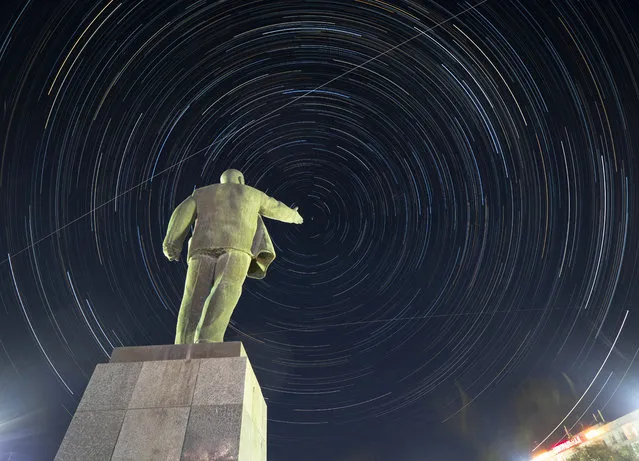
The International Space Station (ISS) moves along its orbit above at the Russian leased Baikonur cosmodrome, Kazakhstan, Thursday, July 18, 2019, with a statue of Soviet Union founder Vladimir Lenin in the foreground. Circular star tracks around the Polar Star and tracks of the ISS is the result of the camera multiple exposure with a total duration of two hours. The new Soyuz mission to the International Space Station (ISS) is scheduled on Saturday, July 20 with U.S. astronaut Andrew Morgan, Russian cosmonaut Alexander Skvortsov and Italian astronaut Luca Parmitano. (Photo by Dmitri Lovetsky/AP Photo)

The International Space Station (ISS) moves along its orbit above at the Russian leased Baikonur cosmodrome, Kazakhstan, Thursday, July 18, 2019, with a statue of Soviet Union founder Vladimir Lenin in the foreground. Circular star tracks around the Polar Star and tracks of the ISS is the result of the camera multiple exposure with a total duration of two hours. (Photo by Dmitri Lovetsky/AP Photo)
Details
08 Aug 2019 00:01:00
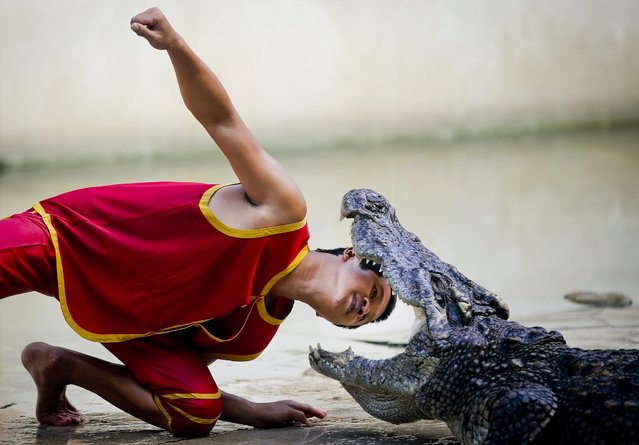
A picture made available 27 November 2015 shows a handler putting his head between the gaping fangs of a crocodile during a show at the Samutprakarn Crocodile Farm and Zoo, Samutprakarn province, outside Bangkok, Thailand, 26 November 2015. The farm and zoo claims to be the world's largest crocodile farm with more than 80,000 freshwater and marine crocodiles, and offers shows such as crocodile wrestling to attract tourists. (Photo by Diego Azubel/EPA)

A picture made available 27 November 2015 shows a handler putting his head between the gaping fangs of a crocodile during a show at the Samutprakarn Crocodile Farm and Zoo, Samutprakarn province, outside Bangkok, Thailand, 26 November 2015. The farm and zoo claims to be the world's largest crocodile farm with more than 80,000 freshwater and marine crocodiles, and offers shows such as crocodile wrestling to attract tourists. (Photo by Diego Azubel/EPA)
Details
28 Nov 2015 08:51:00
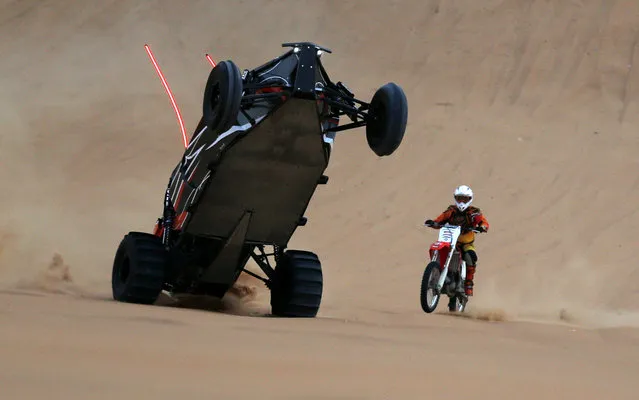
A dune buggy driver trains before competing in a sand dune drag racing event on January 8, 2016, as part of the Liwa 2016 Moreeb Dune Festival in the Liwa desert, some 250 kilometres southwest of Abu Dhabi. The festival, which attracts participants from around the Gulf region, includes a variety of races (cars, bikes, falcons, camels and horses) or other activities aimed at promoting the country's folklore. (Photo by Karim Sahib/AFP Photo)

A dune buggy driver trains before competing in a sand dune drag racing event on January 8, 2016, as part of the Liwa 2016 Moreeb Dune Festival in the Liwa desert, some 250 kilometres southwest of Abu Dhabi. The festival, which attracts participants from around the Gulf region, includes a variety of races (cars, bikes, falcons, camels and horses) or other activities aimed at promoting the country's folklore. (Photo by Karim Sahib/AFP Photo)
Details
09 Jan 2016 13:45:00
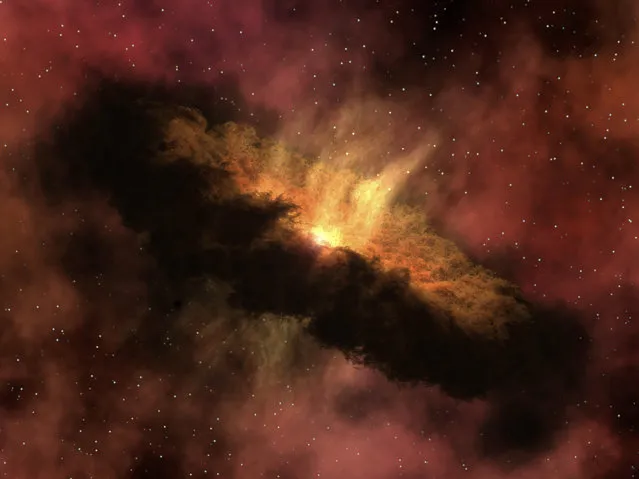
A fledgling solar system containing deep within it enough water vapor to fill all the oceans on Earth five times, located in our Milky Way galaxy about 1,000 light years from Earth in the constellation Perseus. (Photo by Reuters/NASA/JPL-Caltech)

A fledgling solar system containing deep within it enough water vapor to fill all the oceans on Earth five times, located in our Milky Way galaxy about 1,000 light years from Earth in the constellation Perseus. (Photo by Reuters/NASA/JPL-Caltech)
Details
28 Sep 2016 11:01:00
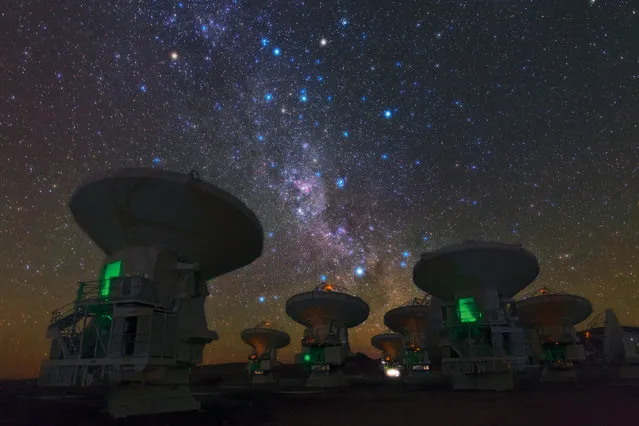
The antennas of the European Southern Observatory's Atacama Large Millimeter/Submillimeter Array, also known as ALMA, are set against the splendor of the Milky Way in this picture by Babak Tafreshi

The antennas of the European Southern Observatory's Atacama Large Millimeter/Submillimeter Array, also known as ALMA, are set against the splendor of the Milky Way in this picture by Babak Tafreshi. Construction of the full ALMA array is due to be completed in Chile's Atacama Desert in 2013, but the facility is already making scientific observations with a partial array of antennas. (Photo by ESO/B. Tafreshi/TWAN)
Details
03 Jun 2012 11:57:00
On August 31, 2012, a long filament of solar material that had been hovering in the sun's atmosphere, the corona, erupted out into space at 4:36 p.m. EDT. The coronal mass ejection, or CME, traveled at over 900 miles per second. The CME did not travel directly toward Earth, but did connect with Earth's magnetic environment, or magnetosphere, causing aurora to appear on the night of Monday, September 3. (Photo by NASA/GSFC/SDO)

On August 31, 2012, a long filament of solar material that had been hovering in the sun's atmosphere, the corona, erupted out into space at 4:36 p.m. EDT. The coronal mass ejection, or CME, traveled at over 900 miles per second. The CME did not travel directly toward Earth, but did connect with Earth's magnetic environment, or magnetosphere, causing aurora to appear on the night of Monday, September 3. (Photo by NASA/GSFC/SDO via The Atlantic)
Details
14 Sep 2012 09:01:00
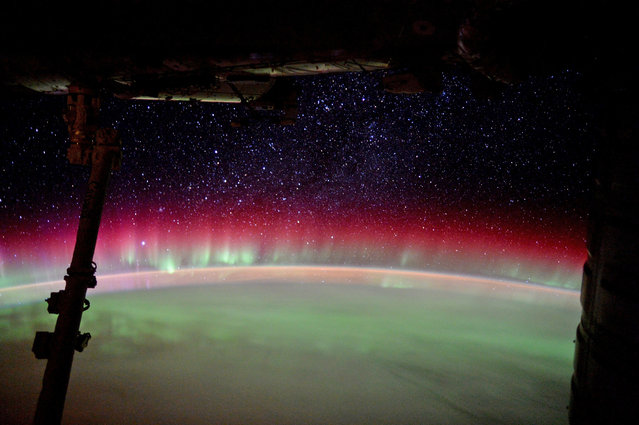
ESA astronaut Tim Peake posted this stunning image on his social media channels, commenting: “Station passed through magnificent aurora Australis last night”. Tim is set to return to Earth on 18 June 2016, bringing his six-month Principia mission to the ISS to an end. During his stay he performed more than 30 scientific experiments for ESA and taking part in numerous others from ESA's international partners. ESA and the UK Space Agency have partnered to develop many exciting educational activities around the Principia mission, aimed at sparking the interest of young children in science and space. (Photo by Tim Peake/ESA/NASA)

ESA astronaut Tim Peake posted this stunning image on his social media channels, commenting: “Station passed through magnificent aurora Australis last night”. Tim is set to return to Earth on 18 June 2016, bringing his six-month Principia mission to the ISS to an end. During his stay he performed more than 30 scientific experiments for ESA and taking part in numerous others from ESA's international partners. ESA and the UK Space Agency have partnered to develop many exciting educational activities around the Principia mission, aimed at sparking the interest of young children in science and space. (Photo by Tim Peake/ESA/NASA)
Details
31 Dec 2016 10:21:00
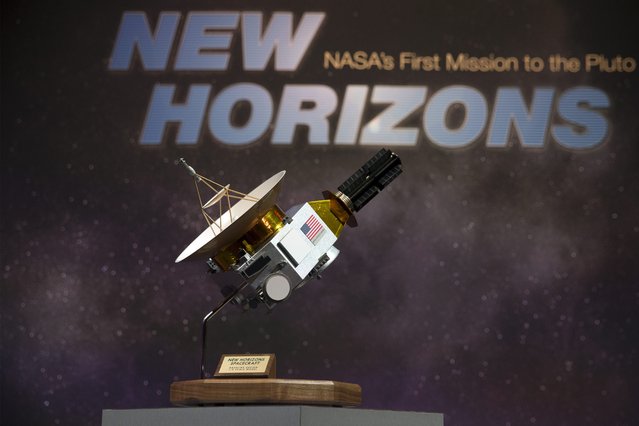
A model of the New Horizons spacecraft is seen at a live television program on NASA television celebrating the spacecraft's closest proximity to Pluto, at Johns Hopkins University Applied Physics Laboratory, site of the mission operations center, in Laurel, Maryland, USA, 14 July 2015. (Photo by Michael Reynolds/EPA)

A model of the New Horizons spacecraft is seen at a live television program on NASA television celebrating the spacecraft's closest proximity to Pluto, at Johns Hopkins University Applied Physics Laboratory, site of the mission operations center, in Laurel, Maryland, USA, 14 July 2015. At approximately 7:49 am ET (11:49 am GMT), 14 July, New Horizons was scheduled to be as close to Pluto as the spacecraft will get; about 7,800 miles (12,500 kilometers) above the surface, following a journey of more than nine years and three billion miles. This is the first mission to the Pluto System and the Kuiper Belt. (Photo by Michael Reynolds/EPA)
Details
15 Jul 2015 10:08:00