Loading...
Done
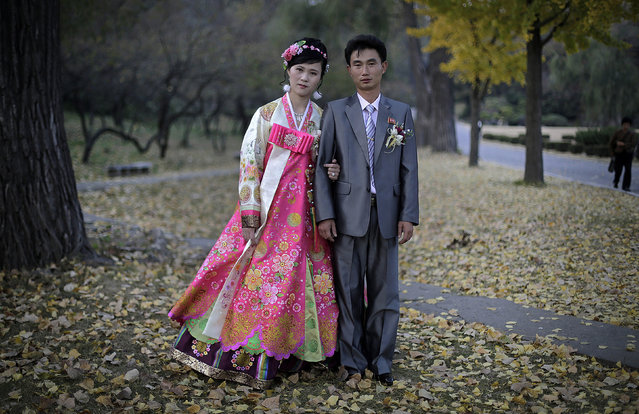
In this October 25, 2014, file photo, North Korean bride Ri Ok Ran, 28, and groom Kang Sung Jin, 32, pose for a portrait at the Moran Hill where they went to take wedding pictures, in Pyongyang, North Korea. The couple were married after dating for about two years. Their motto: “To have many children so that they can serve in the army and defend and uphold our leader and country, for many years into the future”. (Photo by Wong Maye-E/AP Photo)

Associated Press photographer Wong Maye-E tries to get her North Korean subjects to open up as much as is possible in an authoritarian country with no tolerance for dissent and great distrust of foreigners. She has taken dozens of portraits of North Koreans over the past three years, often after breaking the ice by taking photos with an instant camera and sharing them. Her question for everyone she photographs: What is your motto? Their answers reflect both their varied lives and the government that looms incessantly over all of them. (Photo by Wong Maye-E/AP Photo)
Details
16 Jun 2017 06:28:00
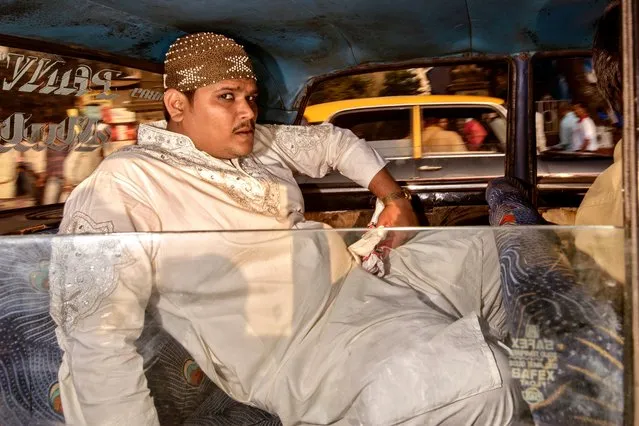
“I’m not scared of breaking the fourth wall”, Wallace has said of the photos where the subject is clearly aware of him taking the shot. “If they are looking at you in a photograph most photographers will think, oh, that’s not a good image. (But) people like to be involved and in the picture. You can see what they are thinking, see them talking”. (Photo by Dougie Wallace/The Guardian)

In Dougie Wallace’s photos of Mumbai taxis, the chatter, yelling, and constant horns of the city are almost audible. A selection of his images is on show at Gayfield Creative Spaces, Edinburgh, as part of the Retina photography festival until 30 July. For four years, the Glasgow-born Wallace focused his photos on one kind of taxi in particular: the Premier Padmini, a 1960s workhorse painted in black and yellow. Locally known as “Kaali-Peeli”, there were once more than 60,000 of them in the Indian city. But thanks to laws restricting pollution, the cars now are fast disappearing from Mumbai’s streets. (Photo by Dougie Wallace/The Guardian)
Details
13 Jul 2016 13:50:00
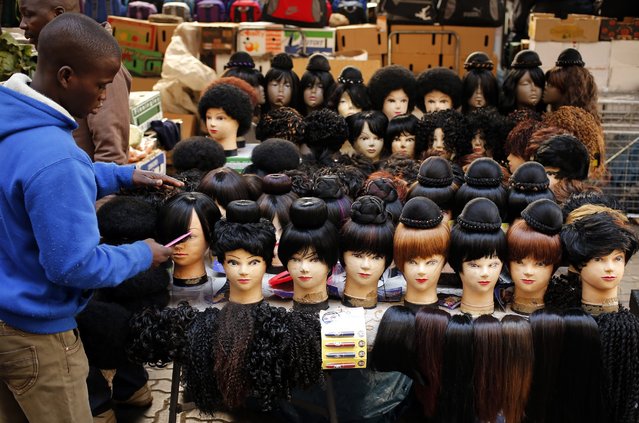
Man prepares wigs as he waits for customers in downtown Johannesburg. Some estimates put Africa's dry hair industry at as much as $6 billion a year; Nigerian singer Muma Gee recently boasted that she spends 500,000 naira ($3,100) on a single hair piece made of 11 sets of human hair. (Photo by Siphiwe Sibeko/Reuters)

Man prepares wigs as he waits for customers in downtown Johannesburg, on August 5, 2014. Some estimates put Africa's dry hair industry at as much as $6 billion a year; Nigerian singer Muma Gee recently boasted that she spends 500,000 naira ($3,100) on a single hair piece made of 11 sets of human hair. (Photo by Siphiwe Sibeko/Reuters)
Details
15 Aug 2014 09:08:00
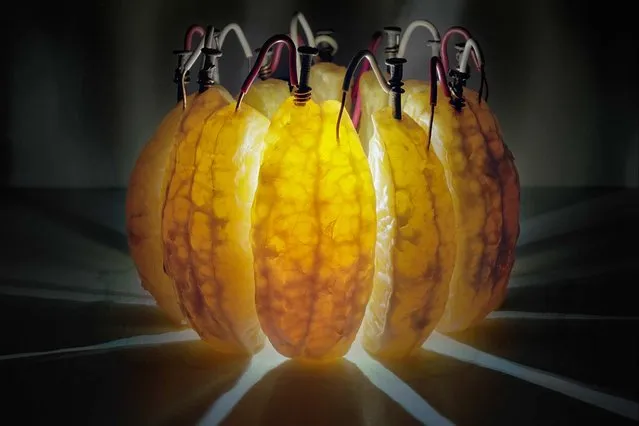
Wedges of an orange generate enough current and electrical juice – 3.5 volts – to power an LED. The fruit’s citric acid helps electrons flow from galvanized nails to copper wire in this 14-hour exposure. This image was published in September’s Visions of Earth, a trio of photos that appear in each issue of National Geographic. (Photo by Caleb Charland/National Geographic)

Wedges of an orange generate enough current and electrical juice – 3.5 volts – to power an LED. The fruit’s citric acid helps electrons flow from galvanized nails to copper wire in this 14-hour exposure. This image was published in September’s Visions of Earth, a trio of photos that appear in each issue of National Geographic. (Photo by Caleb Charland/National Geographic)
Details
06 Jan 2014 12:09:00
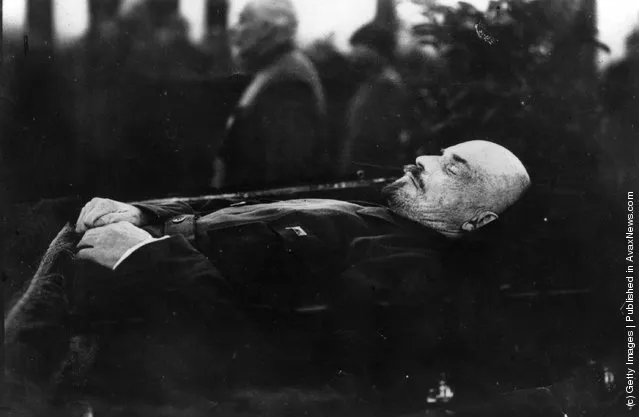
1924:  Vladimir Ilyich Lenin lying in state in the Kremlin

Photo: Vladimir Ilyich Lenin (1870 – 1924) lying in state in the Kremlin. (Photo by Hulton Archive/Getty Images). 1924

Important! For the same article in Russian language click here.

Something quite intriguing is happening within Russian-speaking internet during the last few – should you type a fully academic inquiry (at least, according to Russian academic requirements) in national search engines for "Lenin's mausoleum" – the first thing you get (even in top 10 searches) is website pages talking about black magic and occult. Website authors view this construction differently, but unconditionally agree on one thing: the mausoleum of the "leader of the world proletariat” – the essence of a magical artifact, a sort of “energy vampire”. It was built with a certain purpose: to drain the energy out of miserable Soviet citizens on one hand; and to poison the anthroposphere of one-sixth part of the earth with its vibes (the exact territory that was occupied by the former Soviet Union), depriving the Russian people of will to resist on the other hand. Complete nonsense? No doubt. Nevertheless, an intriguing one. Well, probably because some oddities do exist in mausoleum's history. These oddities are the thing we are going to discuss this time. First, let me refresh you memory on the subject.
Details
16 Oct 2011 11:27:00
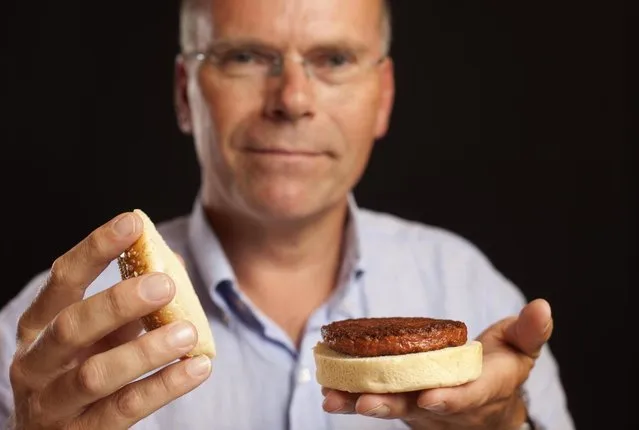
In this handout image provided by Ogilvy, a burger made from cultured beef, which has been developed by Professor Mark Post of Maastricht University in the Netherlands (pictured) is shown to the media during a press conference on August 5, 2013 in London, England. Cultured Beef could help solve the coming food crisis and combat climate change with commercial production of Cultured Beef beginning within ten to twenty years. (Photo by David Parry via Getty Images)

In this handout image provided by Ogilvy, a burger made from cultured beef, which has been developed by Professor Mark Post of Maastricht University in the Netherlands (pictured) is shown to the media during a press conference on August 5, 2013 in London, England. The in-vitro burger, cultured from cattle stem cells, the first example of what its creator says could provide an answer to global food shortages and help combat climate change, was fried in a pan and tasted by two volunteers. The burger is the result of years of research by Dutch scientist Mark Post, a vascular biologist at the University of Maastricht, who is working to show how meat grown in petri dishes might one day be a true alternative to meat from livestock.The meat in the burger has been made by knitting together around 20,000 strands of protein that has been cultured from cattle stem cells in Post's lab. (Photo by David Parry)
Details
06 Aug 2013 08:48:00
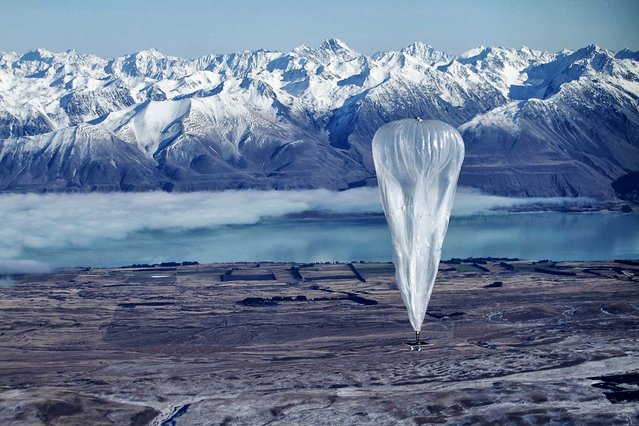
A Google balloon sails through the air with the Southern Alps mountains in the background, in Tekapo, New Zealand. (Photo by Jon Shenk/Associated Press)

“Google is launching balloons into near space to provide internet access to buildings below on the ground. About 30 of the superpressure balloons are being launched from New Zealand from where they will drift around the world on a controlled path. Attached equipment will offer 3G-like speeds to 50 testers in the country”. – BBC News. Photo: A Google balloon sails through the air with the Southern Alps mountains in the background, in Tekapo, New Zealand. (Photo by Jon Shenk/Associated Press)
Details
16 Jun 2013 10:54:00
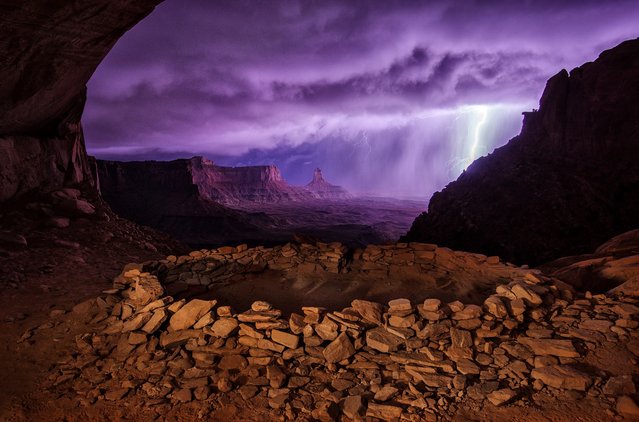
Second Place Winner: “Thunderstorm at False Kiva”. I hiked out to these ruins at night hoping to photograph them with the Milky Way, but instead a thunderstorm rolled through, creating this dramatic image. – Max Seigal. (Photo and caption by Max Seigal/National Geographic Traveler Photo Contest)

Second Place Winner: “Thunderstorm at False Kiva”. I hiked out to these ruins at night hoping to photograph them with the Milky Way, but instead a thunderstorm rolled through, creating this dramatic image. – Max Seigal. National Geographic Traveler Director of Photography Dan Westergren, one of this year's judges, shares his thoughts on the second place winner: “This photo combines two different scenes into one: the small kiva in a cliff dwelling and the grand vista of Canyonlands National Park across the valley. I really like the two different color palettes – warm inside and purple outside. This two-for-one scene was caused by the lightning storm outside the dwelling, which lit up the landscape like it was a huge electronic flash. Looking at this picture I can imagine what a wonderful sight it must have been for the ancient people who lived here. It doesn't seem too amazing now in our modern world, but might have been mind-blowing for the prehistoric residents”. Location: Utah. (Photo and caption by Max Seigal/National Geographic Traveler Photo Contest)
Details
02 Aug 2013 06:16:00