Loading...
Done
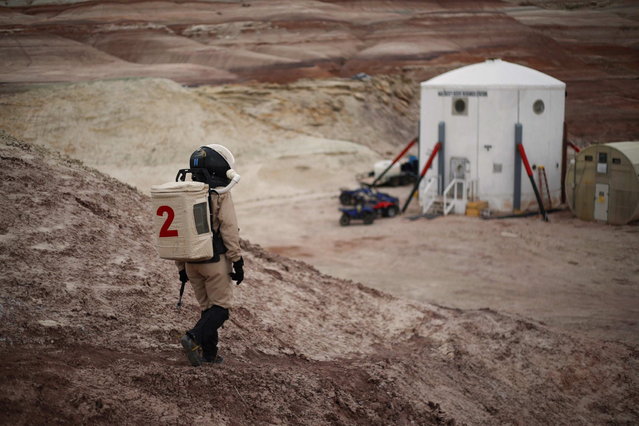
Csilla Orgel, a geologist of Crew 125 EuroMoonMars B mission, makes her way back to the Mars Desert Research Station (MDRS) in the Utah desert March 3, 2013. (Photo by Jim Urquhart/Reuters)

NASA says it could be another 20 years before humans touch down on Mars, but in a sense, the Mars Society has been exploring the red planet for more than a decade – in Utah. Photo: Csilla Orgel, a geologist of Crew 125 EuroMoonMars B mission, makes her way back to the Mars Desert Research Station (MDRS) in the Utah desert March 3, 2013. The MDRS aims to investigate the feasibility of a human exploration of Mars and uses the Utah desert's Mars-like terrain to simulate working conditions on the red planet. Scientists, students and enthusiasts work together developing field tactics and studying the terrain. All outdoor exploration is done wearing simulated spacesuits and carrying air supply packs and crews live together in a small communication base with limited amounts of electricity, food, oxygen and water. Everything needed to survive must be produced, fixed and replaced on site. (Photo by Jim Urquhart/Reuters)
Details
14 Mar 2013 12:11:00
Ocean voyage

Do you think that history is a science? Well, not exactly. First, and foremost, history is the state's “legend of wars”, it’s official regalia. Of course, public historians are not interested in scientific truth – quite the opposite. In this respect, any attempt to present a state’s history as altruistic and benevolent as possible is welcomed and encouraged – as opposed to any revisionism attempts that may be more accurate. In this matter, Chinese have surpassed us all – they revised in highly creative manner (but rather shamelessly) the technology already invented by Europeans, a process that resulted in oldest state on the planet. Here is an interesting paradox: ask any sinologist about the Middle Kingdom during second century B.C., and he will describe it to you in such a vivid manner as if he has been living there all his life – but as soon as you will ask him to describe Chinese history in the 19-20th centuries… let's say, his eagerness will be greatly diminished. However, we will discuss China in a different article, and in the meantime we will try to understand how exactly historic “legend of wars” is formed and functions – based on a specific and well-known example. A great example is Ferdinand Magellan's first voyage around the world.
Details
14 Nov 2011 09:11:00
Swedish brown bears “Fred” and “Frode” play in the snow on January 30, 2014 at the Natur- und Umweltpark (NUP) animal park in Guestrow, northeastern Germany. Despite of icy temperatures, the bear brothers took a break from their winter rest. (Photo by Bernd Wuestneck/AFP Photo/DPA)

Swedish brown bears “Fred” and “Frode” play in the snow on January 30, 2014 at the Natur- und Umweltpark (NUP) animal park in Guestrow, northeastern Germany. Despite of icy temperatures, the bear brothers took a break from their winter rest. (Photo by Bernd Wuestneck/AFP Photo/DPA)
Details
01 Feb 2014 13:50:00
Firework display from the top of the Sky Tower to welcome the New Year on January 1, 2015 in Auckland, New Zealand. (Photo by Dave Rowland/Getty Images)

Firework display from the top of the Sky Tower to welcome the New Year on January 1, 2015 in Auckland, New Zealand. (Photo by Dave Rowland/Getty Images)
Details
01 Jan 2015 13:35:00
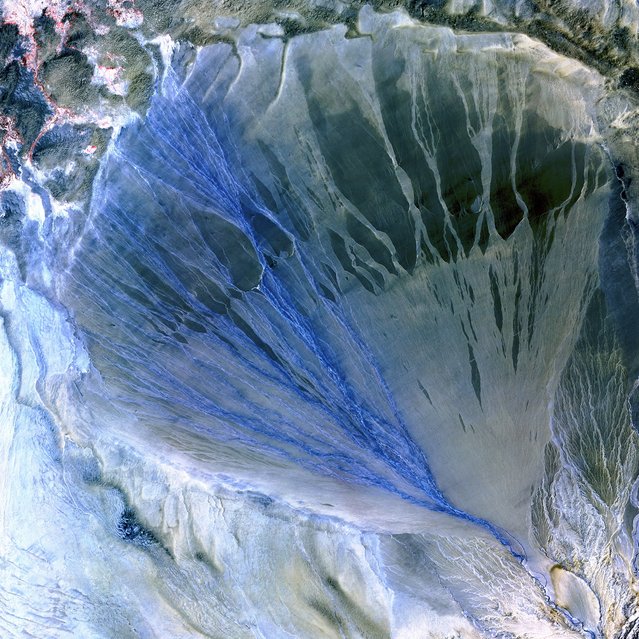
Alluvial Fan, China. A vast alluvial fan blossoms across the desolate landscape between the Kunlun and Altun mountain ranges that form the southern border of the Taklimakan Desert in China’s XinJiang Province. Image taken by the ASTER instrument on NASA’s Terra satellite on May 2nd, 2002. (Photo by NASA/GSFC/USGS EROS Data Center)

Alluvial Fan, China. A vast alluvial fan blossoms across the desolate landscape between the Kunlun and Altun mountain ranges that form the southern border of the Taklimakan Desert in China’s XinJiang Province. Image taken by the ASTER instrument on NASA’s Terra satellite on May 2nd, 2002. (Photo by NASA/GSFC/USGS EROS Data Center)
Details
07 Jan 2013 09:27:00
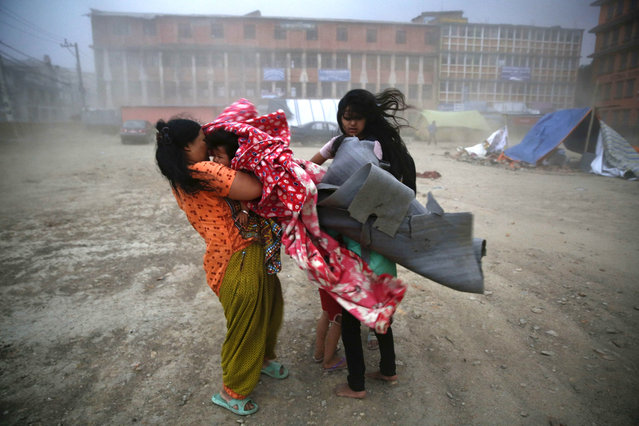
A storm whips through a tented area occupied by Nepalese earthquake survivors as a mother grabs her infant child and runs to find shelter in Kathmandu, Nepal 23 May 2015. Nepalese, who lost their homes in earthquake and fear aftershocks, have been living in temporary shelter in open ground which they had to flee because of the heavy rain and powerful wind. (Photo by Narendra Shrestha/EPA)

A storm whips through a tented area occupied by Nepalese earthquake survivors as a mother grabs her infant child and runs to find shelter in Kathmandu, Nepal 23 May 2015. Nepalese, who lost their homes in earthquake and fear aftershocks, have been living in temporary shelter in open ground which they had to flee because of the heavy rain and powerful wind. (Photo by Narendra Shrestha/EPA)
Details
25 May 2015 10:00:00
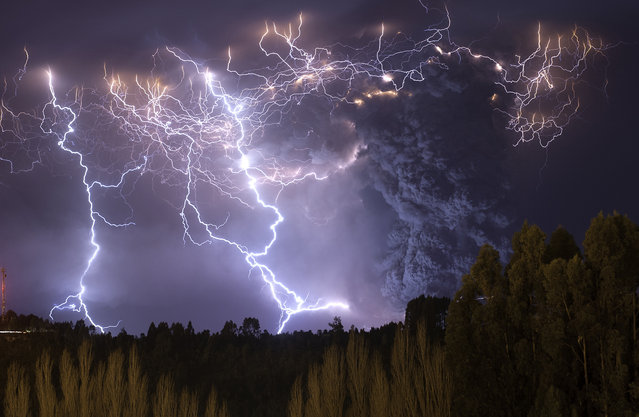
The eruption of Cordon Caulle began on June 4, 2011, located in the Region of Los Rios in Chile. For about 12 months, people and animals became accustomed to living with the daily fall of ash, which also caused problems in the air traffic in South America. The explosions and lightning during first days of the eruption could be seen from hundreds of miles around. This photograph was taken on the second night of eruption from the town of Lago Ranco. (Photo and caption by Francisco Negroni/National Geographic Traveler Photo Contest)

The eruption of Cordon Caulle began on June 4, 2011, located in the Region of Los Rios in Chile. For about 12 months, people and animals became accustomed to living with the daily fall of ash, which also caused problems in the air traffic in South America. The explosions and lightning during first days of the eruption could be seen from hundreds of miles around. This photograph was taken on the second night of eruption from the town of Lago Ranco. (Photo and caption by Francisco Negroni/National Geographic Traveler Photo Contest)

ATTENTION! All pictures are presented in high resolution. To see Hi-Res images – just TWICE click on any picture. In other words, click small picture – opens the BIG picture. Click BIG picture – opens VERY BIG picture.
Details
23 Jun 2013 11:24:00
A Muslim woman wearing a hijab walks past a lingerie advertisement in downtown Vancouver, British Columbia April 26, 2013. (Photo by Andy Clark/Reuters)

A Muslim woman wearing a hijab walks past a lingerie advertisement in downtown Vancouver, British Columbia April 26, 2013. (Photo by Andy Clark/Reuters)

P.S. All pictures are presented in high resolution. To see Hi-Res images – just TWICE click on any picture. In other words, click small picture – opens the BIG picture. Click BIG picture – opens VERY BIG picture (if available; this principle works anywhere on the site AvaxNews)
Details
27 Apr 2013 14:37:00