Loading...
Done
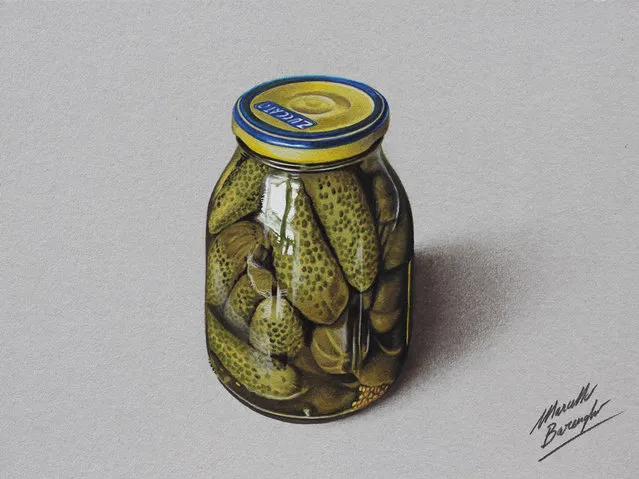
 Photorealistic Illustration By Marcello Barenghi Part2

Italian artist Marcello Barenghi draws incredibly realistic everyday objects that appear almost three dimensional with the help of colored pencils and occasional enhancements using markers or watercolor. Each work appears ever so slightly stylized which I think sets these apart from similar hyperrealistic drawings that are meant to ‘trick’ a viewer. If you want to see more, Barenghi runs a YouTube channel where he documents the process of almost every drawing.

Also see: Part1
Details
02 Jun 2015 09:52:00
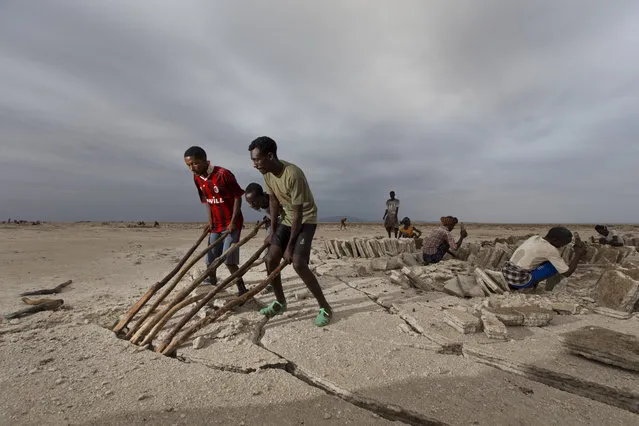
February 8, 2014 – Danakil Desert, Ethiopia: Workers mining salt at the quarry. (Photo by Ziv Koren/Polaris)

Inside the Afar Triangle in Ethiopia’s Danakil desert, camel caravans are used to carry salt. For centuries, the essential mineral has been mined by the Afar people, known for their ability to withstand extremes. The terrain is rugged, travelers are scarce and so are motor vehicles, where the average annual temperature is the highest in the world, and can rise to 122 degrees Fahrenheit, 50 degrees Celsius. (Photo by Ziv Koren/Polaris)
Details
30 Apr 2014 08:17:00
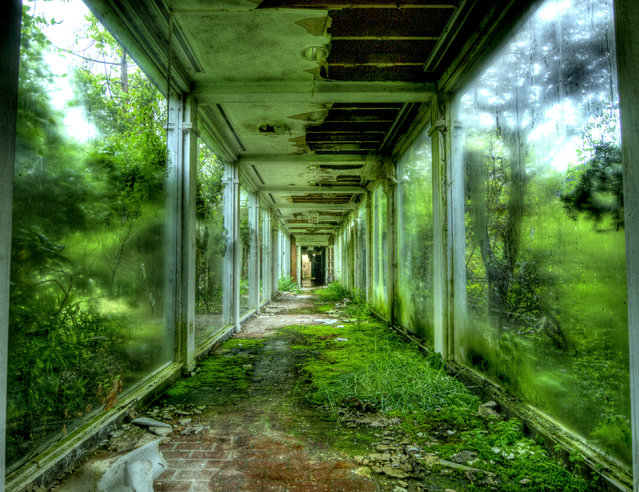
A glass-walled corridor at Cleveland's abandoned aquarium in Ohio. (Photo by Jonny Joo/Barcroft Media)

Jonny Joo, 23, visits derelict malls, stations, towers and other places because they remind him of Silent Hill – a psychological horror video game which was made into a film. “When I first started exploring places, so many would remind me of the game. It was a world I was kind of obsessed with because of how dark and eerie it looked”, Joo said. His book, titled “Empty Spaces”, will feature 116 images and is being released this week. Photo: A glass-walled corridor at Cleveland's abandoned aquarium in Ohio. (Photo by Jonny Joo/Barcroft Media)
Details
25 Apr 2014 10:18:00
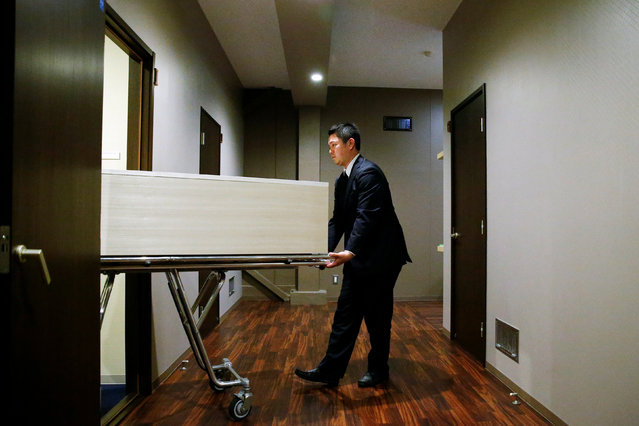
A staff member removes a coffin from a room of the “Corpse Hotel” in Kawasaki, Japan, April 20, 2016. (Photo by Thomas Peter/Reuters)

A staff member removes a coffin from a room of the “Corpse Hotel” in Kawasaki, Japan, April 20, 2016. Many so-called corpse hotels have emerged as a flourishing business in the city following a crunch in crematoriums. Families can rent a room in Sousou on a daily charge of 9,000 Japanese yen (£58, €74, $84) to keep the body of the deceased relative for up to four days until they find a crematorium. (Photo by Thomas Peter/Reuters)
Details
30 Apr 2016 09:46:00
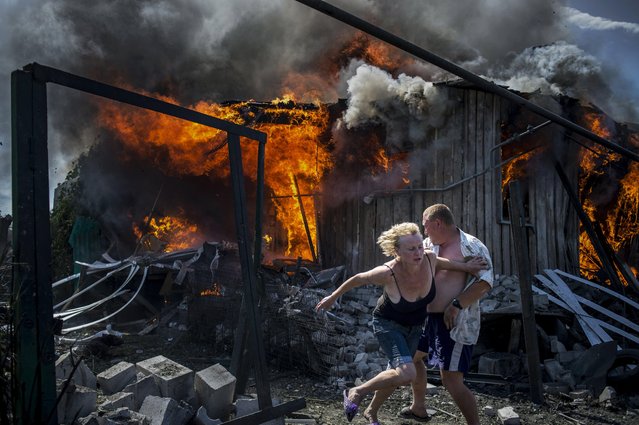
A handout photo made available by the World Press Photo (WPP) organization on 13 February 2017 shows a picture by Rossiya Segodnya photographer Valery Melnikov that won the Long-Term Projects – First Prize award of the 60th annual World Press Photo Contest, it was announced by the WPP Foundation in Amsterdam, The Netherlands on 13 February 2017. Caption: Civilians escape from a fire at a house destroyed by an air attack in the Luhanskaya village. Story: Ordinary people became victims of the conflict between self-proclaimed republics and the official Ukrainian authorities from 2014 onwards in the region of Donbass. Disaster came into their lives unexpectedly. These people were involved in the military confrontation against their will. They experienced the most terrible things: the death of their friends and relatives, destroyed homes and the ruined lives of thousands of people. (Photo by Valery Melnikov/EPA/Rossiya Segodnya/World Press Photo)

A handout photo made available by the World Press Photo (WPP) organization on 13 February 2017 shows a picture by Rossiya Segodnya photographer Valery Melnikov that won the Long-Term Projects – First Prize award of the 60th annual World Press Photo Contest, it was announced by the WPP Foundation in Amsterdam, The Netherlands on 13 February 2017. Caption: Civilians escape from a fire at a house destroyed by an air attack in the Luhanskaya village. (Photo by Valery Melnikov/EPA/Rossiya Segodnya/World Press Photo)
Details
15 Feb 2017 00:06:00
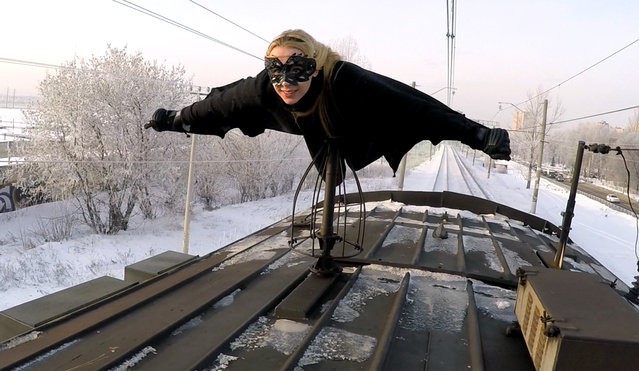
Rush-hour in Russia means one thing for this daredevil: train surfing! The 19-year-old daredevil who goes by the name Kobzarro started train surfing aged 15 as a way of escaping an oppressive family life. Here Kobzarro can be seen balanced on top of a train as it speeds through the wintery Russian environment. Kobzarro is so dedicated to train surfing that she rarely gets inside a train. Even in winter she prefers to travel in this less conventional way. It has resulted in a few run ins with the law, but Kobzarro says it has never resulted in anything more serious than a fine, with many police officers even being interested in the train surfing community. (Photo by Caters News Agency)

Rush-hour in Russia means one thing for this daredevil: train surfing! The 19-year-old daredevil who goes by the name Kobzarro started train surfing aged 15 as a way of escaping an oppressive family life. Here Kobzarro can be seen balanced on top of a train as it speeds through the wintery Russian environment. Kobzarro is so dedicated to train surfing that she rarely gets inside a train. Even in winter she prefers to travel in this less conventional way. It has resulted in a few run ins with the law, but Kobzarro says it has never resulted in anything more serious than a fine, with many police officers even being interested in the train surfing community. (Photo by Caters News Agency)
Details
11 Nov 2016 08:28:00
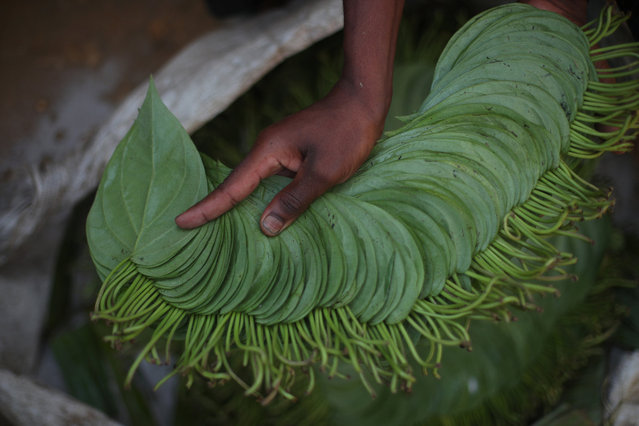
Faruk, 17, a Rohingya refugee trader holds betel leaves which are on sale at a stall in Palong Khali refugee camp near Cox's Bazar, Bangladesh, November 3, 2017. He left his village in Myanmar when the military opened fire towards the Rohingya. “I buy this betel leaf from Palong Khali market, in one bundle there are 160 pieces, I buy it for 80 taka and I sell it for 100 taka. Bangladeshi's and I sell for the same rate in the camp. Outside in the local market it is 80 taka per bundle. My problem is that I don't have money so I can't buy anything to eat, I can't buy fish to eat”, he said. (Photo by Hannah McKay/Reuters)

Faruk, 17, a Rohingya refugee trader holds betel leaves which are on sale at a stall in Palong Khali refugee camp near Cox's Bazar, Bangladesh, November 3, 2017. He left his village in Myanmar when the military opened fire towards the Rohingya. “I buy this betel leaf from Palong Khali market, in one bundle there are 160 pieces, I buy it for 80 taka and I sell it for 100 taka (1 Bangladeshi Taka = 0.012 US Dollar). Bangladeshi's and I sell for the same rate in the camp. Outside in the local market it is 80 taka per bundle. My problem is that I don't have money so I can't buy anything to eat, I can't buy fish to eat”, he said. (Photo by Hannah McKay/Reuters)
Details
27 Nov 2017 08:54:00
Bloodthirsty by Thomas P Peschak, Germany/South Africa — winner, Behaviour: birds. When rations run short on Wolf Island, in the remote northern Galápagos, the sharp-beaked ground finches become vampires. Their sitting targets are Nazca boobies and other large birds. The finches rely on a scant diet of seeds and insects, which regularly dries up, so they drink blood to survive. ‘I’ve seen more than half a dozen finches drinking from a single Nazca booby,’ says Tom. Rather than leave their nests the boobies tolerate the vampires, and the blood loss doesn’t seem to cause permanent harm. (Photo by Thomas P Peschak/2018 Wildlife Photographer of the Year)

Bloodthirsty by Thomas P. Peschak, Germany/South Africa — winner, Behaviour: birds. When rations run short on Wolf Island, in the remote northern Galápagos, the sharp-beaked ground finches become vampires. Their sitting targets are Nazca boobies and other large birds. The finches rely on a scant diet of seeds and insects, which regularly dries up, so they drink blood to survive. ‘I’ve seen more than half a dozen finches drinking from a single Nazca booby,’ says Tom. Rather than leave their nests the boobies tolerate the vampires, and the blood loss doesn’t seem to cause permanent harm. (Photo by Thomas P. Peschak/2018 Wildlife Photographer of the Year)
Details
19 Oct 2018 00:05:00