Loading...
Done
File photo dated 21/04/66 of Pattie Boyd in London's West End wearing a mini skirt, as the British designer Mary Quant, widely credited with popularising the mini skirt has recalled its “feeling of freedom and liberation” 50 years after she took the fashion world by storm. (Photo by PA Wire)

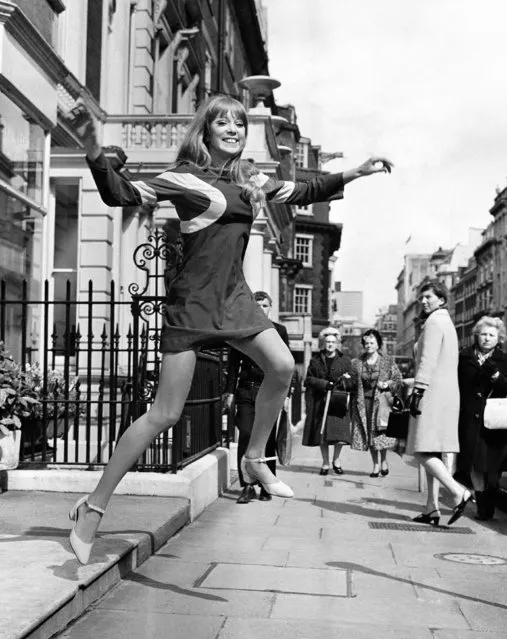
File photo dated 21/04/66 of Pattie Boyd in London's West End wearing a mini skirt, as the British designer Mary Quant, widely credited with popularising the mini skirt has recalled its “feeling of freedom and liberation” 50 years after she took the fashion world by storm. Quant, who named the skirt after her favourite make of car, said she “couldn't have imagined” in 1964 that it would become a staple of women's clothing, but added: “It seemed then to be obvious, and so right”. (Photo by PA Wire)
Details
29 Jan 2015 11:33:00
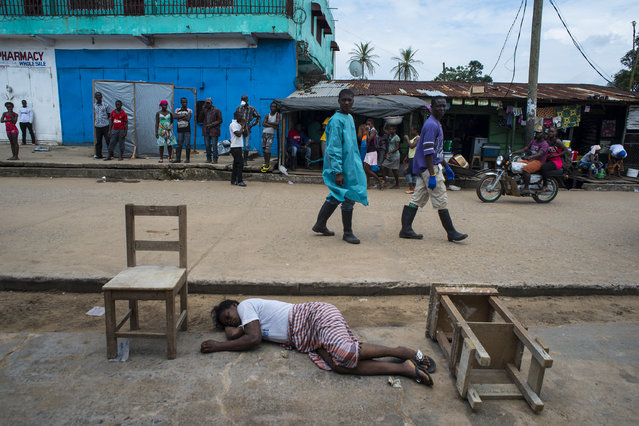
A woman lays dead outside the Redemption Hospital on Saturday September 20, 2014 in Monrovia, Liberia. Ebola patients come to the hospital, which has become a transfer and holding center to intake Ebola patients, but there is no space and some die while waiting outside. Redemption is located in one of the poorest neighborhoods of Monrovia that locals call "New Kru Town”. (Photo by Michel du Cille/The Washington Post)

A woman lays dead outside the Redemption Hospital on Saturday September 20, 2014 in Monrovia, Liberia. Ebola patients come to the hospital, which has become a transfer and holding center to intake Ebola patients, but there is no space and some die while waiting outside. Redemption is located in one of the poorest neighborhoods of Monrovia that locals call "New Kru Town”. Health workers are overwhelmed with a constant stream of new patients since the Ebola outbreak. (Photo by Michel du Cille/The Washington Post)
Details
16 Oct 2014 12:59:00
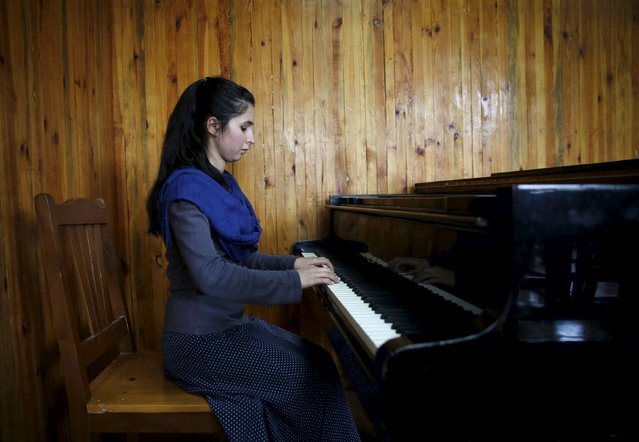
Negin Ekhpulwak, leader of the Zohra orchestra, an ensemble of 35 women, practises on a piano at Afghanistan's National Institute of Music, in Kabul, Afghanistan April 9, 2016. (Photo by Ahmad Masood/Reuters)

Negin Ekhpulwak, leader of the Zohra orchestra, an ensemble of 35 women, practises on a piano at Afghanistan's National Institute of Music, in Kabul, Afghanistan April 9, 2016. Playing instruments was banned under Taliban rule in Afghanistan, and even today, many conservative Muslims frown on most forms of music. Living in an orphanage in the capital, Kabul, 19-year-old Negin Ikhpolwak leads an ensemble of 35 women that plays both Western and Afghan musical instruments. In a country notorious internationally for harsh restrictions on women in most areas of life, Negin's story highlights a double challenge. (Photo by Ahmad Masood/Reuters)
Details
19 Apr 2016 13:47:00
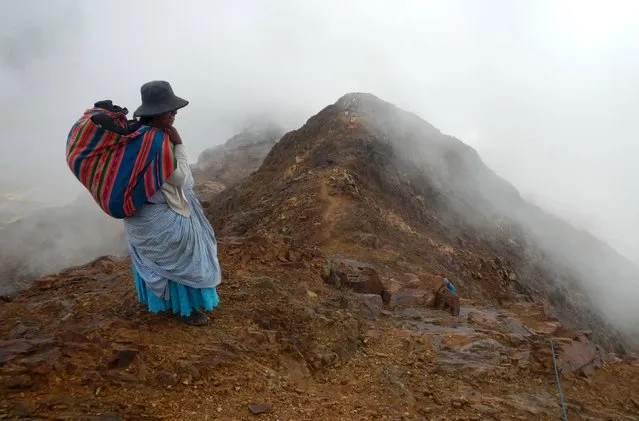
A porter stands at the bottom of the Illimani mountain, on the outskirts of La Paz, Bolivia, April 16, 2016. (Photo by David Mercado/Reuters)

A porter stands at the bottom of the Illimani mountain, on the outskirts of La Paz, Bolivia, April 16, 2016. For years, Lydia Huayllas, 48, has worked as a cook at base camps and mountain-climbing refuges on the steep, glacial slopes of Huayna Potosi, a 19,974-foot (6,088-meter) Andean peak outside of La Paz, Bolivia. But two years ago, she and 10 other Aymara indigenous women, ages 42 to 50, who also worked as porters and cooks for mountaineers, put on crampons – spikes fixed to a boot for climbing – under their wide traditional skirts and started to do their own climbing. (Photo by David Mercado/Reuters)
Details
22 Apr 2016 12:33:00
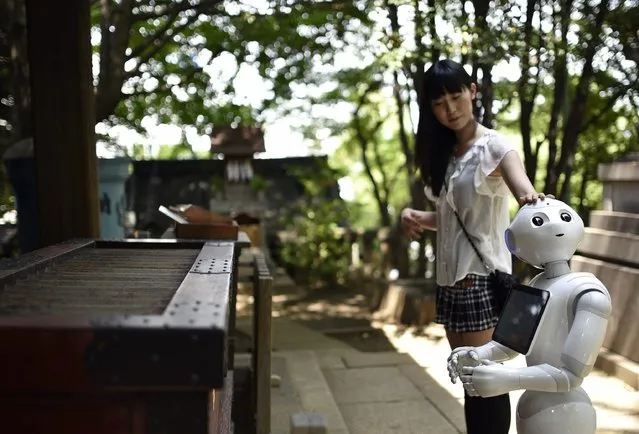
Tomomi Ota visits a local shrine with her humanoid robot Pepper in Tokyo, Japan, 26 June 2016. (Photo by Franck Robichon/EPA)

Tomomi Ota visits a local shrine with her humanoid robot Pepper in Tokyo, Japan, 26 June 2016. Reaching 120cm in height and 28 kilograms in weight, Pepper does not enter in the category of portable robot. But those characteristics dont stop Tomomi Ota to take Pepper in a cart to stroll in her neighborhood, go shopping or even take the subway... (Photo by Franck Robichon/EPA)
Details
08 Jul 2016 12:09:00
Serbian police officers of the Special Anti-Terrorist Unit pose for a picture in their base outside Belgrade October 8, 2014. (Photo by Marko Djurica/Reuters)

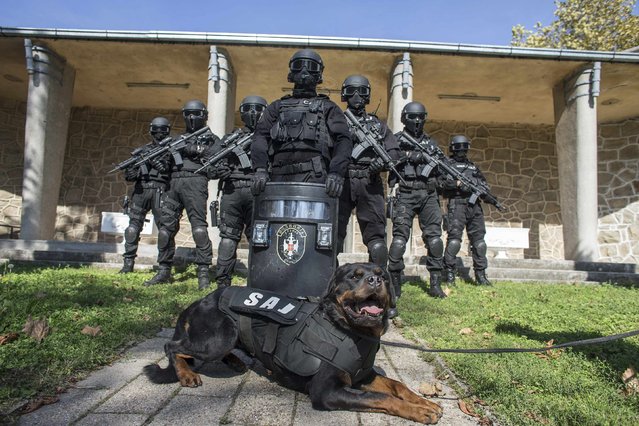
Serbian police officers of the Special Anti-Terrorist Unit pose for a picture in their base outside Belgrade October 8, 2014. When the killing of an unarmed black teenager by a white policeman in Ferguson, Missouri, in August sparked sometimes violent protests, the response of police in camouflage gear and armoured vehicles wielding stun grenades and assault rifles seemed more like a combat operation than a public order measure. Some U.S. police departments have recently acquired U.S. military-surplus hardware from wars abroad, but there are many law enforcers around the world whose rules of engagement also allow the use of lethal force with relatively few restrictions. But for every regulation that gives police wide scope to use firearms, there is another code that sharply limits their use. In Serbia, police may use measures ranging from batons to special vehicles, water cannon and tear gas on groups of people who have gathered illegally and are behaving in a way that is violent or could cause violence, but they may use firearms only when life is endangered. (Photo by Marko Djurica/Reuters)
Details
27 Nov 2014 14:53:00
A model's make up picture is stuck to a mirror backstage during the Autumn/Winter Madrid's Mercedes Benz Fashion Week, in Madrid, Wednesday, February 1, 2012. (Photo by Daniel Ochoa de Olza/AP Photo)

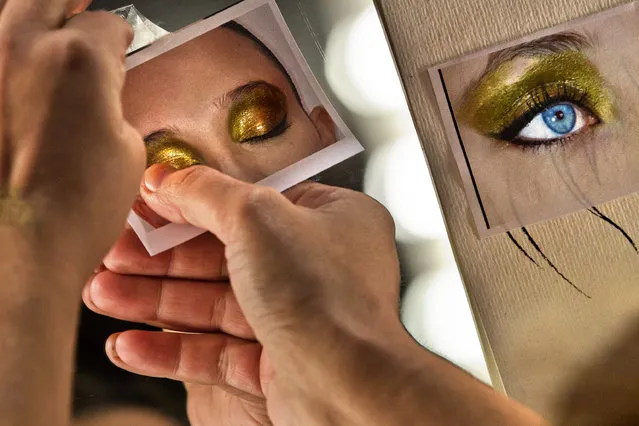
A model's make up picture is stuck to a mirror backstage during the Autumn/Winter Madrid's Mercedes Benz Fashion Week, in Madrid, Wednesday, February 1, 2012. (Photo by Daniel Ochoa de Olza/AP Photo)
Details
10 Sep 2015 12:49:00
Buddy the dog peers from a vehicle before the start of a movie at a drive in cinema in Snagov, Romania, Monday, June 1, 2020. Romania further loosened the measures imposed during a nationwide lockdown in order to limit the spread of the COVID-19 infections, with museums, open air restaurants, cinemas and beaches opening for public on Monday. (Photo by Andreea Alexandru/AP Photo)

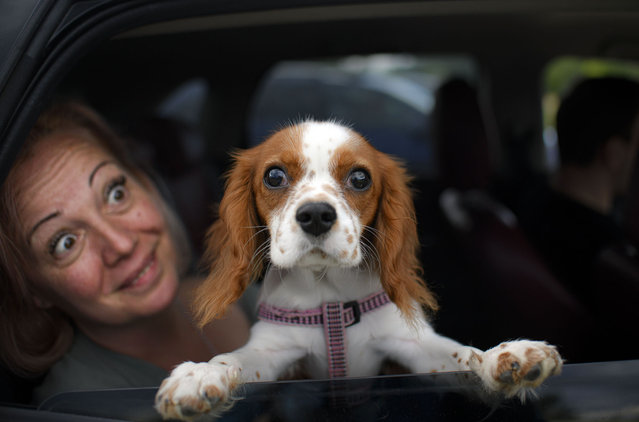
Buddy the dog peers from a vehicle before the start of a movie at a drive in cinema in Snagov, Romania, Monday, June 1, 2020. Romania further loosened the measures imposed during a nationwide lockdown in order to limit the spread of the COVID-19 infections, with museums, open air restaurants, cinemas and beaches opening for public on Monday. (Photo by Andreea Alexandru/AP Photo)
Details
21 Jun 2020 00:05:00