Loading...
Done
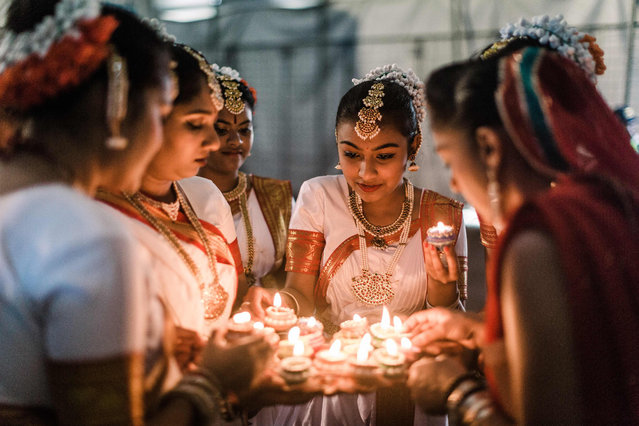
A group of colourful dancers from the Kumari Shiksha Dance Institution light colourful clay lamps in preparation to celebrate Diwali during the two day Diwali (Festival of Lights) Hindu festival celebrations at the old Drive-Inn in Durban, on October 19, 2019. The two-day festival attracts over 100,000 visitors. The festival celebrations include, parading of floats, chariots, singing of devotional songs, dances, games, face painting, food stalls of vegetarian food, clothing, display of toys and jewellery. Young people also get the opportunity to showcase their cultural and spiritual talents. A billion Hindus worlwide will officially celebrate Diwali on 27 October 2019. (Photo by Rajesh Jantilal/AFP Photo)

A group of colourful dancers from the Kumari Shiksha Dance Institution light colourful clay lamps in preparation to celebrate Diwali during the two day Diwali (Festival of Lights) Hindu festival celebrations at the old Drive-Inn in Durban, on October 19, 2019. The two-day festival attracts over 100,000 visitors. The festival celebrations include, parading of floats, chariots, singing of devotional songs, dances, games, face painting, food stalls of vegetarian food, clothing, display of toys and jewellery. Young people also get the opportunity to showcase their cultural and spiritual talents. A billion Hindus worlwide will officially celebrate Diwali on 27 October 2019. (Photo by Rajesh Jantilal/AFP Photo)
Details
22 Oct 2019 00:07:00
Members of the Cyclophonica band play instruments as they make a stop during a ride in Rio de Janeiro May 17, 2015. (Photo by Pilar Olivares/Reuters)

Members of the Cyclophonica band play instruments as they make a stop during a ride in Rio de Janeiro May 17, 2015. The Cyclophonica band was formed by a group of musicians riding bicycles around the city, mixing sport and culture and entertaining people on the streets, according to its founder Leonardo Fuks. (Photo by Pilar Olivares/Reuters)
Details
19 May 2015 11:46:00
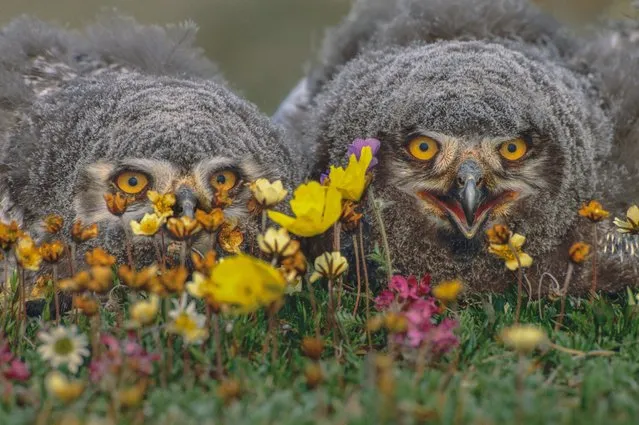
Snowy owlets (Bubo scandiacus), Arctic National Wildlife Refuge, Alaska, USA. “A pair of gray-feathered snowy owlets hunker down in the abundant flowers that flourish in the dropping-enriched soil of their nest mound”. (Photo by Art Wolfe/Art Wolfe Stock)

The photography of Art Wolfe covers the globe, capturing landscapes, wildlife, and cultures from every continent; here he talks through a selection of his favourite images. Art Wolfe is an American photographer and conservationist. His photographs have been noted by environmental advocacy groups for their “stunning” visual impact. Here: Snowy owlets (Bubo scandiacus), Arctic National Wildlife Refuge, Alaska, USA. (Photo by Art Wolfe/Art Wolfe Stock)
Details
19 Mar 2018 00:05:00
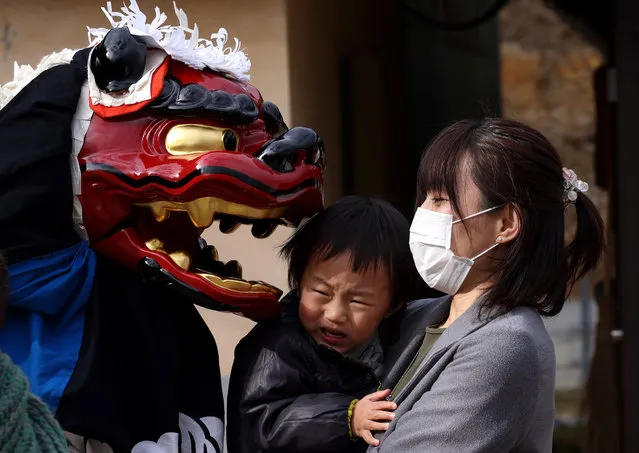
A performer wearing a lion mask performs the Ise Daikagura lion dance at the remote village of Yamanawa on February 08, 2021 in Ryuo, Japan. Ise Daikagura is a group of traditional Lion Dance performers who pray in front of farmers houses and businesses for good grain harvests and disease-free lives. Performers play sacred music using drums and flutes with two lion mask dancers. A lion mask is considered a symbol of God, who enters the house and performs in front of the Shinto God, a statue placed inside the house, mostly in the kitchen. These prayers are called “Kamodo Barai”. After the prayers, they are gifted with money, rice, sake and Japanese sweets from the householders. A group can travel for more than one hundred days to thousands of households and businesses throughout rural-villages in western Japan, and pray to those who are unable to visit the country’s most sacred shrine, the Grand Ise Shrine in Mie Prefecture. The group started its performance in the Edo era between 1603 to 1868 according to Japanese history. The Japanese government designated it as an important folk cultural national property in 1981. (Photo by Buddhika Weerasinghe/Getty Images)

A performer wearing a lion mask performs the Ise Daikagura lion dance at the remote village of Yamanawa on February 08, 2021 in Ryuo, Japan. Ise Daikagura is a group of traditional Lion Dance performers who pray in front of farmers houses and businesses for good grain harvests and disease-free lives. (Photo by Buddhika Weerasinghe/Getty Images)
Details
18 Feb 2021 09:27:00
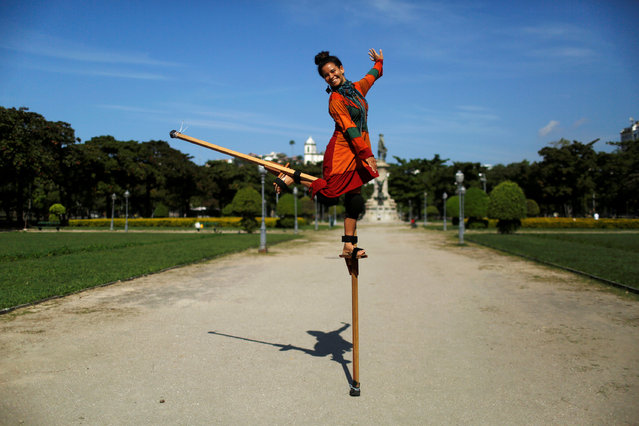
Raquel Poti, a 32-year-old street artist, poses at a park in Rio de Janeiro, Brazil, June 25, 2016. Raquel thinks the Olympics promotes a lifestyle that combines sports, culture and education. She is concerned about the large investment for the event while the population needs improvements in basic services. (Photo by Pilar Olivares/Reuters)

Just a week before Rio de Janeiro hosts South America's first Olympics, city residents expressed mixed feelings about the cost and security of the Games, while holding out hope they will bring joy to a nation facing economic and political crises. The conflicted thoughts mirror a recent survey by the Datafolha polling group showing that half of Brazilians were opposed to holding the Games, while 63 percent think the costs of hosting the event will outweigh benefits. (Photo by Pilar Olivares/Reuters)
Details
03 Aug 2016 11:51:00


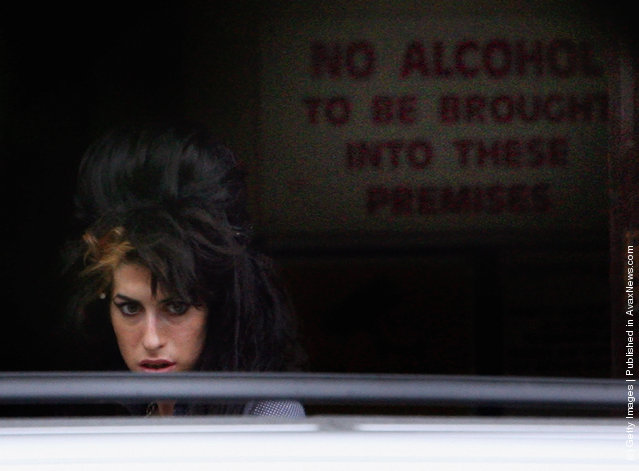
“The 27 Club, also occasionally known as the Forever 27 Club or Club 27, is a name for a group of influential rock and blues musicians who all died at the age of 27. The 27 Club consists of two related phenomena, both in the realm of popular culture. The first is a list of five famous rock musicians who died at age 27: Brian Jones, Jimi Hendrix, Janis Joplin, Jim Morrison, and Kurt Cobain. The second is the idea that many other notable musicians have also died at the age of 27”. – Wikipedia

Photo: Singer Amy Winehouse arrives at Snaresbrook Crown Court to see husband Blake Fielder-Civil on June 2, 2008 in London, England. (Photo by Dan Kitwood/Getty Images). Amy Winehouse dies at 27...
Details
26 Jul 2011 11:46:00
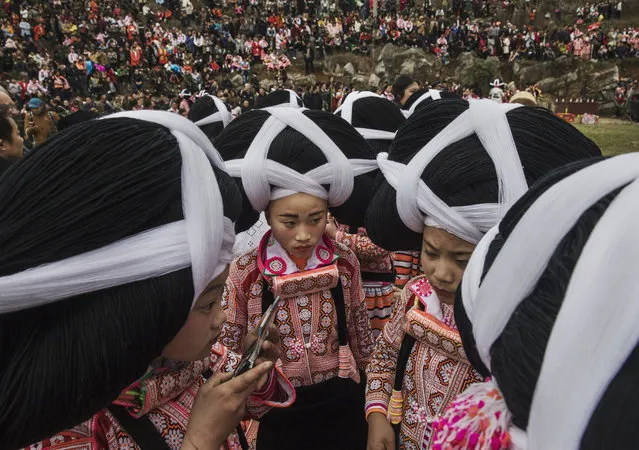
Girls of the Long Horn Miao ethnic minority group wear headdresses as they prepare gather for Tiaohua or Flower Festival as part of the Lunar New Year on February 6, 2017 in Longga village, Guizhou province, southern China. The Long Horn Miao are recognized for their declining practice of wrapping a blend of linen, wool, and the hair of their ancestors around animal horns or a wooden clip to make headdresses. Many young women say they now wear the headdresses only for special occasions and festivals, as the ornaments, which are attached by the horns to their real hair, have proved impractical for modern daily life in a fast changing world. China officially recognizes 56 different ethnic minorities, and statistics show over 7 million Chinese identifying themselves as Miao. But the small Long Horn Miao community counts only around 5000 people living in 12 villages, whose age-old traditions, language, and culture are fading. It is increasingly difficult in a modernizing China, as young people are drawn from remote rural villages to opportunities in bigger cities amongst wide-scale urbanization. Farming and labour remain the mainstays of life for the Long Horn Miao, leaving the area relatively poor in comparison with many parts of China. The government has invested significant amounts into local infrastructure and the tourism industry to try to bolster the local economy. (Photo by Kevin Frayer/Getty Images)

Girls of the Long Horn Miao ethnic minority group wear headdresses as they prepare gather for Tiaohua or Flower Festival as part of the Lunar New Year on February 6, 2017 in Longga village, Guizhou province, southern China. (Photo by Kevin Frayer/Getty Images)
Details
13 Feb 2017 00:01:00
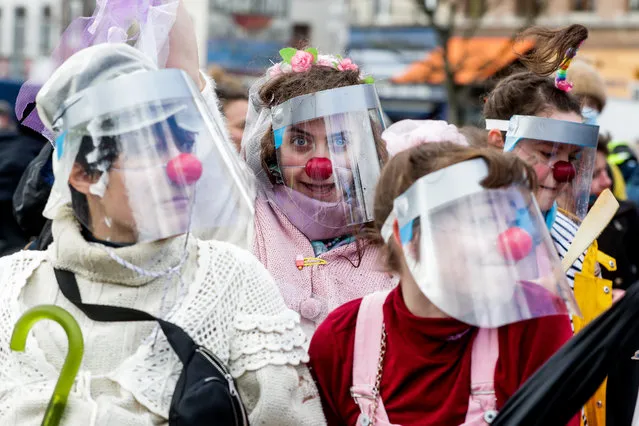
Participants of the “Still Standing for Culture” action of the cultural sector rally in Les Marolles neighborhood of Brussels, Belgium, 13 March 2021. Workers of the cultural sector along with second-hand dealers of the Jeu de Balle place gathered in Les Marolles to denounce the lack of financial support and call for solutions to the impact of the coronavirus crisis on culture professionals and the sector as a whole one year after the Covid-19 pandemic lockdowns started. (Photo by Stephanie Lecocq/EPA/EFE)

Participants of the “Still Standing for Culture” action of the cultural sector rally in Les Marolles neighborhood of Brussels, Belgium, 13 March 2021. Workers of the cultural sector along with second-hand dealers of the Jeu de Balle place gathered in Les Marolles to denounce the lack of financial support and call for solutions to the impact of the coronavirus crisis on culture professionals and the sector as a whole one year after the Covid-19 pandemic lockdowns started. (Photo by Stephanie Lecocq/EPA/EFE)
Details
14 Mar 2021 09:19:00