Loading...
Done
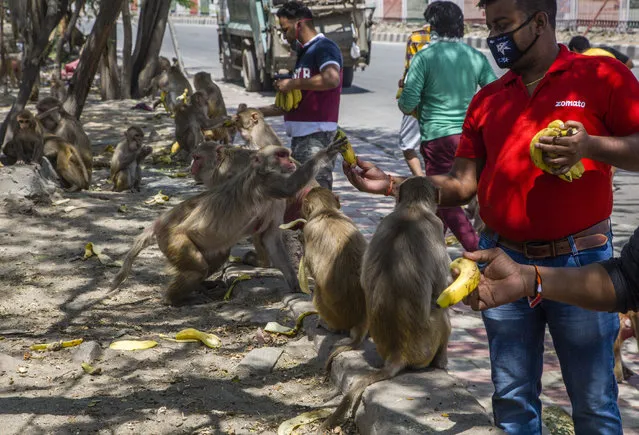
Men give bananas to monkeys gathered on the side of the road as India remains under an unprecedented lockdown over the highly contagious coronavirus (COVID-19) on April 08, 2020 in New Delhi, India. Wild animals, including monkeys, are roaming human settlements in India as people are staying indoors due to the 21-day lockdown. With India's 1.3 billion population and tens of millions of cars off the roads, wildlife is moving towards areas inhabited by humans. Wild animals in many countries have been seen roaming streets. A study says some 60 percent of the new diseases found around the globe every year are zoonotic, meaning they originate in animals and are passed on to humans. COVID-19 is a zoonotic disease that is suspected to have come from the wet markets of Wuhan, China. (Photo by Yawar Nazir/Getty Images)

Men give bananas to monkeys gathered on the side of the road as India remains under an unprecedented lockdown over the highly contagious coronavirus (COVID-19) on April 08, 2020 in New Delhi, India. Wild animals, including monkeys, are roaming human settlements in India as people are staying indoors due to the 21-day lockdown. (Photo by Yawar Nazir/Getty Images)
Details
12 Apr 2020 00:05:00


“The Greek Civil War was fought from 1945 to 1949 between the Greek governmental army, backed by the United Kingdom and United States, and the Democratic Army of Greece (ΔΣΕ) (Greek initials DSE), the military branch of the Greek Communist Party (KKE), backed by Bulgaria, Yugoslavia and Albania. It was the result of a highly polarized struggle between leftists and rightists which started in 1943 and targeted the power vacuum that the German-Italian occupation during World War II had created. One of the first conflicts of the Cold War, according to some analysts it represents the first example of a postwar Western interference in the internal politics of a foreign country, and for others, marked the first serious test of the theory of the so-called Churchill-Stalin percentages agreement. The first signs of the civil war occurred in 1942–1944, during the Occupation”. – Wikipedia

Photo: A Greek commando soldier, wearing a fur-collared jacket supplied by the Americans, waits for a guerrilla target to emerge during the Greek Civil War. (Photo by Bert Hardy/Picture Post/Getty Images). 22nd May 1948

Details
15 Aug 2013 15:47:00
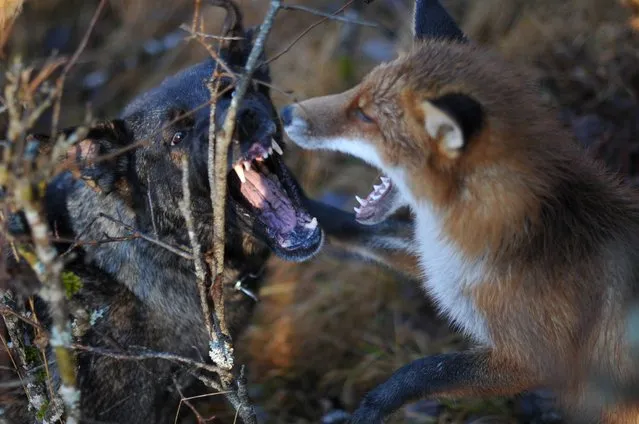
Life Fox And Hound

Tinni the dog and Sniffer the fox became quick friends, prompting the pooch's owner Torgeir Berge to start a campaign against the highly controversial fur trade after he noticed "how similar foxes and dogs actually are," calling the fox the "dog of the forest." Berge and his friend Berit Helberg plan to release a book sometime next year chronicling the duo, because "no animals should be living like the animals in the fur industry are living." According to animal advocacy group PETA, many creatures bound for the fur industry are allegedly kept in small, restrictive cages for their entire lives. Berge and Helberg said they plan to donate a portion of the proceeds to help save the Sniffers of the world, and we can totally see why.
Details
24 Apr 2014 14:40:00
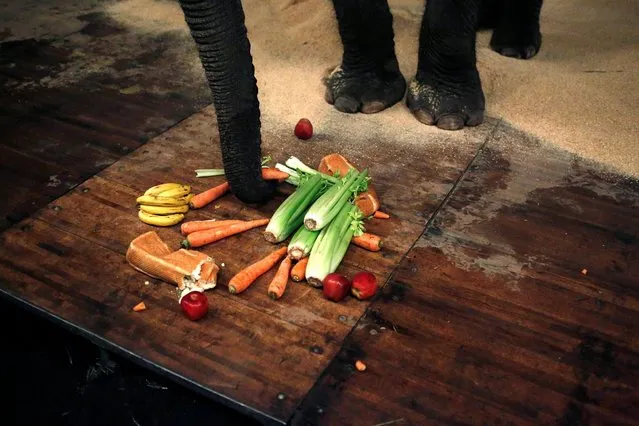
An elephant eats a snack after performing at Ringling Bros and Barnum & Bailey Circus' “Circus Extreme” show at the Mohegan Sun Arena at Casey Plaza in Wilkes-Barre, Pennsylvania, U.S., April 29, 2016. (Photo by Andrew Kelly/Reuters)

An elephant eats a snack after performing at Ringling Bros and Barnum & Bailey Circus' “Circus Extreme” show at the Mohegan Sun Arena at Casey Plaza in Wilkes-Barre, Pennsylvania, U.S., April 29, 2016. Elephants take a final bow at Ringling Bros and Barnum & Bailey Circus on Sunday, ending a 145-year spectacle that delighted fans but enraged animal activists, who say the highly publicized retirement is not enough. (Photo by Andrew Kelly/Reuters)
Details
01 May 2016 11:24:00


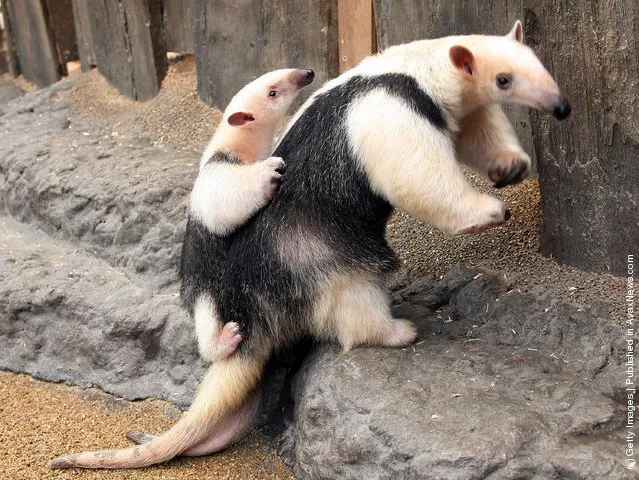
“The Southern Tamandua, Collared Anteater or Lesser Anteater (Tamandua tetradactyla) is a species of anteater from South America. It is a solitary animal, found in many habitats from mature to highly disturbed secondary forests and arid savannas. It feeds on ants, termites and bees. It has very strong foreclaws that can be used to break insect nests or to defend itself”. – Wikipedia

Photo: A three-month-old baby Southern Tamandua “Konbu” lies on its mother Tae's back at Sunshine International Aquarium on July 7, 2009 in Tokyo, Japan. Baby Southern Tamandua feels safe and comfortable holding onto something and normally stays on the mother's back until around 3 months old. (Photo by Junko Kimura/Getty Images)
Details
19 May 2011 10:31:00
BERTI the robot interacts with a Sony AIBO robot dog

“Life-size humanoid robot BERTI (Bristol EluMotion Robotic Torso number 1 or RT-1) is a self contained, fully automated Robotic Torso, designed and built by Elumotion to provide a robotic platform based on human anatomy. RT-1 is a highly articulated manipulating platform and includes novel dexterous hands that allow emulation of human gesturing”. – Elumotion.com

Photo: BERTI the robot interacts with a Sony AIBO robot dog at The Science Museum's Antenna Gallery on February 17, 2009 in London. (Photo by Peter Macdiarmid/Getty Images)
Details
12 Sep 2011 10:53:00
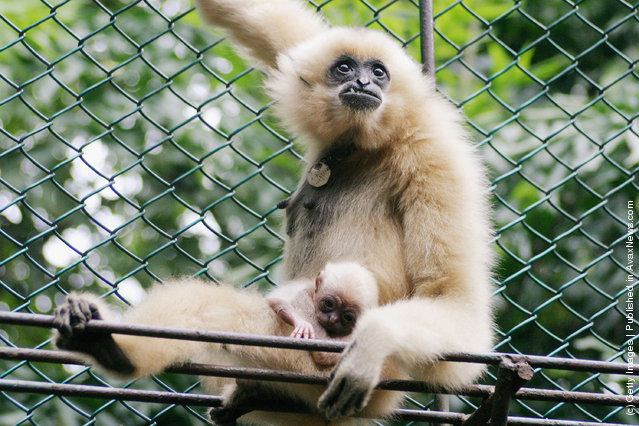
Newborn White-Cheeked Gibbon Nomascus

“Nomascus is the second most speciose genus of gibbons (family Hylobatidae). Originally this genus was a subgenus of Hylobates, and all individuals were considered one species, Hylobates concolor. Species within Nomascus are characterized by 52 chromosomes. Some species are all black, some light with a distinct black tuft of crown fur, and some by distinct, light-colored cheek patches. Nomascus is found from southern China (Yunnan) to southern Vietnam, and also on Hainan Island. One of the genus' species, Nomascus nasutus, has been deemed “the most critically endangered ape species in the world”. All of the species in this genus are endangered or critically endangered”. – Wikipedia

Photo: A newborn White-Cheeked Gibbon clings to its mother in the Nanning Zoo on April 12, 2004 in Nanning, Guangxi province, China. The White-Cheeked Gibbon's natural habitat is Southern China as well as Vietnam and Laos. They are classified as highly endangered and are on the brink of extinction due to poaching and reduction of natural rainforests. (Photo by Getty Images)
Details
12 Aug 2011 11:51:00
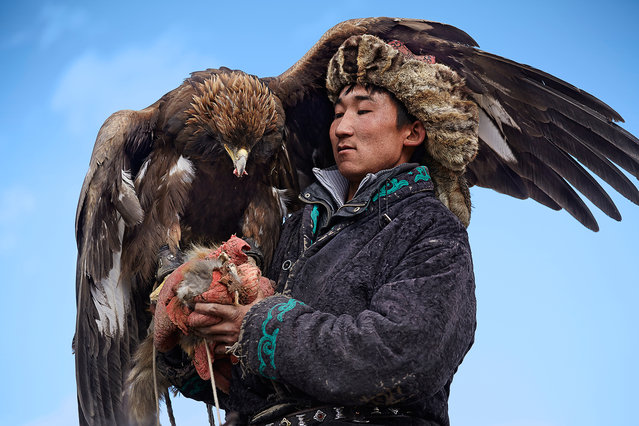
In one of the planet’s most desolate and harsh terrains, the Altai Mountains which run from Siberia in Russia down to Mongolia’s Gobi Desert, hunting with eagles is currently only practiced by a handful of Kyrgyz and Kazakhs. This form of falconry, the practice of hunting with the aid of birds of prey, can be traced back as far as 4,000 years in Central Asia. (Photo by Tariq Zaidi/The Washington Post)

In one of the planet’s most desolate and harsh terrains, the Altai Mountains which run from Siberia in Russia down to Mongolia’s Gobi Desert, hunting with eagles is currently only practiced by a handful of Kyrgyz and Kazakhs. This form of falconry, the practice of hunting with the aid of birds of prey, can be traced back as far as 4,000 years in Central Asia. Here: after a successful hunt, a proud hunter rewards his eagle by feeding it the lungs of the prey, which is considered the most highly prized part of the animal. (Photo by Tariq Zaidi/The Washington Post)
Details
22 Aug 2015 12:46:00