Loading...
Done
Students exercise in body training at Bishan Vocational Education Center in Chongqing, southwest China, January 13, 2016. These students were trained to be stewardesses of the high-speed train. (Photo by Xie Jie/Xinhua)

Students exercise in body training at Bishan Vocational Education Center in Chongqing, southwest China, January 13, 2016. These students were trained to be stewardesses of the high-speed train. (Photo by Xie Jie/Xinhua)
Details
15 Jan 2016 12:49:00
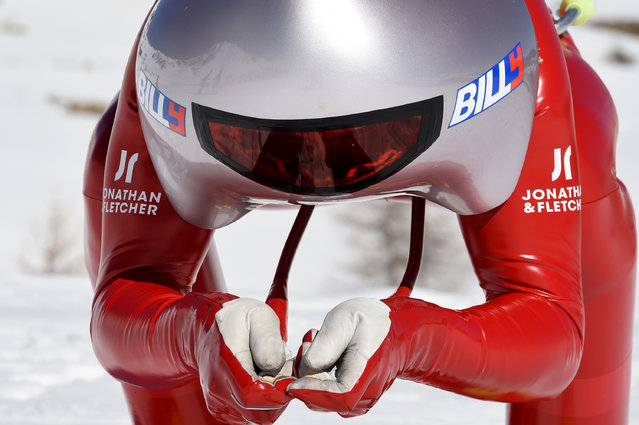
France's Simon Billy gets ready to practice speed skiing on the Chabriere ski slope in Vars, on March 29, 2017. (Photo by Jean-Pierre Clatot/AFP Photo)

France's Simon Billy gets ready to practice speed skiing on the Chabriere ski slope in Vars, on March 29, 2017. (Photo by Jean-Pierre Clatot/AFP Photo)
Details
30 Mar 2017 11:48:00
Ella Bucio of Mexico takes part in a training session before Women's Speed Semi Final at the FIG Parkour World Championships in Tokyo on October 15, 2022. (Photo by Philip Fong/AFP Photo)

Ella Bucio of Mexico takes part in a training session before Women's Speed Semi Final at the FIG Parkour World Championships in Tokyo on October 15, 2022. (Photo by Philip Fong/AFP Photo)
Details
24 Oct 2022 04:43:00
Atomic Annie at work during the Upshot-Knothole test series, 1953. (Photo by Los Alamos National Laboratory/US Army)

“A fter the former Soviet Union conducted its first nuclear test in August 1949, the US reevaluated its postwar defense policies. With the US monopoly on atomic weapons broken, military and political leaders chose to diversify the American stockpile by developing thermonuclear and tactical nuclear weapons. One of the more interesting concepts to come out of this period was atomic artillery, which was successfully tested at the Nevada Proving Grounds (now the Nevada Test Site) in May 1953”. – Alan Carr. Photo: Atomic Annie at work during the Upshot-Knothole test series, 1953. (Photo by Los Alamos National Laboratory/US Army)
Details
11 Mar 2013 11:43:00
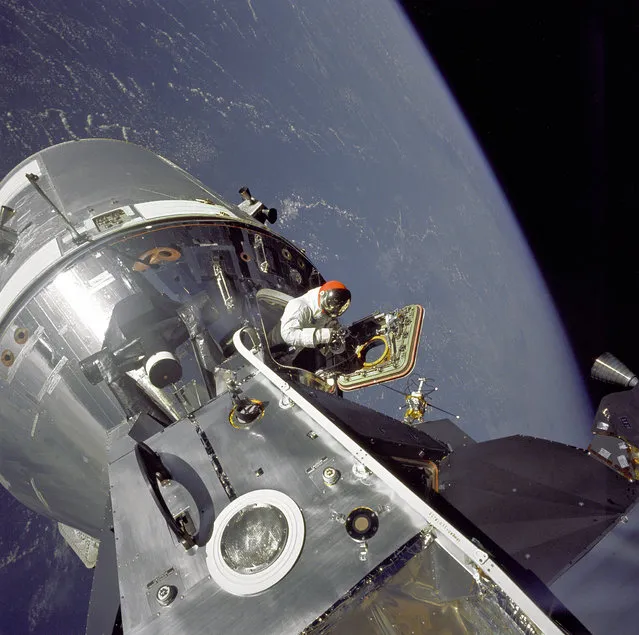
Apollo 9 Command/Service Modules (CSM) nicknamed “Gumdrop” and Lunar Module (LM), nicknamed “Spider” are shown docked together as Command Module pilot David R. Scott stands in the open hatch. Astronaut Russell L. Schweickart, Lunar Module pilot, took this photograph of Scott during his EVA as he stood on the porch outside the Lunar Module. Apollo 9 was an Earth orbital mission designed to test docking procedures between the CSM and LM as well as test fly the Lunar Module in the relative safe confines of Earth orbit. (Photo by NASA)

Apollo 9 Command/Service Modules (CSM) nicknamed “Gumdrop” and Lunar Module (LM), nicknamed “Spider” are shown docked together as Command Module pilot David R. Scott stands in the open hatch. Astronaut Russell L. Schweickart, Lunar Module pilot, took this photograph of Scott during his EVA as he stood on the porch outside the Lunar Module. Apollo 9 was an Earth orbital mission designed to test docking procedures between the CSM and LM as well as test fly the Lunar Module in the relative safe confines of Earth orbit. (Photo by NASA)
Details
20 Jul 2014 11:47:00


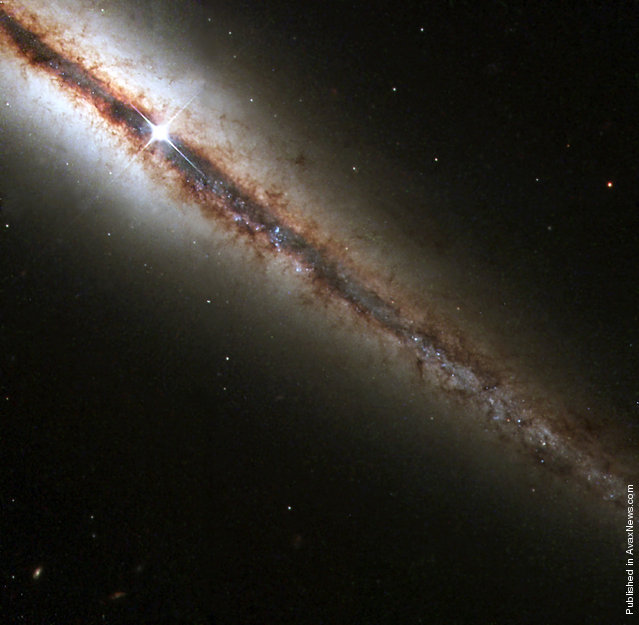
An image produced by the Hubble telescope of the perfectly “edge-on” galaxy, or NGC 4013, March 1, 2001. This new Hubble picture reveals, with great detail, huge clouds of dust and gas extending along, as well as far above, the galaxy's main disk. NGC 4013 is a spiral galaxy, similar to the Milky Way, lying some 55 million light-years from Earth in the direction of the constellation Ursa Major. Viewed face-on, it would look like a nearly circular pinwheel, but NGC 4013 happens to be seen edge-on from our vantage point. Even at 55 million light-years, the galaxy is larger than Hubble's field of view, and the image shows only a little more than half of the object, albeit with unprecedented detail. (Photo Courtesy of NASA/Newsmakers)

Details
28 Feb 2015 22:33:00
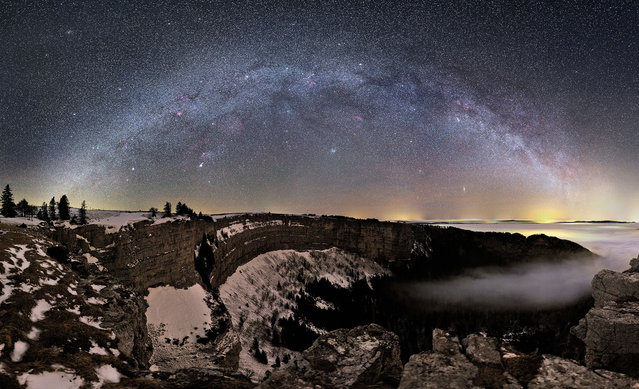
Milky Way over Switzerland

Milky Way over Switzerland

The Milky Way is the galaxy in which Earth is contained. This name derives from its appearance as a dim “milky” glowing band arching across the night sky, in which the naked eye cannot distinguish individual stars. The term “Milky Way” is a translation of the Classical Latin via lactea, from the Hellenistic Greek γαλαξίας κύκλος (pr. galaxías kýklos, “milky circle”). The Milky Way appears like a band because it is a disk-shaped structure being viewed from inside. The fact that this faint band of light is made up of stars was proven in 1610 when Galileo Galilei used his telescope to resolve it into individual stars. In the 1920s, observations by astronomer Edwin Hubble showed that the Milky Way is just one of many galaxies.


Details
20 Jun 2012 10:11:00
Mohamed Gamal Abdel Nasser, a workshop owner, tests primus stoves known as “Bagour” in Arabic, in Cairo, Egypt, May 11, 2016. (Photo by Mohamed Abd El Ghany/Reuters)

Mohamed Gamal Abdel Nasser, a workshop owner, tests primus stoves known as “Bagour” in Arabic, in Cairo, Egypt, May 11, 2016. (Photo by Mohamed Abd El Ghany/Reuters)
Details
18 May 2016 13:49:00