Loading...
Done
This tiny hedgehog is in a prickly position as hes unable to grow spikes, leaving him needing round-the-clock care. The woodland critter was found with no spikes and has been taken in by a family hoping to nurse him back to health so he can be released into the wild. Named Mr Prickleless, the hedgehog was rescued by Dina Nixon and her daughter Jennifer, 25, after being taken into a rescue centre in December last year. (Photo by Caters News Agency)

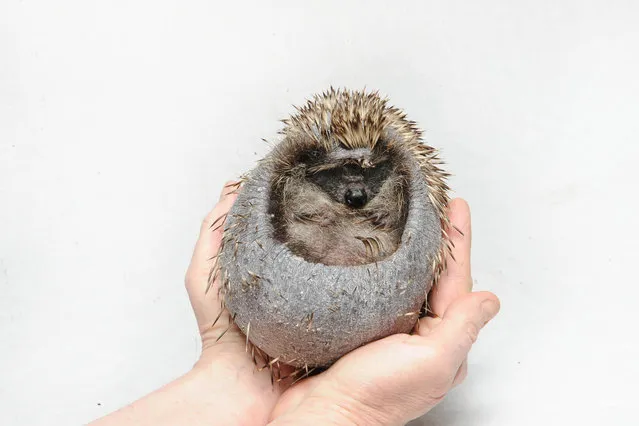
This tiny hedgehog is in a prickly position as hes unable to grow spikes, leaving him needing round-the-clock care. The woodland critter was found with no spikes and has been taken in by a family hoping to nurse him back to health so he can be released into the wild. Named Mr Prickleless, the hedgehog was rescued by Dina Nixon and her daughter Jennifer, 25, after being taken into a rescue centre in December last year. It is not known what happened to his spikes, but Dina has vowed that if they ever do return he will be returned to the wild. But for now the hedgehog has taken shelter in a rabbit hutch in her garden. (Photo by Caters News Agency)
Details
19 Jul 2014 11:03:00
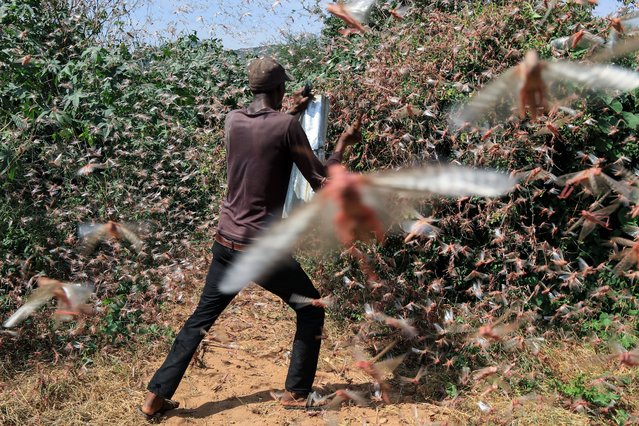
A man uses iron sheet to make noises, as a way of trying to disperse desert locusts that had invaded their farms during the second wave invasion in Kakongo village, in Nuu-Mwingi East, in Kitui, Kenya, 06 February 2021. The second wave invasion of the desert locusts in the country comes at a time where most famers are expecting to harvest their farm produce in the country. According to the United Nations Food and Agriculture Organization (FAO), on 04 February, warned numerous immature desert locust swarms persist in southern Ethiopia and Kenya. Some of the swarms are in community areas and therefore cannot be treated. In Kenya, immature swarms continue to spread westwards across northern and central counties where there are currently about 20 small swarms present, mostly about 50 hectares in size, it said. (Photo by Daniel Irungu/EPA/EFE)

A man uses iron sheet to make noises, as a way of trying to disperse desert locusts that had invaded their farms during the second wave invasion in Kakongo village, in Nuu-Mwingi East, in Kitui, Kenya, 06 February 2021. The second wave invasion of the desert locusts in the country comes at a time where most famers are expecting to harvest their farm produce in the country. (Photo by Daniel Irungu/EPA/EFE)
Details
25 Feb 2021 08:17:00


In this handout from the Food and Drug Administration (FDA), a new FDA warning label for a cigarette packs is seen. The FDA released nine new warning labels that will be required for cigarette packs in the U.S. (Photo by FDA via Getty Images)
Details
22 Jun 2011 10:40:00
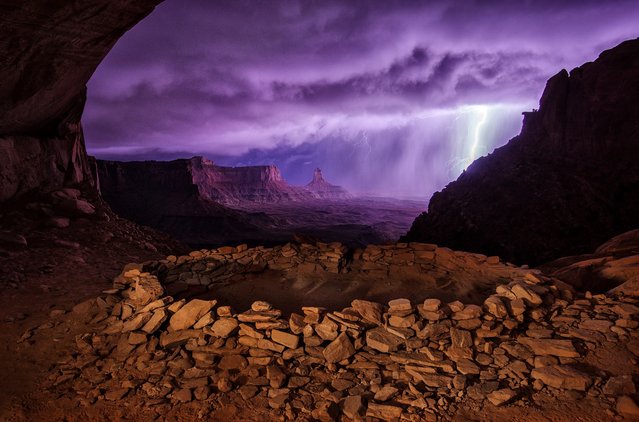
Second Place Winner: “Thunderstorm at False Kiva”. I hiked out to these ruins at night hoping to photograph them with the Milky Way, but instead a thunderstorm rolled through, creating this dramatic image. – Max Seigal. (Photo and caption by Max Seigal/National Geographic Traveler Photo Contest)

Second Place Winner: “Thunderstorm at False Kiva”. I hiked out to these ruins at night hoping to photograph them with the Milky Way, but instead a thunderstorm rolled through, creating this dramatic image. – Max Seigal. National Geographic Traveler Director of Photography Dan Westergren, one of this year's judges, shares his thoughts on the second place winner: “This photo combines two different scenes into one: the small kiva in a cliff dwelling and the grand vista of Canyonlands National Park across the valley. I really like the two different color palettes – warm inside and purple outside. This two-for-one scene was caused by the lightning storm outside the dwelling, which lit up the landscape like it was a huge electronic flash. Looking at this picture I can imagine what a wonderful sight it must have been for the ancient people who lived here. It doesn't seem too amazing now in our modern world, but might have been mind-blowing for the prehistoric residents”. Location: Utah. (Photo and caption by Max Seigal/National Geographic Traveler Photo Contest)
Details
02 Aug 2013 06:16:00
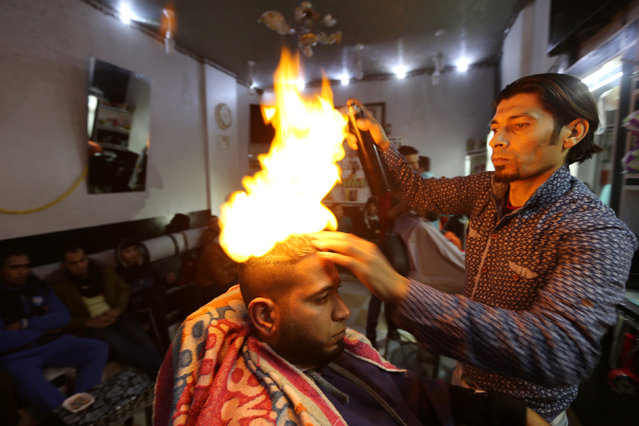
Palestinian barber Ramadan Odwan styles and straightens the hair of a customer with fire at his salon in Rafah, in the southern Gaza Strip February 2, 2017. In Ramadan Odwan's barbershop in Gaza, hair isn't just blow-dried, it's blowtorch-dried. “People have gone crazy about it, many people are curious to go through the experience and they are not afraid”, he told Reuters. “People here love adventures”. Odwan, 37, is not the first stylist in the world to use flame to straighten hair, but his craft is unique in the Gaza Strip. In his salon in the southern Gaza town of Rafah, Odwan applied what he described as a protective liquid coating to a customer's hair – he declined to disclose its contents – before aiming for the head and pressing the button on a small blowtorch. “I control how long I apply fire, I keep it on and off for 10 seconds or 15 seconds. It is completely safe and I have not encountered any accident since I started it two months ago”, Odwan added. Odwan charges 20 shekels ($5.20) for a haircut and fire-straightening. A barber for the past 18 years, he said part of the reason he uses the technique is to show that Palestinian barbers are as “professional as those out there around the world”. (Photo by Ibraheem Abu Mustafa/Reuters)

Palestinian barber Ramadan Odwan styles and straightens the hair of a customer with fire at his salon in Rafah, in the southern Gaza Strip February 2, 2017. In Ramadan Odwan's barbershop in Gaza, hair isn't just blow-dried, it's blowtorch-dried. “People have gone crazy about it, many people are curious to go through the experience and they are not afraid”, he told Reuters. “People here love adventures”. (Photo by Ibraheem Abu Mustafa/Reuters)
Details
11 Feb 2017 00:05:00
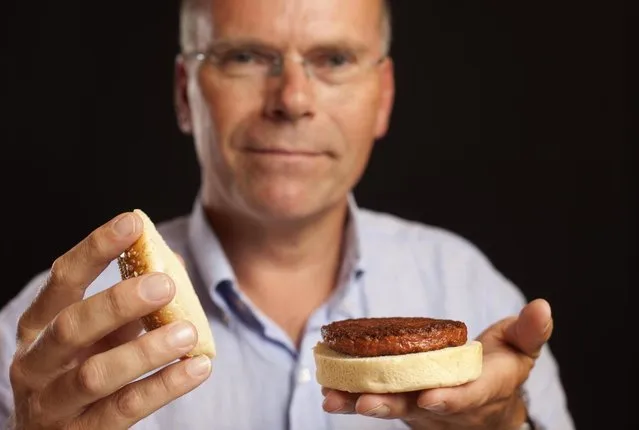
In this handout image provided by Ogilvy, a burger made from cultured beef, which has been developed by Professor Mark Post of Maastricht University in the Netherlands (pictured) is shown to the media during a press conference on August 5, 2013 in London, England. Cultured Beef could help solve the coming food crisis and combat climate change with commercial production of Cultured Beef beginning within ten to twenty years. (Photo by David Parry via Getty Images)

In this handout image provided by Ogilvy, a burger made from cultured beef, which has been developed by Professor Mark Post of Maastricht University in the Netherlands (pictured) is shown to the media during a press conference on August 5, 2013 in London, England. The in-vitro burger, cultured from cattle stem cells, the first example of what its creator says could provide an answer to global food shortages and help combat climate change, was fried in a pan and tasted by two volunteers. The burger is the result of years of research by Dutch scientist Mark Post, a vascular biologist at the University of Maastricht, who is working to show how meat grown in petri dishes might one day be a true alternative to meat from livestock.The meat in the burger has been made by knitting together around 20,000 strands of protein that has been cultured from cattle stem cells in Post's lab. (Photo by David Parry)
Details
06 Aug 2013 08:48:00
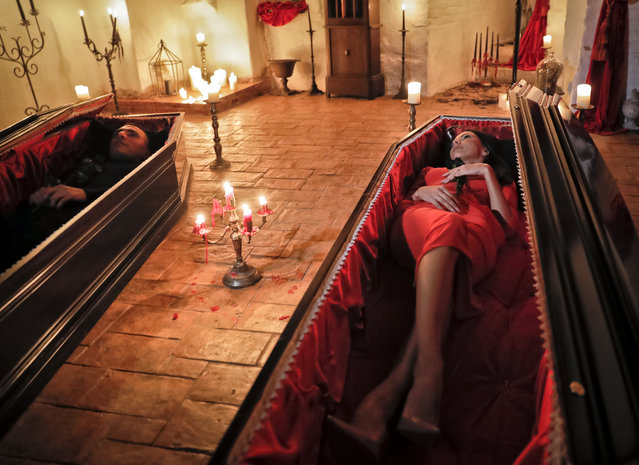
Tami Varma, right, and her brother Robin, the grandchildren of Devendra Varma, a scholar of English gothic tales and an expert in vampire lore, pose in coffins at the Bran Castle, in Bran, Romania, Monday, October 31, 2016. A Canadian brother and sister are passing Halloween night curled up in red velvet coffins in the Transylvanian castle that inspired the Dracula legend, the first time in 70 years anyone has spent the night in the gothic fortress, after they bested 88,000 people who entered a competition hosted by Airbnb to get the chance to dine and sleep at the castle in Romania. A portrait of medieval prince Vlad the Impaler is placed on the wall. (Photo by Vadim Ghirda/AP Photo)

Tami Varma, right, and her brother Robin, the grandchildren of Devendra Varma, a scholar of English gothic tales and an expert in vampire lore, pose in coffins at the Bran Castle, in Bran, Romania, Monday, October 31, 2016. A Canadian brother and sister are passing Halloween night curled up in red velvet coffins in the Transylvanian castle that inspired the Dracula legend, the first time in 70 years anyone has spent the night in the gothic fortress, after they bested 88,000 people who entered a competition hosted by Airbnb to get the chance to dine and sleep at the castle in Romania. A portrait of medieval prince Vlad the Impaler is placed on the wall. (Photo by Vadim Ghirda/AP Photo)
Details
01 Nov 2016 12:32:00
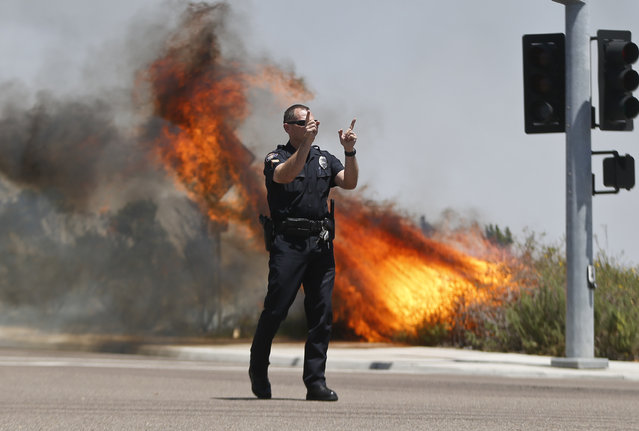
A Carlsbad,Calif. police officer turns traffic away as flames leap behind him Wednesday, May 14, 2014, in Carlsbad, Calif. Weather conditions that at least temporarily calmed allowed firefighters to gain ground early Wednesday on a pair of wildfires that forced thousands of residents to leave their homes. (Photo by AP Photo)

A Carlsbad,Calif. police officer turns traffic away as flames leap behind him Wednesday, May 14, 2014, in Carlsbad, Calif. Weather conditions that at least temporarily calmed allowed firefighters to gain ground early Wednesday on a pair of wildfires that forced thousands of residents to leave their homes. (Photo by AP Photo)
Details
16 May 2014 16:03:00