Loading...
Done
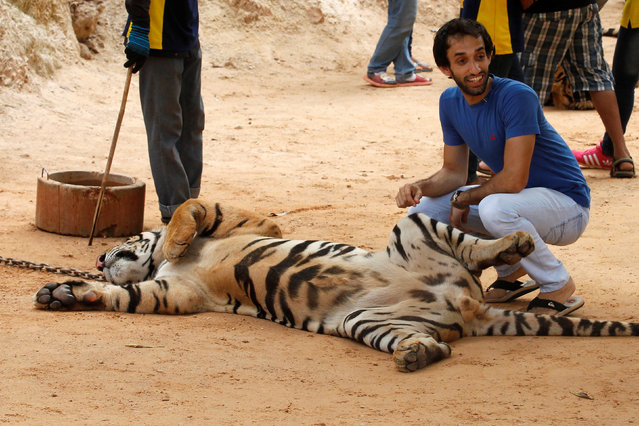
A tourist poses next to a tiger before officials start moving tigers from Thailand's controversial Tiger Temple, a popular tourist destination which has come under fire in recent years over the welfare of its big cats in Kanchanaburi province, west of Bangkok, Thailand, May 30, 2016. (Photo by Chaiwat Subprasom/Reuters)

A tourist poses next to a tiger before officials start moving tigers from Thailand's controversial Tiger Temple, a popular tourist destination which has come under fire in recent years over the welfare of its big cats in Kanchanaburi province, west of Bangkok, Thailand, May 30, 2016. Wildlife authorities raid a Buddhist temple that has more than 100 tigers, taking away three cats and vowing to confiscate scores more in response to global pressure over wildlife trafficking. (Photo by Chaiwat Subprasom/Reuters)
Details
31 May 2016 11:51:00
A gold prospector sits and eats close to a soldier at a gold mine near the village of Gamina, in western Ivory Coast, March 18, 2015. (Photo by Luc Gnago/Reuters)

Nestled among the cocoa plantations of western Ivory Coast is a gold mine that does not feature on any official maps. It is not run by an industrial mining company, nor does it pay taxes to the central government. The unlicensed mine is a key part of a lucrative business empire headed by the deputy commander of the West African nation's elite Republican Guard, United Nations investigators allege. Here: A gold prospector sits and eats close to a soldier at a gold mine near the village of Gamina, in western Ivory Coast, March 18, 2015. (Photo by Luc Gnago/Reuters)
Details
08 May 2015 13:54:00


“The Berlin Wall (German: Berliner Mauer) was a barrier constructed by the German Democratic Republic (GDR, East Germany) starting on 13 August 1961, that completely cut off West Berlin from surrounding East Germany and from East Berlin. The barrier included guard towers placed along large concrete walls, which circumscribed a wide area (later known as the “death strip”) that contained anti-vehicle trenches, “fakir beds” and other defenses. The Soviet-dominated Eastern Bloc officially claimed that the wall was erected to protect its population from fascist elements conspiring to prevent the “will of the people” in building a socialist state in East Germany. However, in practice, the Wall served to prevent the massive emigration and defection that marked Germany and the communist Eastern Bloc during the post-World War II period”. – Wikipedia

Photo: West Berlin policemen and East German Volkspolizei face each other across the border in Berlin, circa 1955. (Photo by Three Lions/Hulton Archive/Getty Images)
Details
22 May 2011 10:49:00
The Swarovski Crystal Head Fountain In Austria

A stone giant exhausted after his long travels decided to rest a while and drink from a pond far below. He lay down and started drinking from the crystal clear pond. So delicious was the water that he was unable to quench his thirst no matter how much he tried. Weeks have passed, months, years. The body of the stone giant became one with the hills and even his tongue has turned to water. This might seem like a fairy tale, yet you’ll be able to see this stone giant if you ever come to Wattens, Austria. He’s still there, guarding the entrance to Swarovski Kristallwelted, otherwise known as the Crystal Worlds. This is a one-of-a-kind theme park that was created by the people who first created Swarovski crystals.
Details
02 Mar 2015 08:30:00


“Igor Fyodorovich Stravinsky (17 June [O.S. 5 June] 1882 – 6 April 1971) was a Russian-born, naturalized French, later naturalized American composer, pianist, and conductor. He is widely acknowledged as one of the most important and influential composers of 20th century music. He was a quintessentially cosmopolitan Russian who was named by Time magazine as one of the 100 most influential people of the century. He became a naturalized French citizen in 1934 and a naturalized US citizen in 1945. In addition to the recognition he received for his compositions, he also achieved fame as a pianist and a conductor, often at the premieres of his works”. – Wikipedia

Photo: Composer Igor Stravinsky (right) and impresario Sergei Diaghilev in Seville during their Ballets Russes collaboration. (Photo by Hulton Archive/Getty Images). 1921
Details
06 Apr 2011 07:59:00
Ethnic Cham Muslim people pass the time near their boats on banks of Mekong river in Phnom Penh July 29, 2013. (Photo by Damir Sagolj/Reuters)

Ethnic Cham Muslim people pass the time near their boats on banks of Mekong river in Phnom Penh July 29, 2013. About 100 ethnic Cham families, made up of nomads and fishermen without houses or land who arrived at the Cambodian capital in search of better lives, live on their small boats on a peninsula where the Mekong and Tonle Sap rivers meet, just opposite the city's centre. The community has been forced to move several times from their locations in Phnom Penh as the land becomes more valuable. They fear that their current home, just behind a new luxurious hotel under construction at the Chroy Changva district is only temporary and that they would have to move again soon. (Photo by Damir Sagolj/Reuters)
Details
31 Jul 2013 06:34:00
Longsheng Rice Terraces

The Longsheng Rice Terraces are located in Longsheng County, about 100 km (2 hours drive) from Guilin, Guangxi, China. The most popular are Ping An Rice Terrace and Jinkeng Rice Terrace. The terraced fields are built along the slope winding from the riverside up to the mountain top, the highest part being 880 m in elevation while the lowest part is 380 m[citation needed]. The coiling line that starts from the mountain foot up to the mountain top divides the mountain into layers of water glittering in the sun in spring, layers of green rice shoots in summer, layers of golden rice in fall, and layers of silvery frost in winter. The terraced fields were mostly built during the Ming Dynasty, about 500 years ago.
Details
18 Oct 2013 12:45:00
Tridacna Gigas, or Giant Clams

“The giant clam, Tridacna gigas (known as pā’ua in Cook Islands Māori), is the largest living bivalve mollusc. T. gigas is one of the most endangered clam species. It was mentioned as early as 1825 in scientific reports. One of a number of large clam species native to the shallow coral reefs of the South Pacific and Indian oceans, they can weigh more than 200 kilograms (440 lb) measure as much as 120 cm (47 in) across, and have an average lifespan in the wild of 100 years or more”. – Wikipedia

Photo: Tridacna Gigas, or Giant Clams spew water as a traditional fisherman passes by a small sanctuary on January 23, 2004 near Bolinao in the Northern Philippines. The clams, prime builders for coral reefs and providing shelter for spawning fish and other marine life, are exposed by low tides in the sanctuary. Overfishing and pollution throughout the country are not only threatening food security, but are also starting to choke one of the few working clam sanctuaries in the world. (Photo by David Greedy/Getty Images)
Details
01 Oct 2011 13:10:00