Loading...
Done


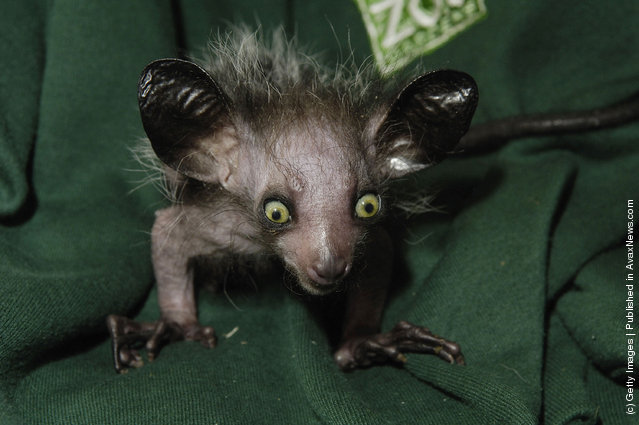
“The aye-aye (Daubentonia madagascariensis) is a lemur, a strepsirrhine primate native to Madagascar that combines rodent-like teeth and a special thin middle finger to fill the same ecological niche as a woodpecker. It is the world's largest nocturnal primate, and is characterized by its unusual method of finding food; it taps on trees to find grubs, then gnaws holes in the wood and inserts its narrow middle finger to pull the grubs out. The only other animal species known to find food in this way is the striped possum. From an ecological point of view the aye-aye fills the niche of a woodpecker as it is capable of penetrating wood to extract the invertebrates within”. – Wikipedia

Photo: In this handout image from Bristol Zoo is seen the first captive bred aye-aye in the UK named “Kintana” (meaning star in Malagasy) April 15, 2005 at Bristol Zoo Gardens, England. The zoo announced today only the second baby aye-aye to be hand-reared in the world (the first was in Jersey Zoo) and has now made his first public appearance since his birth on 11 February 2005. (Photo by Rob Cousins/Bristol Zoo via Getty Images)
Details
13 Apr 2011 13:33:00
“Whether that means getting up way before the sun, like I do most days, going out somewhere that I’m not comfortable or just trying to get different angles or styles of photos, I am trying to display the crazy beauty of the ocean, and usually moments that literally last less than a split second”. (Photo by Ryan Pernoski/Caters News Agency)

These kaleidoscopic images are the work of one persistent photographer’s efforts to capture vibrant hues at the exact moment a wave breaks. Ryan Pernofski‘s stunning shots feature brilliant yellows, reds, blues and purples as an array of sunlight hits the water at the perfect time. What’s even more impressive: Ryan, a 27-year-old Australian, began shooting his popular masterpieces without using a professional camera, taking his iPhone out into the water instead. Ryan began experimenting with this method in 2012, using an underwater housing to protect his phone, as he could not afford a professional camera. (Photo by Ryan Pernoski/Caters News Agency)
Details
09 Jun 2018 00:05:00
A member of the punk group p*ssy Riot is restrained by a member of the Cossack militia in Sochi, Russia, on Wednesday, February 19, 2014. Cossack militia attacked the p*ssy Riot punk group with horsewhips on Wednesday as the group tried to perform under a sign advertising the Sochi Olympics. (Photo by Morry Gash/AP Photo)

A member of the punk group p*ssy Riot is restrained by a member of the Cossack militia in Sochi, Russia, on Wednesday, February 19, 2014. Cossack militia attacked the p*ssy Riot punk group with horsewhips on Wednesday as the group tried to perform under a sign advertising the Sochi Olympics. The group had gathered to perform in a downtown Sochi restaurant, about 30km (21miles) from where the Winter Olympics are being held.They left the restaurant wearing bright dresses and ski masks and had only been performing for a few seconds when they were set upon by Cossacks. (Photo by Morry Gash/AP Photo)
Details
20 Feb 2014 10:13:00


“Harisu (하리수 or 河莉秀) is the stage name of Lee Kyung-eun originally Lee Kyung-yeop (born February 17, 1975), a transsexual pop singer, model and actress from South Korea. Born biologically male, Harisu identified as female from early childhood, and underwent s*x reassignment surgery in the 1990s. She is noted for being South Korea's first transgender entertainer, and in 2002 became only the second person in Korea to legally change their gender. Her stage name is an adaptation of the English phrase «hot issue»”.

Photo: South Korean transsexual singer and actress Harisu (R) poses for pictures with a fan who played the role of groom during a simulated Chinese wedding at a fan club activity on August 5, 2006 in Changchun of Jilin Province, China. (Photo by China Photos/Getty Images)
Details
17 Mar 2011 11:31:00
Chinese artist Kong Ning walks in her costume made of hundreds of orange plastic blowing horns during her art performance raising awareness of the hazardous smog in front of the Drum tower in a historical part of Beijing on a very polluted day December 7, 2015. (Photo by Damir Sagolj/Reuters)

Chinese artist Kong Ning walks in her costume made of hundreds of orange plastic blowing horns during her art performance raising awareness of the hazardous smog in front of the Drum tower in a historical part of Beijing on a very polluted day December 7, 2015. Kong, whose works include themes related to China's air pollution problem, named her new performance “The Orange Horns Bride Marries the Blue Sky” and presented it dressed in orange, the colour of the second highest pollution alert level issued again in Beijing as hazardous smog blankets the capital. (Photo by Damir Sagolj/Reuters)
Details
09 Dec 2015 08:05:00
In this Monday, July 20, 2015 photo, Bill Lattin, the Southern California Timing Association president and Speed Week race director, stands in the Bonneville Salt Flats in Utah. (Photo by Rick Bowmer/AP Photo)

In this Monday, July 20, 2015 photo, Bill Lattin, the Southern California Timing Association president and Speed Week race director, stands in the Bonneville Salt Flats in Utah. A small city of tents, trailers and thousands of visitors appears almost every August in the Utah desert to watch cars, motorcycles and anything with wheels rocket across gleaming white sheets of salt at speeds of 400 mph. But wet weather has forced the cancellation of Speed Week for the second straight year and revived a debate about whether nearby mining is depleting the Bonneville Salt Flats of their precious resource. (Photo by Rick Bowmer/AP Photo)
Details
28 Jul 2015 13:01:00
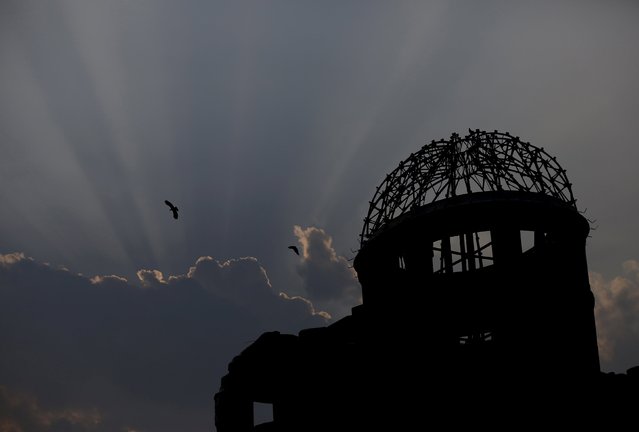
Birds fly over the Atomic Bomb Dome in Hiroshima, western Japan July 29, 2015. On August 6, 1945, the U.S. dropped the atomic bomb on Hiroshima, killing about 140,000 by the end of the year in a city of 350,000 residents, in the world's first nuclear attack. (Photo by Issei Kato/Reuters)

Birds fly over the Atomic Bomb Dome in Hiroshima, western Japan July 29, 2015. On August 6, 1945, the U.S. dropped the atomic bomb on Hiroshima, killing about 140,000 by the end of the year in a city of 350,000 residents, in the world's first nuclear attack. Three days later, a second atomic bomb was dropped on Nagasaki. Influenced by the shadows scorched into outdoor surfaces by the heat of the blasts 70 years ago, Reuters photographer Issei Kato pays homage to survivors, residents and historic buildings in both cities in a personal project that captures the shadows of today. (Photo by Issei Kato/Reuters)
Details
04 Aug 2015 12:01:00
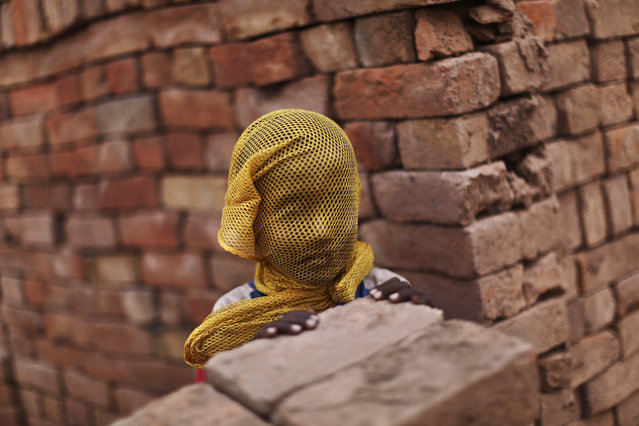
A Pakistani boy who lives near by a brick factory, covers his face with a scarf to avoid a sand storm, on the outskirts of Islamabad, Pakistan, Wednesday, June 6, 2012. (Photo by Muhammed Muheisen/AP Photo)

“Muhammed’s work has received many international awards, among others Breaking News Pulitzer Prize of 2005 for covering war in Iraq, POYI, Picture of the year 2007, of Saudi Arabia of the Annual Muslim pilgrimage, best Multimedia of the Annual Israeli photo contest of 2007, honorable mention Atlanta photojournalism seminar of 2008 and photo of the year of the Annual Israeli photo contest of 2008 with two first prizes and two second prizes in different categories, two prizes in the Atlanta photojournalism seminar of 2009, 6 prizes in the Annual Israeli photo contest of 2009”. – Associated Press
Details
11 Aug 2014 11:22:00