Loading...
Done
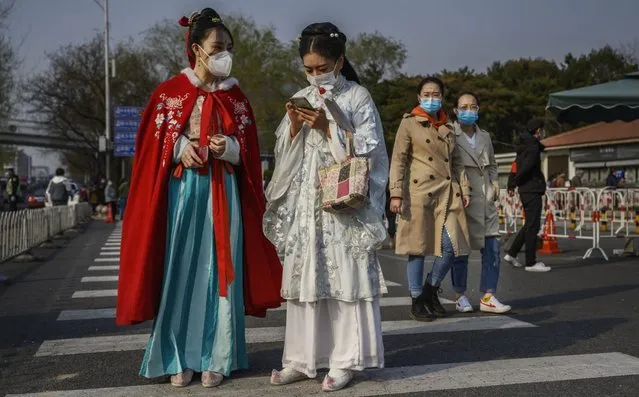
Chinese women wear protective masks as they are dressed in traditional clothing from the Qing Dynasty era outside a park on March 29, 2020 in Beijing, China. A limited section of the iconic tourist site was re-opened to the public this week allowing a smaller number of visitors to reserve tickets online in advance and to enter after passing health screening. With the pandemic hitting hard across the world, China recorded its first day with no new domestic cases of the coronavirus last week, since the government imposed sweeping measures to keep the disease from spreading. For two months, millions of people across China have been restricted in how they move from their homes, while other cities have been locked down in ways that appeared severe at the time but are now being replicated in other countries trying to contain the virus. Officials believe the worst appears to be over in China, though there are concerns of another wave of infections as the government attempts to reboot the worlds second largest economy. In Beijing, it is mandatory to wear masks outdoors, retail stores operate on reduced hours, restaurants employ social distancing among patrons, and tourist attractions at risk of drawing large crowds remain closed. Monitoring and enforcement of virus-related measures and the quarantine of anyone arriving to Beijing is carried out by neighborhood committees and a network of Communist Party volunteers who wear red arm bands. A primary concern for Chinese authorities remains the arrival of flights from Europe and elsewhere, given the exposure of passengers in regions now regarded as hotbeds for transmission. Since January, China has recorded more than 81,000 cases of COVID-19 and at least 3200 deaths, mostly in and around the city of Wuhan, in central Hubei province, where the outbreak first started. (Photo by Kevin Frayer/Getty Images)

Chinese women wear protective masks as they are dressed in traditional clothing from the Qing Dynasty era outside a park on March 29, 2020 in Beijing, China. A limited section of the iconic tourist site was re-opened to the public this week allowing a smaller number of visitors to reserve tickets online in advance and to enter after passing health screening. (Photo by Kevin Frayer/Getty Images)
Details
01 Apr 2020 00:05:00
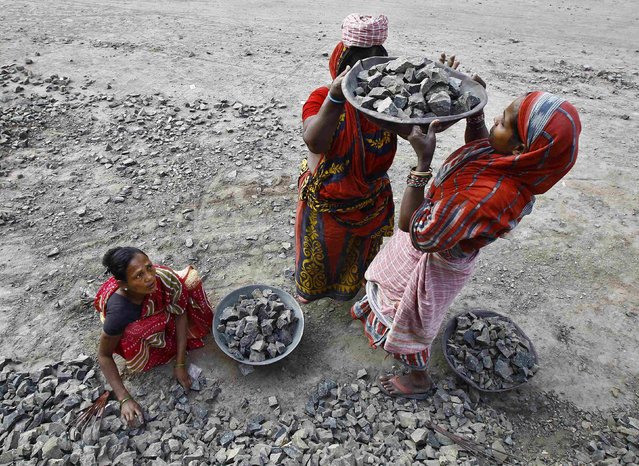
Women labourers work at the construction site of a road in Kolkata January 8, 2015. Across towns and cities in India, it is not uncommon to see women cleaning building sites, carrying bricks and or shoveling gravel - helping construct the infrastructure necessary for the country's economic and social development. (Photo by Rupak De Chowdhuri/Reuters)

Women labourers work at the construction site of a road in Kolkata January 8, 2015. Across towns and cities in India, it is not uncommon to see women cleaning building sites, carrying bricks and or shoveling gravel – helping construct the infrastructure necessary for the country's economic and social development. They help build roads, railway tracks, airports, and offices. They lay pipes for clean water supplies, cables for telecommunications, and dig the drains for sewage systems. But although women make up at least 20 percent of India's 40 million construction workers, they are less recognized than male workers with lower pay and often prone to safety hazards and sexual harassment. They are often unaware of their rights or scared to complain, say activists now trying to campaign for better treatment of women in the construction industry. (Photo by Rupak De Chowdhuri/Reuters)

Details
15 Jan 2015 13:47:00
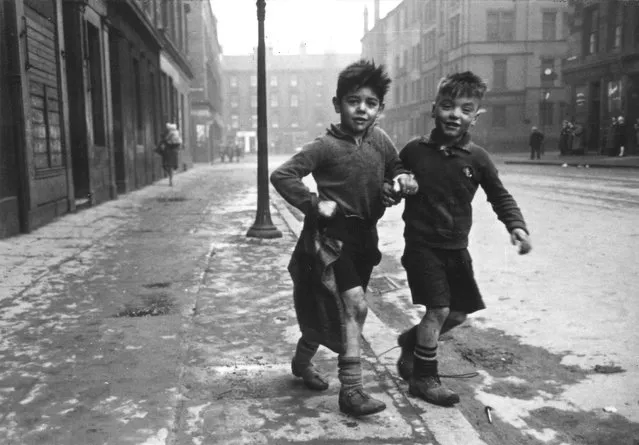
Two boys in the Gorbals area of Glasgow, UK on January 31, 1948. The Gorbals tenements were built quickly and cheaply in the 1840s, providing housing for Glasgow's burgeoning population of industrial workers. Conditions were appalling; overcrowding was standard and sewage and water facilities inadequate. The tenements housed about 40,000 people with up to eight family members sharing a single room, 30 residents sharing a toilet and 40 sharing a tap. By the time this photograph was taken 850 tenements had been demolished since 1920. Redevelopment of the area began in the late 1950s and the tenements were replaced with a modern tower block complex in the sixties. (Photo by Bert Hardy/Getty Images)

Two boys in the Gorbals area of Glasgow, UK on January 31, 1948. The Gorbals tenements were built quickly and cheaply in the 1840s, providing housing for Glasgow's burgeoning population of industrial workers. Conditions were appalling; overcrowding was standard and sewage and water facilities inadequate. The tenements housed about 40,000 people with up to eight family members sharing a single room, 30 residents sharing a toilet and 40 sharing a tap. By the time this photograph was taken 850 tenements had been demolished since 1920. Redevelopment of the area began in the late 1950s and the tenements were replaced with a modern tower block complex in the sixties. (Photo by Bert Hardy/Getty Images)
Details
09 Mar 2017 00:03:00
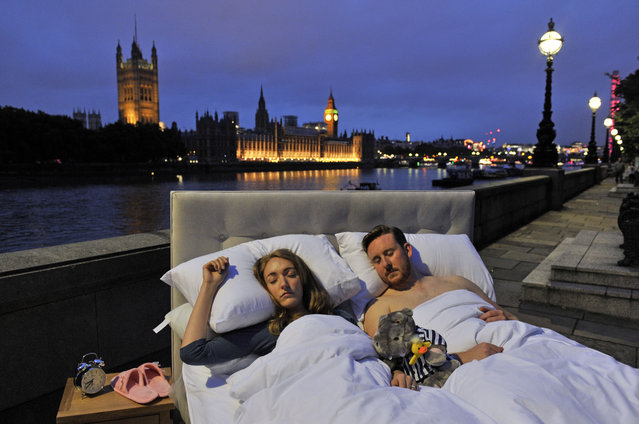
Londoners enjoy a “Silent Night” as Big Ben falls silent, London, UK on August 21, 2017. Londoners snuggle up to enjoy the city's first silent night as Big Ben chimed its last for four years. As the sun set over London last night the city bid a temporary farewell to the chimes of its beloved Big Ben. Londoners were testing out the new quiet of the Southbank in an unusual fashion. A luxurious bed, courtesy of bed firm, Silentnight, complete with fluffy white duvet, plump pillows, a hot water bottle and a cuddly toy, emerged in the heart of the city, just in time for bed. It didn't take local residents and workers long to make the most of the peace and quiet with the city's tired workers climbing in for a nap. Rose Allerston from Clapham, London said “After a stressful day in the office, I couldn't think of anything better than going home and climbing into bed - but when I saw this bed opposite Big Ben I just couldn't resist getting in for a snuggle”. (Photo by Imagewise Ltd/Rex Features/Shutterstock)

Londoners enjoy a “Silent Night” as Big Ben falls silent, London, UK on August 21, 2017. ose Allerston from Clapham, London said “After a stressful day in the office, I couldn't think of anything better than going home and climbing into bed – but when I saw this bed opposite Big Ben I just couldn't resist getting in for a snuggle”. (Photo by Imagewise Ltd/Rex Features/Shutterstock)
Details
23 Aug 2017 08:44:00
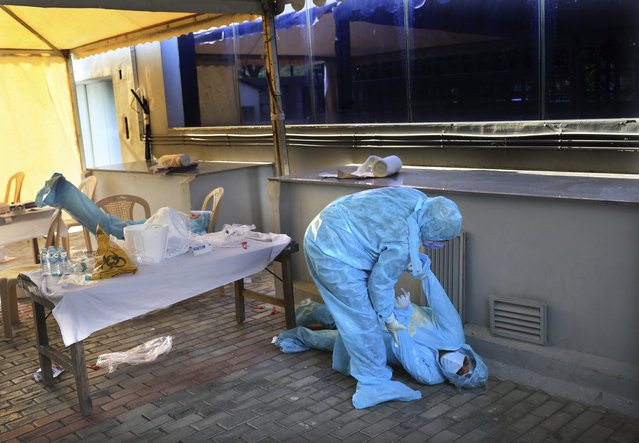
In this April 27, 2020 photo, a health worker helps another as she fainted because of exhaustion and long working hours during a swab test drive for COVID 19, in New Delhi, India. Two and a half months of nationwide lockdown kept numbers of infections relatively low in India. But with restrictions easing in recent weeks, cases have shot up, raising questions about whether authorities have done enough to avert catastrophe. Half of Delhi’s 8,200 hospital beds dedicated to COVID-19 patients are already full and officials are projecting more than half a million cases in the city alone by July 31. (Photo by Manish Swarup/AP Photo)

In this April 27, 2020 photo, a health worker helps another as she fainted because of exhaustion and long working hours during a swab test drive for COVID 19, in New Delhi, India. Two and a half months of nationwide lockdown kept numbers of infections relatively low in India. But with restrictions easing in recent weeks, cases have shot up, raising questions about whether authorities have done enough to avert catastrophe. Half of Delhi’s 8,200 hospital beds dedicated to COVID-19 patients are already full and officials are projecting more than half a million cases in the city alone by July 31. (Photo by Manish Swarup/AP Photo)
Details
08 Jan 2021 00:01:00
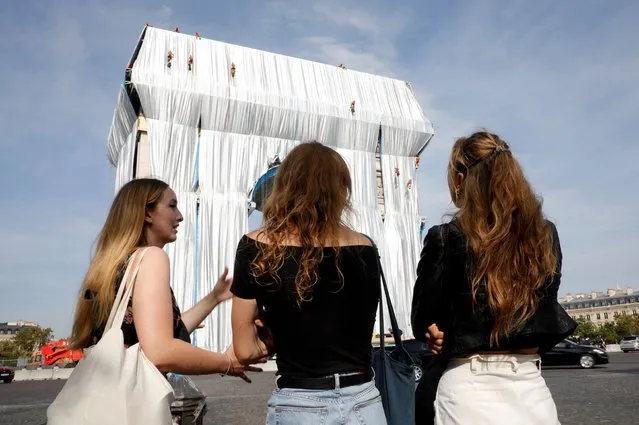
Bystanders look on as workers arrange silver blue fabric, part of the process of wrapping L'Arc de Triomphe in Paris on September 13, 2021, designed by the late artist Christo. Work has begun on wrapping the Arc de Triomphe in Paris in silvery-blue fabric as a posthumous tribute to the artist Christo, who had dreamt of the project for decades. Bulgarian-born Christo, a longtime Paris resident, had plans for sheathing the imposing war memorial at the top of the Champs-Elysees while renting an apartment near it in the 1960s (Photo by Geoffroy Van der Hasselt/AFP Photo)

Bystanders look on as workers arrange silver blue fabric, part of the process of wrapping L'Arc de Triomphe in Paris on September 13, 2021, designed by the late artist Christo. Work has begun on wrapping the Arc de Triomphe in Paris in silvery-blue fabric as a posthumous tribute to the artist Christo, who had dreamt of the project for decades. Bulgarian-born Christo, a longtime Paris resident, had plans for sheathing the imposing war memorial at the top of the Champs-Elysees while renting an apartment near it in the 1960s (Photo by Geoffroy Van der Hasselt/AFP Photo)
Details
01 May 2022 04:48:00
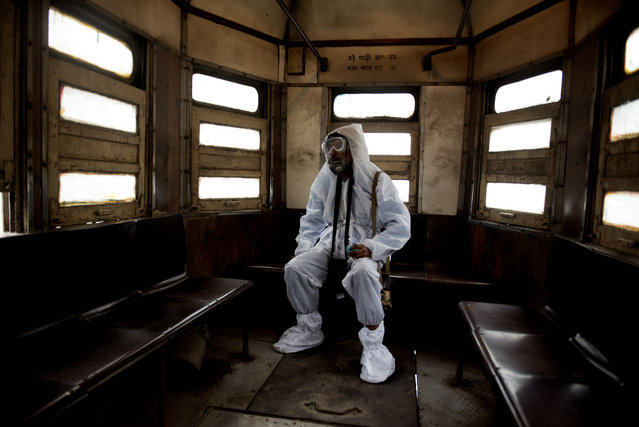
Fighting Infections (single image) | Fighting Pandemic by Sudipto Das. “It’s exhausting. A tram conductor in Kolkata, India, wears protective clothing from head to toe even in the heat of a summer afternoon. This was when restrictions were easing after India’s first Covid-19 lockdown – public transport was running, but staff were advised to suit up like this. We’ve all grown used to saluting the efforts of healthcare workers, but plenty of other people in public-facing jobs have performed gruelling duties too to keep people safe”. (Photo by Sudipto Das/Wellcome Photography Prize 2021)

Fighting Infections (single image) | Fighting Pandemic by Sudipto Das. “It’s exhausting. A tram conductor in Kolkata, India, wears protective clothing from head to toe even in the heat of a summer afternoon. This was when restrictions were easing after India’s first Covid-19 lockdown – public transport was running, but staff were advised to suit up like this. We’ve all grown used to saluting the efforts of healthcare workers, but plenty of other people in public-facing jobs have performed gruelling duties too to keep people safe”. (Photo by Sudipto Das/Wellcome Photography Prize 2021)
Details
29 Jun 2021 09:49:00


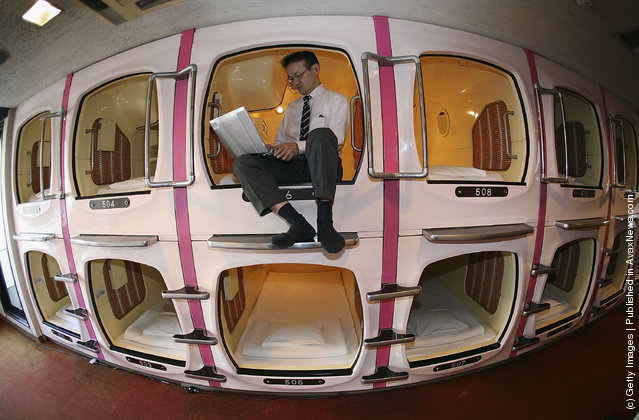
A visitor relaxes in a sleeping module at Tokyo's tube Hotel “Capsule Inn Akihabara” on February 6, 2007 in Tokyo, Japan. The two-square-meter sleep modules are equipped with a TV, Radio and Wireless LAN and are priced at 3500 yen per night. Uptil recently it has mainly been the office workers who stay at such tube hotels when they cannot go home, but recently they are attracting many foreign travellers due to their Japanese style. (Photo by Koichi Kamoshida/Getty Images)
Details
20 May 2011 08:50:00