Loading...
Done
The battleship USS Iowa fires its 16-inch guns during duty in the Persian Gulf on December 16, 1987. In 1943, the Iowa ferried President Franklin Roosevelt home from the Teheran Conference, where post-WW II leaders divided up the world. The ship fought battles from the South Pacific to Korea and escorted convoys through the Persian Gulf. Forty-seven sailors died atop its deck when an explosion ripped through a gun turret. Now, the new port for the retired USS Iowa just might be the home of California's annual asparagus festival, the gritty agriculture port town of Stockton on the San Joaquin River, about 80 miles inland from San Francisco. (Photo by Eric Risberg/AP Photo)

The battleship USS Iowa fires its 16-inch guns during duty in the Persian Gulf on December 16, 1987. In 1943, the Iowa ferried President Franklin Roosevelt home from the Teheran Conference, where post-WW II leaders divided up the world. The ship fought battles from the South Pacific to Korea and escorted convoys through the Persian Gulf. Forty-seven sailors died atop its deck when an explosion ripped through a gun turret. Now, the new port for the retired USS Iowa just might be the home of California's annual asparagus festival, the gritty agriculture port town of Stockton on the San Joaquin River, about 80 miles inland from San Francisco. (Photo by Eric Risberg/AP Photo)
Details
12 Apr 2018 00:05:00
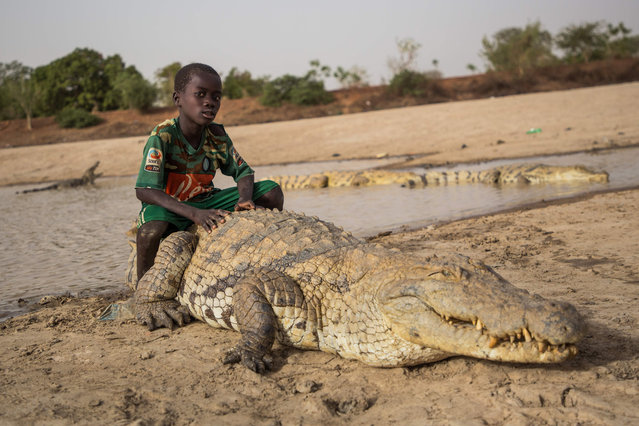
A boy sits on the back of a crocodile on May 19, 2018 at a pond in Bazoule in Burkina Faso, a village which happily shares its local pond with “sacred” crocodiles. Crocodiles may be one of the deadliest hunters in the animal kingdom, but in a small village in Burkina Faso it is not unusual to see someone sitting atop one of the fearsome reptiles. According to local legend, the startling relationship with the predators dates back to at least the 15 th century. The village was in the grip of an agonising drought until the crocodiles led women to a hidden pond where the population could slake their thirst. (Photo by Olympia de Maismont/AFP Photo)

A boy sits on the back of a crocodile on May 19, 2018 at a pond in Bazoule in Burkina Faso, a village which happily shares its local pond with “sacred” crocodiles. Crocodiles may be one of the deadliest hunters in the animal kingdom, but in a small village in Burkina Faso it is not unusual to see someone sitting atop one of the fearsome reptiles. According to local legend, the startling relationship with the predators dates back to at least the 15 th century. The village was in the grip of an agonising drought until the crocodiles led women to a hidden pond where the population could slake their thirst. (Photo by Olympia de Maismont/AFP Photo)
Details
17 Jul 2018 00:01:00
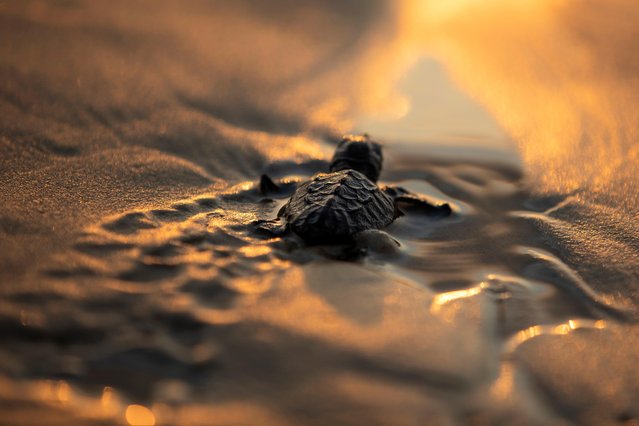
A newly-hatched baby sea turtle makes its way into the Mediterranean Sea for the first time, as part of the Israeli Sea Turtle Rescue Center's conservation program, at a beach near Mikhmoret north of Tel Aviv, Israel September 9, 2019. Green turtles are endangered worldwide, the World Wildlife Fund says. Among other hazards, they are threatened by hunting, human encroachment on the beaches where they nest, and pollution of their feeding grounds offshore. According to the Israeli rescue center, only about 20 female green turtles nest along the Israeli Mediterranean coast during a breeding season that usually lasts from May until August. (Photo by Amir Cohen/Reuters)

A newly-hatched baby sea turtle makes its way into the Mediterranean Sea for the first time, as part of the Israeli Sea Turtle Rescue Center's conservation program, at a beach near Mikhmoret north of Tel Aviv, Israel September 9, 2019. Green turtles are endangered worldwide, the World Wildlife Fund says. Among other hazards, they are threatened by hunting, human encroachment on the beaches where they nest, and pollution of their feeding grounds offshore. According to the Israeli rescue center, only about 20 female green turtles nest along the Israeli Mediterranean coast during a breeding season that usually lasts from May until August. (Photo by Amir Cohen/Reuters)
Details
27 Sep 2019 00:05:00
People release floating lanterns during the festival of Yee Peng in the northern capital of Chiang Mai, Thailand November 14, 2016. Yi Peng refers to the full moon day in the second month according to the Lanna lunar calendar (the twelfth month according to the Thai lunar calendar). Swarms of Lanna-style sky lanterns are launched into the air where they resemble large shoals of giant fluorescent jellyfish gracefully floating through the sky. The festival is meant as a time for tham bun, to make merit. Khom loi are made from a thin fabric, such as rice paper, stretched over a bamboo or wire frame, to which a candle or fuel cell is attached. When the fuel cell is lit, the resulting hot air is trapped inside the lantern and creates enough lift for the khom loi to float up into the sky. (Photo by Athit Perawongmetha/Reuters)

People release floating lanterns during the festival of Yee Peng in the northern capital of Chiang Mai, Thailand November 14, 2016. Yi Peng refers to the full moon day in the second month according to the Lanna lunar calendar (the twelfth month according to the Thai lunar calendar). Swarms of Lanna-style sky lanterns are launched into the air where they resemble large shoals of giant fluorescent jellyfish gracefully floating through the sky. The festival is meant as a time for tham bun, to make merit. Khom loi are made from a thin fabric, such as rice paper, stretched over a bamboo or wire frame, to which a candle or fuel cell is attached. When the fuel cell is lit, the resulting hot air is trapped inside the lantern and creates enough lift for the khom loi to float up into the sky. (Photo by Athit Perawongmetha/Reuters)
Details
15 Nov 2016 11:54:00
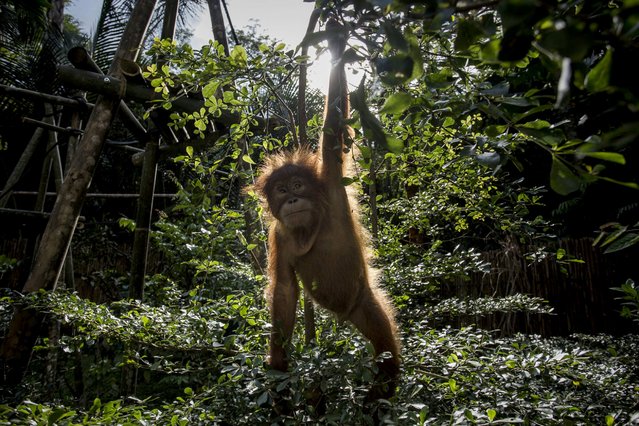
A Baby sumatran orangutan (Pongo abelii) plays around in a tree as they train at Sumatran Orangutan Conservation Programme's rehabilitation center on November 12, 2016 in Kuta Mbelin, North Sumatra, Indonesia. The Orangutans in Indonesia have been known to be on the verge of extinction as a result of deforestation and poaching. Found mostly in South-East Asia, where they live on the islands of Sumatra and Borneo, the endangered species continue to lose their habitat as a result of corporate expansion in a developing economy. Indonesia approved palm oil concessions on nearly 15 million acres of peatlands over the past years and thousands of square miles have been cleared for plantations, including the lowland areas that are the prime habitat for orangutans. (Photo by Ulet Ifansasti/Getty Images)

A Baby sumatran orangutan (Pongo abelii) plays around in a tree as they train at Sumatran Orangutan Conservation Programme's rehabilitation center on November 12, 2016 in Kuta Mbelin, North Sumatra, Indonesia. The Orangutans in Indonesia have been known to be on the verge of extinction as a result of deforestation and poaching. Found mostly in South-East Asia, where they live on the islands of Sumatra and Borneo, the endangered species continue to lose their habitat as a result of corporate expansion in a developing economy. Indonesia approved palm oil concessions on nearly 15 million acres of peatlands over the past years and thousands of square miles have been cleared for plantations, including the lowland areas that are the prime habitat for orangutans. (Photo by Ulet Ifansasti/Getty Images)
Details
16 Nov 2016 11:14:00
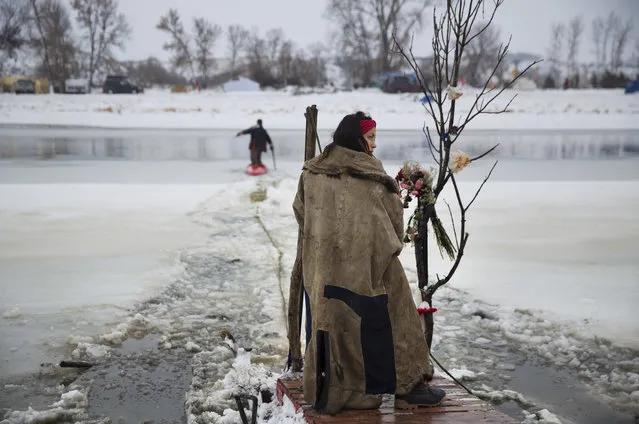
In this Thursday, December 1, 2016 photo, Cat Bigney, part of the Oglala Native American tribe, waits on the shore of the Cannonball river for travelers to arrive by canoe at the Oceti Sakowin camp where people have gathered to protest the Dakota Access oil pipeline in Cannon Ball, N.D. So far, those at the camp have shrugged off the heavy snow, icy winds and frigid temperatures. But if they defy next week's government deadline to abandon the camp, demonstrators know the real deep freeze lies ahead. Life-threatening wind chills and towering snow drifts could mean the greatest challenge is simple survival. (Photo by David Goldman/AP Photo)

In this Thursday, December 1, 2016 photo, Cat Bigney, part of the Oglala Native American tribe, waits on the shore of the Cannonball river for travelers to arrive by canoe at the Oceti Sakowin camp where people have gathered to protest the Dakota Access oil pipeline in Cannon Ball, N.D. So far, those at the camp have shrugged off the heavy snow, icy winds and frigid temperatures. But if they defy next week's government deadline to abandon the camp, demonstrators know the real deep freeze lies ahead. Life-threatening wind chills and towering snow drifts could mean the greatest challenge is simple survival. (Photo by David Goldman/AP Photo)
Details
06 Dec 2016 10:22:00
Police officers take cover as they clash with protesters after an officer shot and killed a black man in Brooklyn Center, Minneapolis, Minnesota on April 11,2021. Protests broke out April 11, 2021 night after US police fatally shot a young Black man in a suburb of Minneapolis – where a former police officer is currently on trial for the murder of George Floyd. Hundreds of people gathered outside the police station in Brooklyn Center, northwest of Minneapolis. Police fired teargas and flash bangs at the demonstrators, according to an AFP videojournalist at the scene. (Photo by Kerem Yucel/AFP Photo)

Police officers take cover as they clash with protesters after an officer shot and killed a black man in Brooklyn Center, Minneapolis, Minnesota on April 11,2021. Protests broke out April 11, 2021 night after US police fatally shot a young Black man in a suburb of Minneapolis – where a former police officer is currently on trial for the murder of George Floyd. Hundreds of people gathered outside the police station in Brooklyn Center, northwest of Minneapolis. Police fired teargas and flash bangs at the demonstrators, according to an AFP videojournalist at the scene. (Photo by Kerem Yucel/AFP Photo)
Details
15 Apr 2021 09:10:00
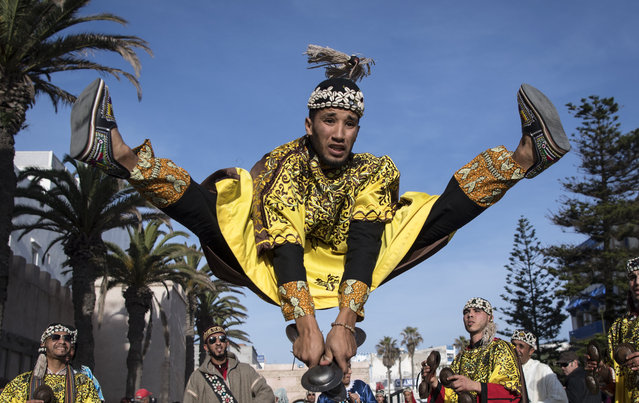
A Gnawa traditional group performs in the city of Essaouira on December 14, 2019, to celebrate the decision of adding the Gnawa culture to UNESCO's list of Intangible Cultural Heritage of Humanity. Gnawa culture, a centuries-old Moroccan practice rooted in music, African rituals and Sufi traditions, was added to UNESCO's list of Intangible Cultural Heritage of Humanity earlier in the week. Gnawa refers to a “set of musical productions, fraternal practices and therapeutic rituals where the secular mixes with the sacred”, according to the nomination submitted by Morocco. Often dressed in colourful outfits, Gnawa musicians play the guenbri, a type of lute with three strings, accompanied by steel castanets called krakebs. (Photo by Fadel Senna/AFP Photo)

A Gnawa traditional group performs in the city of Essaouira on December 14, 2019, to celebrate the decision of adding the Gnawa culture to UNESCO's list of Intangible Cultural Heritage of Humanity. Gnawa culture, a centuries-old Moroccan practice rooted in music, African rituals and Sufi traditions, was added to UNESCO's list of Intangible Cultural Heritage of Humanity earlier in the week. Gnawa refers to a “set of musical productions, fraternal practices and therapeutic rituals where the secular mixes with the sacred”, according to the nomination submitted by Morocco. Often dressed in colourful outfits, Gnawa musicians play the guenbri, a type of lute with three strings, accompanied by steel castanets called krakebs. (Photo by Fadel Senna/AFP Photo)
Details
18 Dec 2019 00:05:00