Loading...
Done
A Muslim worshipper attends a  mass prayer against COVID-19, the new coronavirus, in Dakar on March 4, 2020, after two cases were confirmed in Senegal in the previous days. Across the world, 3,155 people have died from the virus. More than 92,723 have been infected in 78 countries and territories, according to AFP's latest toll based on official sources at 1700 GMT on March 3, 2020. (Photo by John Wessels/AFP Photo)

A Muslim worshipper attends a mass prayer against COVID-19, the new coronavirus, in Dakar on March 4, 2020, after two cases were confirmed in Senegal in the previous days. Across the world, 3,155 people have died from the virus. More than 92,723 have been infected in 78 countries and territories, according to AFP's latest toll based on official sources at 1700 GMT on March 3, 2020. (Photo by John Wessels/AFP Photo)
Details
26 Mar 2020 00:01:00
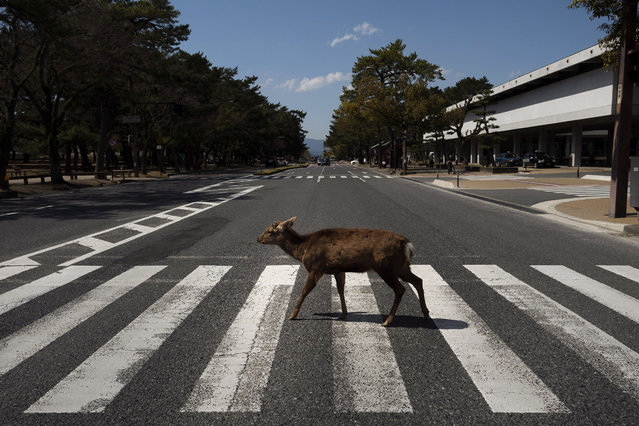
A deer walks across a pedestrian crossing in Nara, Japan, Thursday, March 19, 2020. More than 1,000 deer roam free in the ancient capital city of Japan. Despite the town's tourism decline, these wild animals are doing just fine without treats from tourists, according to a deer protection group. (Photo by Jae C. Hong/AP Photo)

A deer walks across a pedestrian crossing in Nara, Japan, Thursday, March 19, 2020. More than 1,000 deer roam free in the ancient capital city of Japan. Despite the town's tourism decline, these wild animals are doing just fine without treats from tourists, according to a deer protection group. (Photo by Jae C. Hong/AP Photo)
Details
31 Mar 2020 00:01:00
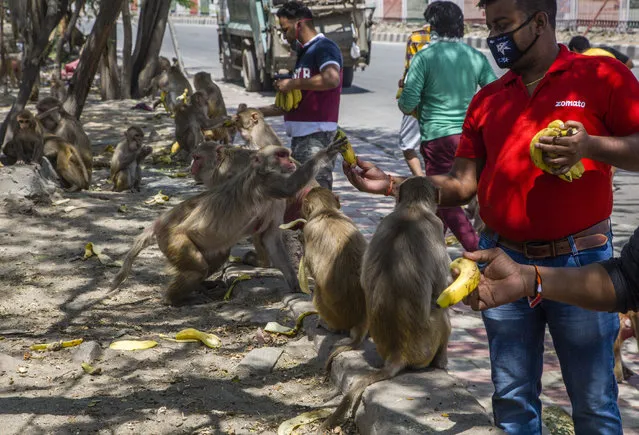
Men give bananas to monkeys gathered on the side of the road as India remains under an unprecedented lockdown over the highly contagious coronavirus (COVID-19) on April 08, 2020 in New Delhi, India. Wild animals, including monkeys, are roaming human settlements in India as people are staying indoors due to the 21-day lockdown. With India's 1.3 billion population and tens of millions of cars off the roads, wildlife is moving towards areas inhabited by humans. Wild animals in many countries have been seen roaming streets. A study says some 60 percent of the new diseases found around the globe every year are zoonotic, meaning they originate in animals and are passed on to humans. COVID-19 is a zoonotic disease that is suspected to have come from the wet markets of Wuhan, China. (Photo by Yawar Nazir/Getty Images)

Men give bananas to monkeys gathered on the side of the road as India remains under an unprecedented lockdown over the highly contagious coronavirus (COVID-19) on April 08, 2020 in New Delhi, India. Wild animals, including monkeys, are roaming human settlements in India as people are staying indoors due to the 21-day lockdown. (Photo by Yawar Nazir/Getty Images)
Details
12 Apr 2020 00:05:00
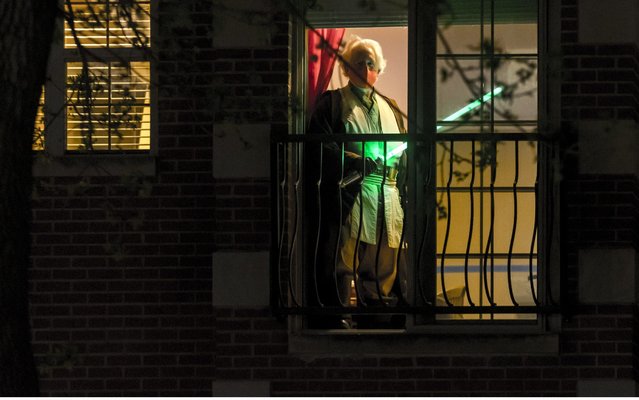
Jedi Ambassador of The Chicago Jedi, Dan McCann, 56, standing in his window in Chicago, Illinois on May 3, 2020. Normally, Dan would be preparing for The Galactic Battle For Chi-Town, a yearly mock Lightsaber battle in Chicago, which this year is being done via selfies shared over Facebook due to Illinois and Chicago's Stay At Home order. (Photo by Chris Riha/ZUMA Wire/Rex Features/Shutterstock)

Jedi Ambassador of The Chicago Jedi, Dan McCann, 56, standing in his window in Chicago, Illinois on May 3, 2020. Normally, Dan would be preparing for The Galactic Battle For Chi-Town, a yearly mock Lightsaber battle in Chicago, which this year is being done via selfies shared over Facebook due to Illinois and Chicago's Stay At Home order. (Photo by Chris Riha/ZUMA Wire/Rex Features/Shutterstock)
Details
11 May 2020 00:03:00
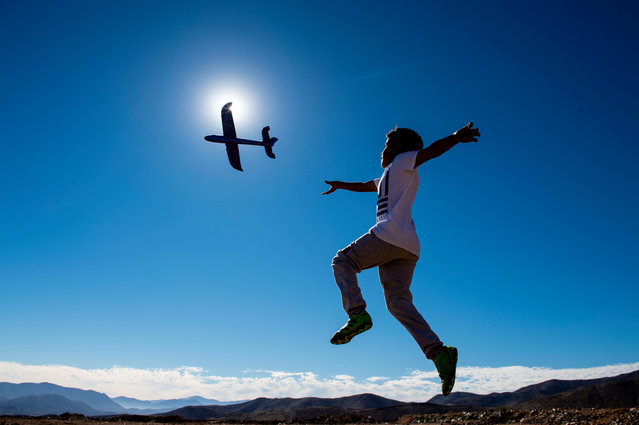
A boy plays with a toy plane on the eve of a solar eclipse, in La Higuera, Coquimbo Region, in the Atacama desert about 580 km north of Santiago, on July 1, 2019. A total solar eclipse will be visible from small parts of Chile and Argentina on July 2. (Photo by Martin Bernetti/AFP Photo)

A boy plays with a toy plane on the eve of a solar eclipse, in La Higuera, Coquimbo Region, in the Atacama desert about 580 km north of Santiago, on July 1, 2019. A total solar eclipse will be visible from small parts of Chile and Argentina on July 2. (Photo by Martin Bernetti/AFP Photo)
Details
14 May 2020 00:03:00
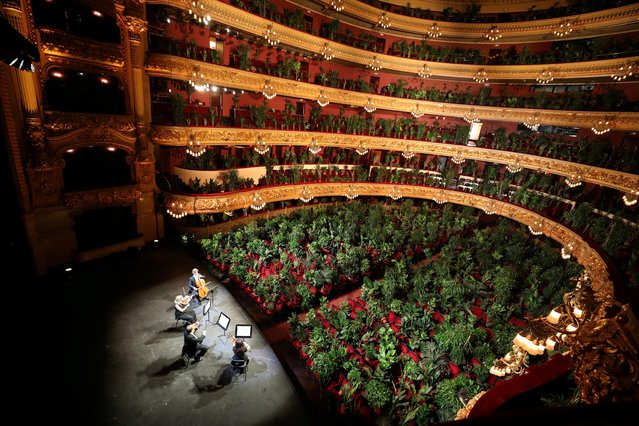
Nursery plants are seen placed in people's seats during a rehearsal as Barcelona's Gran Teatre del Liceu opera reopens its doors with a concert for plants, to raise awareness about the importance of an audience after the coronavirus lockdown, in Barcelona, Spain on June 22, 2020. The Gran Teatre del Liceu reopens its doors, in which the 2,292 seats of the auditorium will be occupied on this occasion by plants. It will be on 22 June, broadcast live online, when the UceLi Quartet string quartet performs Puccini's “Crisantemi” for this verdant public, brought in from local nurseries. (Photo by Nacho Doce/Reuters)

Nursery plants are seen placed in people's seats during a rehearsal as Barcelona's Gran Teatre del Liceu opera reopens its doors with a concert for plants, to raise awareness about the importance of an audience after the coronavirus lockdown, in Barcelona, Spain on June 22, 2020. The Gran Teatre del Liceu reopens its doors, in which the 2,292 seats of the auditorium will be occupied on this occasion by plants. It will be on 22 June, broadcast live online, when the UceLi Quartet string quartet performs Puccini's “Crisantemi” for this verdant public, brought in from local nurseries. (Photo by Nacho Doce/Reuters)
Details
24 Jun 2020 00:07:00
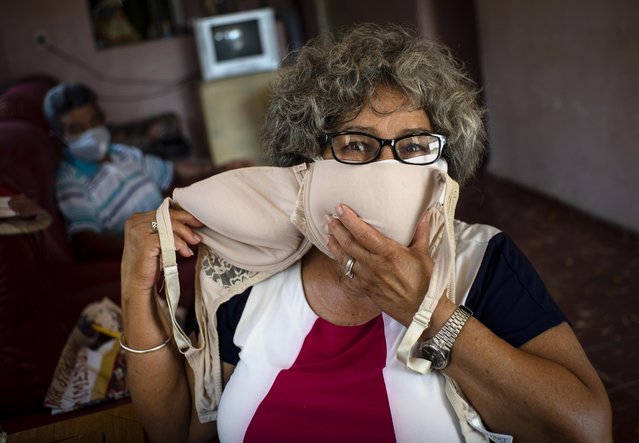
Idania Espanola, 63, poses for a photo showing a bra that she will adapt into two face masks, amid the spread of the new coronavirus in Cojimar, Cuba, east of Havana, Tuesday, March 31, 2020. (Photo by Ramon Espinosa/AP Photo)

Idania Espanola, 63, poses for a photo showing a bra that she will adapt into two face masks, amid the spread of the new coronavirus in Cojimar, Cuba, east of Havana, Tuesday, March 31, 2020. (Photo by Ramon Espinosa/AP Photo)
Details
03 Jul 2020 00:01:00
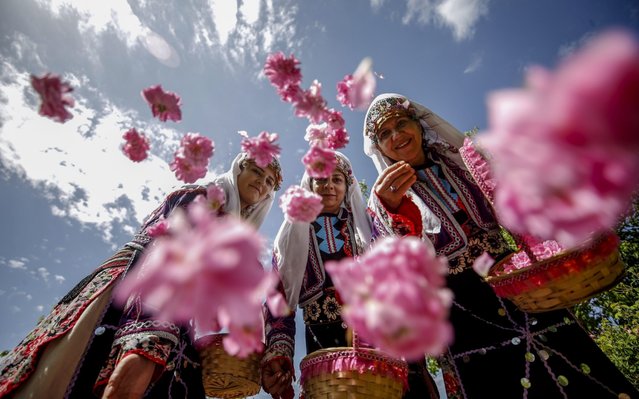
Women, with traditional clothes, collect rose petals at a rose field during rose harvesting season in Isparta, Turkey on June 17, 2020. The collected roses are exported to world wide known perfume factories, especially French companies, after the some process at the factories. Women wear traditional clothes to promote rose harvest with the support of Isparta Municipality. (Photo by Mustafa Ciftci/Anadolu Agency via Getty Images)

Women, with traditional clothes, collect rose petals at a rose field during rose harvesting season in Isparta, Turkey on June 17, 2020. The collected roses are exported to world wide known perfume factories, especially French companies, after the some process at the factories. Women wear traditional clothes to promote rose harvest with the support of Isparta Municipality. (Photo by Mustafa Ciftci/Anadolu Agency via Getty Images)
Details
04 Jul 2020 00:03:00