Folk dancers in Ahmedabad, western India, rehearsing on September 14, 2025 for the Hindu festival of Navaratri, which begins next week. (Photo by Sam Panthaky/Getty Images)
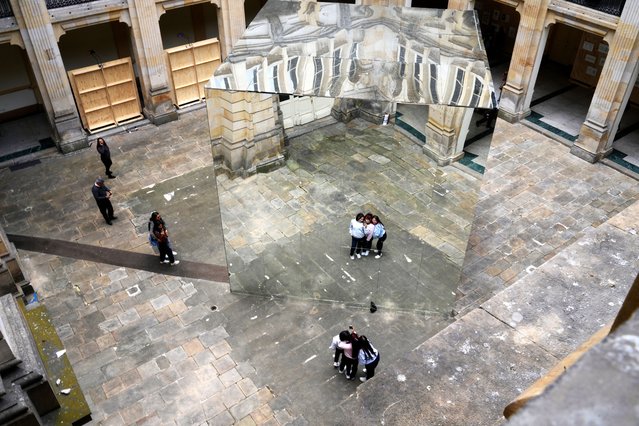
A trio poses for a photo in front of the art installation Surrender (Flag) by John Gerrard of Ireland displayed in a courtyard of the Palacio de San Francisco, as part of the first art biennial in Bogota, Colombia, Tuesday, September 23, 2025. (Photo by Fernando Vergara/AP Photo)
Participants compete in the High-Heels Race as part of the Pride celebrations, in the Chueca neighbourhood in Madrid on July 4 29, 2024. MADO (Madrid Pride) is a series of street celebrations that take place during the city´s LGBTIQ (lesbian, gay, bisеxual, transgender, intersеx and queer) Pride week. (Photo by Óscar del Pozo/AFP Photo)
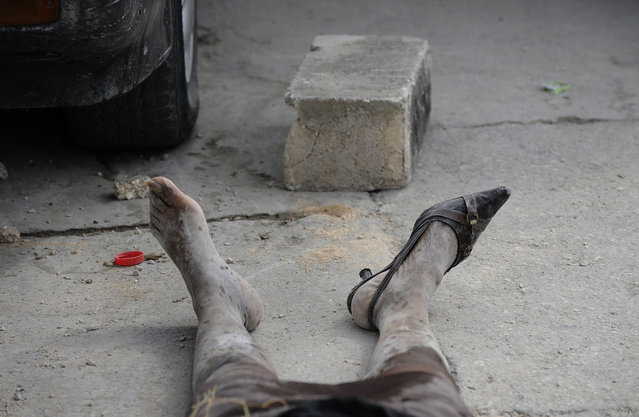
In this photo submitted by the Washington Post tilted “The Moment Time Stopped”, survivors piled bodies of the dead outside for weeks after earthquake on January 14, 2010 in Port-au-Prince, Haiti. The 7.0 magnitude earthquake struck in 2010, and the Haitian government has said more than 300,000 people were killed. The exact toll is unknown because there was no systematic effort to count bodies among the chaos and destruction. (Photo by Carol Guzy/AP Photo/The Washington Post)
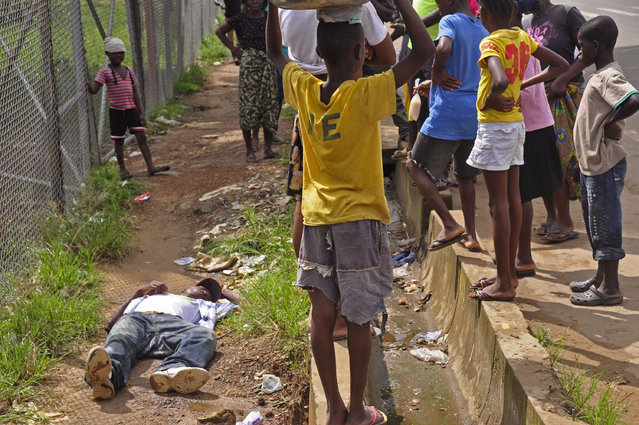
Children surround a man, left, that fell down while walking on a street suspected of having contracted the Ebola virus in the city of Monrovia, Liberia, Tuesday, August 19, 2014. The World Health Organization says the outbreak has killed more than 1,200 people, while authorities struggle to contain its spread and treat the sick. (Photo by Abbas Dulleh/AP Photo)
A demonstrator with face painted in the colours of the Palestinian flag protests outside the Israeli Embassy in west London July 26, 2014. Foreign ministers from the United States, Europe and the Middle East called on Saturday for an extension of the 12-hour ceasefire between Israel and Hamas in the Gaza Strip, French Foreign Minister Laurent Fabius said. (Photo by Luke MacGregor/Reuters)
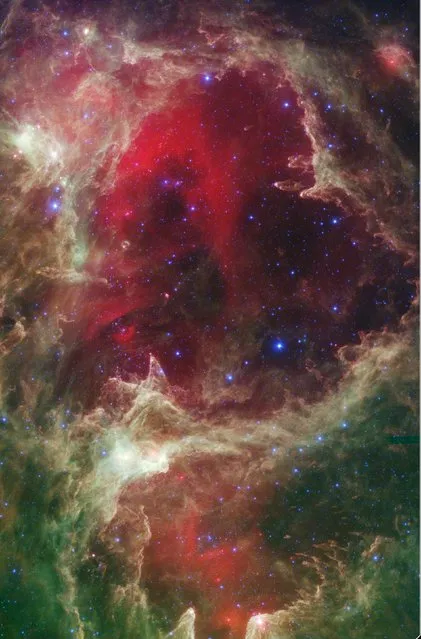
An infrared portrait from NASA's Spitzer Space Telescope which shows generations of stars is seen in this undated NASA handout image released February 14, 2013. In this wispy star-forming region, called W5, the oldest stars can be seen as blue dots in the centers of the two hollow cavities (other blue dots are background and foreground stars not associated with the region). Red shows heated dust that pervades the region's cavities, while green highlights dense clouds. (Photo by NASA/Reuters/JPL-Caltech/Harvard-Smithsonian/Handout)