Loading...
Done
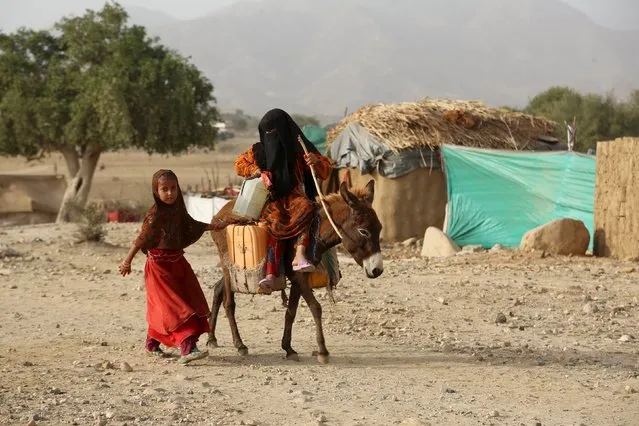
A girl rides a donkey as another walks by at the Shawqaba camp for internally displaced people who were forced to leave their villages by the war in Yemen's northwestern province of Hajjah March 12, 2016. In northwest Yemen, one of the poorest countries in the Middle East, about 400 families uprooted by the war have been stuck in the Shawqaba camp in Hajjah province for the past year. Residents live in poorly built huts that protect them neither from summer heat nor winter cold in a camp that lacks the most basic services. (Photo by Abduljabbar Zeyad/Reuters)

A girl rides a donkey as another walks by at the Shawqaba camp for internally displaced people who were forced to leave their villages by the war in Yemen's northwestern province of Hajjah March 12, 2016. In northwest Yemen, one of the poorest countries in the Middle East, about 400 families uprooted by the war have been stuck in the Shawqaba camp in Hajjah province for the past year. Residents live in poorly built huts that protect them neither from summer heat nor winter cold in a camp that lacks the most basic services. (Photo by Abduljabbar Zeyad/Reuters)
Details
09 Apr 2016 13:16:00
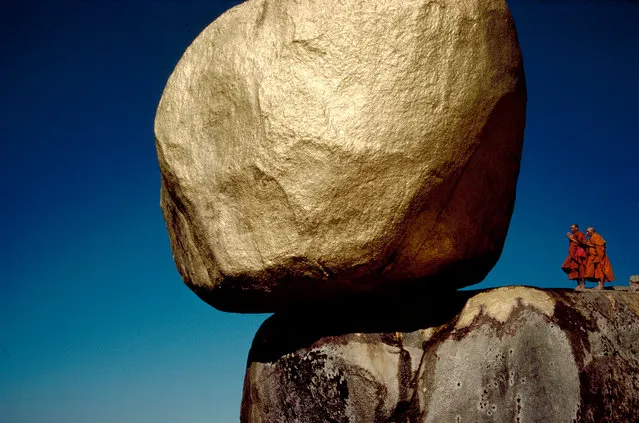
Kyaiktiyo, Burma, 1978. The Golden Rock at Shwe Pyi Daw (the Golden Country), the Buddhist holy place. Hiroji Kubota writes: “I was desperate to keep a distance from America for a while; luckily, I found Burma and its gentle and compassionate people. In the spring of 1978, on the top of the hill where I took this photo, I had two Leica bodies: the one with Tri-X and the other with Kodachrome 64. Soon after, I realised that the colour one looked very colourful and was more powerful. That was my decisive moment, to become a colour photographer”. (Photo by Hiroji Kubota/Magnum Photos)

Kyaiktiyo, Burma, 1978. The Golden Rock at Shwe Pyi Daw (the Golden Country), the Buddhist holy place. Hiroji Kubota writes: “I was desperate to keep a distance from America for a while; luckily, I found Burma and its gentle and compassionate people. In the spring of 1978, on the top of the hill where I took this photo, I had two Leica bodies: the one with Tri-X and the other with Kodachrome 64. Soon after, I realised that the colour one looked very colourful and was more powerful. That was my decisive moment, to become a colour photographer”. (Photo by Hiroji Kubota/Magnum Photos)
Details
10 Jun 2016 13:30:00
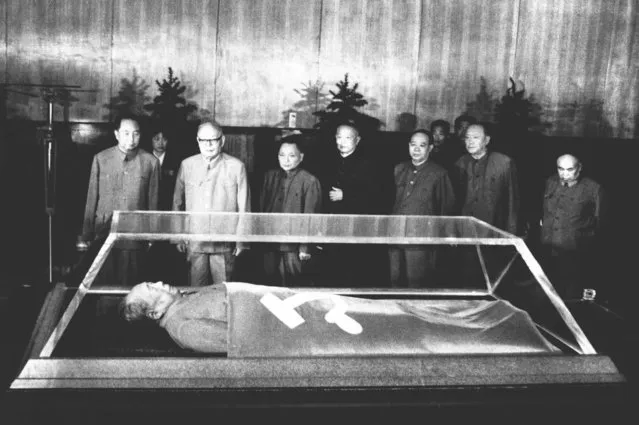
In this September 10, 1977, file photo, from left, Hua Guofeng, Chinese Communist Party (CCP) chairman and Mao Zedong's immediate successor; Ye Jianying, CCP vice chairman and future ceremonial head of state; Deng Xiaoping, no formal titles at the time but soon to emerge as paramount leader during the reform era; Li Xiannian, CCP vice chairman and future president; Wang Dongxing, head of the leadership bodyguard unit who helped topple the Gang of Four, view the body of later Chinese leader Mao Zedong in Beijing. (Photo via AP Photo)

In this September 10, 1977, file photo, from left, Hua Guofeng, Chinese Communist Party (CCP) chairman and Mao Zedong's immediate successor; Ye Jianying, CCP vice chairman and future ceremonial head of state; Deng Xiaoping, no formal titles at the time but soon to emerge as paramount leader during the reform era; Li Xiannian, CCP vice chairman and future president; Wang Dongxing, head of the leadership bodyguard unit who helped topple the Gang of Four, view the body of later Chinese leader Mao Zedong in Beijing. (Photo via AP Photo)
Details
13 Jun 2016 10:34:00
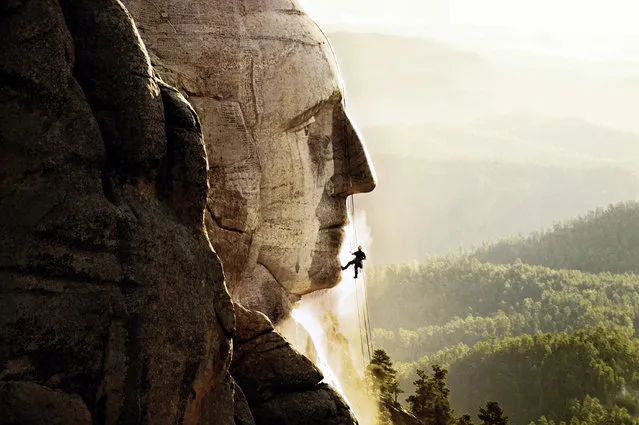
Thorsten Mowes has a more intimate knowledge of the worlds most famous monuments than perhaps anyone else on the planet – because hes spent his entire career cleaning them. As a cultural cleaning expert with nearly 25 years experience, he has been commissioned to make wonders all over the world shine like new - from the London Eye to Christ the Redeemer. The places he has been to, stood on top of, or even hung halfway down include Mount Rushmore and the Space Needle in America, the London Eye, the Statue of Christ in Brazil and the Forbidden City in China. Here: A man cleans a part of Mount Rushmore. (Photo by Caters News Agency)

Thorsten Mowes has a more intimate knowledge of the worlds most famous monuments than perhaps anyone else on the planet – because hes spent his entire career cleaning them. As a cultural cleaning expert with nearly 25 years experience, he has been commissioned to make wonders all over the world shine like new – from the London Eye to Christ the Redeemer. The places he has been to, stood on top of, or even hung halfway down include Mount Rushmore and the Space Needle in America, the London Eye, the Statue of Christ in Brazil and the Forbidden City in China. Here: A man cleans a part of Mount Rushmore. (Photo by Caters News Agency)
Details
29 Jul 2016 12:24:00
Senji Nakajima sleeps with his Love Doll “Saori” at Love Hotel on June 4, 2016 in Nagano, Japan. Senji Nakajima, 61 years old, lives with his life-size 'love doll' named “Saori” in his apartment in Tokyo, Japan. Nakajima, married with two children, who lives away from home for work, first started his life with Saori six years ago. At first, he used to imagine as if the doll was his first girl friend, and used it only for sexual purposes to fill the loneliness, but months later, he started to find Saori actually has an original personality. “She never betrays, not after only money. I'm tired of modern rational humans. They are heartless”, Nakajima says, “for me, she is more than a doll. Not just a silicon rubber. She needs much help, but still is my perfect partner who shares precious moments with me and enriches my life”. (Photo by Taro Karibe/Getty Images)

Senji Nakajima sleeps with his Love Doll “Saori” at Love Hotel on June 4, 2016 in Nagano, Japan. Senji Nakajima, 61 years old, lives with his life-size “love doll” named “Saori” in his apartment in Tokyo, Japan. Nakajima, married with two children, who lives away from home for work, first started his life with Saori six years ago. (Photo by Taro Karibe/Getty Images)
Details
07 Aug 2016 09:21:00
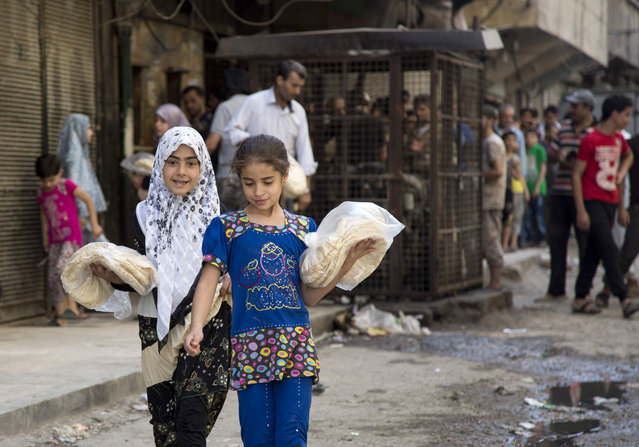
Syrian girls carry bags with bread as people queue up outisde a bakery in a rebel held neighbourhood in the northern city of Aleppo on July 12, 2016. Since mid-2012, Aleppo has been roughly divided between government control in the west and rebel control in the east, and has suffered enormous destruction in the war that has killed more than 280,000 people nationwide. Last week, a government advance brought regime troops within firing range of the Castello Road, the only remaining supply route into the opposition-held east, effectively severing rebel neighbourhoods from the outside world. With their route to the outside world cut, there is no new flour coming to the city's bakeries, and fuel to light their ovens is also now hard to find. (Photo by Karam Al-Masri/AFP Photo)

Syrian girls carry bags with bread as people queue up outisde a bakery in a rebel held neighbourhood in the northern city of Aleppo on July 12, 2016. Since mid-2012, Aleppo has been roughly divided between government control in the west and rebel control in the east, and has suffered enormous destruction in the war that has killed more than 280,000 people nationwide. Last week, a government advance brought regime troops within firing range of the Castello Road, the only remaining supply route into the opposition-held east, effectively severing rebel neighbourhoods from the outside world. With their route to the outside world cut, there is no new flour coming to the city's bakeries, and fuel to light their ovens is also now hard to find. (Photo by Karam Al-Masri/AFP Photo)
Details
08 Aug 2016 10:02:00
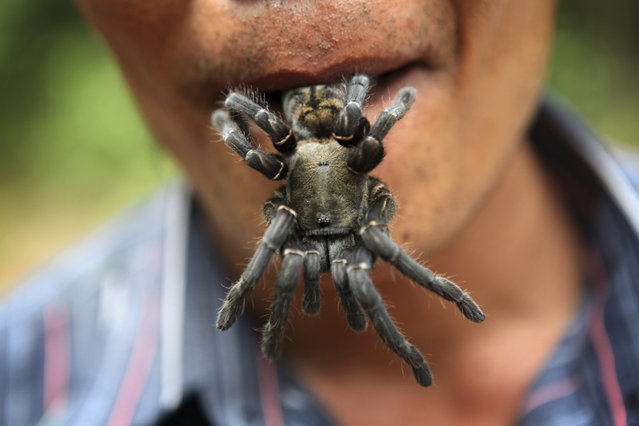
A Cambodian tuk tuk driver and guide with a tarantula in his mouth shortly after is was dug from the ground on June 7, 2010 in Skuon, Kampong Cham Province, Cambodia. The trade for spiders and other insects as food and for medicinal purposes has been in effect since the 1970's in Cambodia but only very recently have tourists been finding a way to see where the spiders are hunted in the nearby countryside. One guide, who can be found in Kampong Cham Town has started offering tours to tourists who can find him. (Photo by Tim Whitby/Getty Images)

A Cambodian tuk tuk driver and guide with a tarantula in his mouth shortly after is was dug from the ground on June 7, 2010 in Skuon, Kampong Cham Province, Cambodia. The trade for spiders and other insects as food and for medicinal purposes has been in effect since the 1970's in Cambodia but only very recently have tourists been finding a way to see where the spiders are hunted in the nearby countryside. One guide, who can be found in Kampong Cham Town has started offering tours to tourists who can find him. (Photo by Tim Whitby/Getty Images)
Details
04 Sep 2016 09:27:00
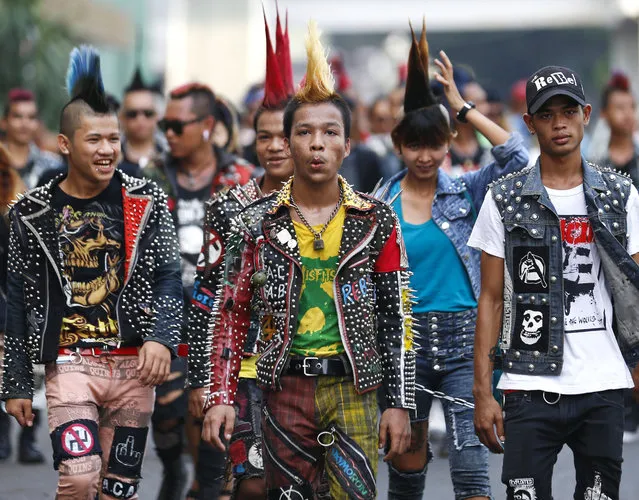
Myanmar punks walk in the downtown area as they take part in a punk gathering ahead of the Thingyan water festival in Yangon, Myanmar, 12 April 2017. Myanmar punks have been gathering in Yangon on the day ahead of Thingyan water festival to celebrate every year. The annual water festival is marked with large groups of people congregating to celebrate by splashing water and throwing powder at each others faces as a symbolic sign of cleansing and washing away the sins from the old year to mark the traditional New Year in countries such as Myanmar, Thailand, Laos and Cambodia. This year, the Myanmar Thingyan water festival falls on 13 April and ends on 16 April. (Photo by Lynn Bo Bo/EPA)

Myanmar punks walk in the downtown area as they take part in a punk gathering ahead of the Thingyan water festival in Yangon, Myanmar, 12 April 2017. Myanmar punks have been gathering in Yangon on the day ahead of Thingyan water festival to celebrate every year. The annual water festival is marked with large groups of people congregating to celebrate by splashing water and throwing powder at each others faces as a symbolic sign of cleansing and washing away the sins from the old year to mark the traditional New Year in countries such as Myanmar, Thailand, Laos and Cambodia. This year, the Myanmar Thingyan water festival falls on 13 April and ends on 16 April. (Photo by Lynn Bo Bo/EPA)
Details
13 Apr 2017 09:28:00