Loading...
Done
McMurdo Station Antarctic

McMurdo Station is a U.S. Antarctic research centre located on the southern tip of Ross Island, which is in the New Zealand-claimed Ross Dependency on the shore of McMurdo Sound in Antarctica. It is operated by the United States through the United States Antarctic Program, a branch of the National Science Foundation. The station is the largest community in Antarctica, capable of supporting up to 1,258 residents, and serves as the United States Antarctic science facility. All personnel and cargo going to or coming from Amundsen–Scott South Pole Station first pass through McMurdo.
Details
05 Sep 2013 10:18:00
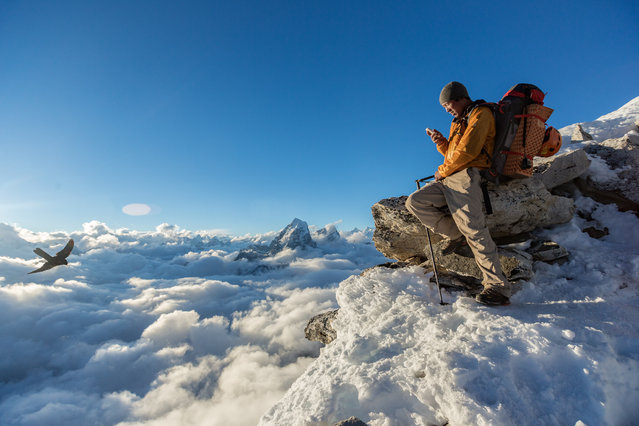
Finding just the right spot above the clouds at Camp 1 on Ama Dablam, Danuru Sherpa uses his iPhone to catch up with friends and family. Even at 18,500 feet (5,654 meters), climbers here can check their email and other dispatches from the world below. (Photo by Aaron Huey/National Geographic)

Finding just the right spot above the clouds at Camp 1 on Ama Dablam, Danuru Sherpa uses his iPhone to catch up with friends and family. Even at 18,500 feet (5,654 meters), climbers here can check their email and other dispatches from the world below. (Photo by Aaron Huey/National Geographic)
Details
28 Apr 2014 09:14:00
A U.S. Air Force SR-71A, also known as the Blackbird, is put through it's paces during a test flight

“The Lockheed SR-71 “Blackbird” was an advanced, long-range, Mach 3+ strategic reconnaissance aircraft. It was developed as a black project from the Lockheed A-12 reconnaissance aircraft in the 1960s by the Lockheed Skunk Works. Clarence “Kelly” Johnson was responsible for many of the design's innovative concepts. During reconnaissance missions the SR-71 operated at high speeds and altitudes to allow it to outrace threats. If a surface-to-air missile launch was detected, the standard evasive action was simply to accelerate and outrun the missile”. – Wikipedia

Photo: A U.S. Air Force SR-71A, also known as the “Blackbird”, is put through it's paces during a test flight over Beale Air Force Base in California. The aircraft is a strategic reconnaissance plane by Lockheed and is the world's fastest and highest flying operational aircraft. (Photo by Getty Images)
Details
07 Sep 2011 12:17:00
Kew Gardens employee Lauren Bird Royal examines the flowering of the Titan Arum lily at the Botanical Gardens

“The titan arum or Amorphophallus titanum (from Ancient Greek amorphos, “without form, misshapen” + phallos, “phallus”, and titan, “giant”) is a flowering plant with the largest unbranched inflorescence in the world. The titan arum's inflorescence is not as large as that of the Talipot palm, Corypha umbraculifera, but the inflorescence of the Talipot palm is branched rather than unbranched”. – Wikipedia

Photo: Kew Gardens employee Lauren Bird Royal examines the flowering of the Titan Arum lily at the Botanical Gardens at Kew on September 30, 2005 in London, England. For the first time in horticultural history, the Titan Arum lily can be seen at all three active stages in its lifecycle – in flower, fruit and leaf.The flowering corm is nearly three metres tall and weighs 91kg and is very rarely seen outside of the rainforests of Sumatra, Indonesia. (Photo by Scott Barbour/Getty Images)
Details
20 Sep 2011 11:13:00
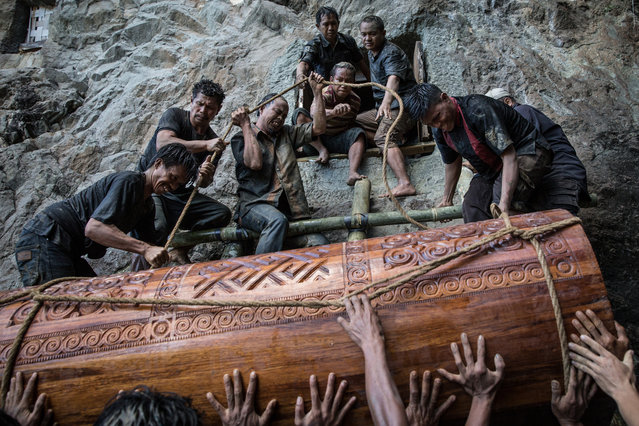
It is said that Torajans are people who “live to die”. For this Indonesian ethnic group, funerals are such extravagant events that they sometimes attract tourists. Families can postpone burials years (and the deceased are considered sick and hosted at home until the funeral) until the family can raise enough money and gather as many relatives as possible. And then it’s a jubilant multiday social event with a parade, dances and animal sacrifices. Agung Parameswara photographed these funerary practices when he traveled to South Sulawesi province, where the Torajans live. But often, their funeral isn’t the last time the dead are seen. In August, crypts are opened, coffins are slid back out and bodies delicately unsheathed. This tender ritual is known as Ma’Nene, which is customarily performed every few years. (Photo by Agung Parameswara/The Washington Post)

It is said that Torajans are people who “live to die”. For this Indonesian ethnic group, funerals are such extravagant events that they sometimes attract tourists. Families can postpone burials years (and the deceased are considered sick and hosted at home until the funeral) until the family can raise enough money and gather as many relatives as possible. And then it’s a jubilant multiday social event with a parade, dances and animal sacrifices. Agung Parameswara photographed these funerary practices when he traveled to South Sulawesi province, where the Torajans live. (Photo by Agung Parameswara/The Washington Post)
Details
06 Oct 2016 09:15:00
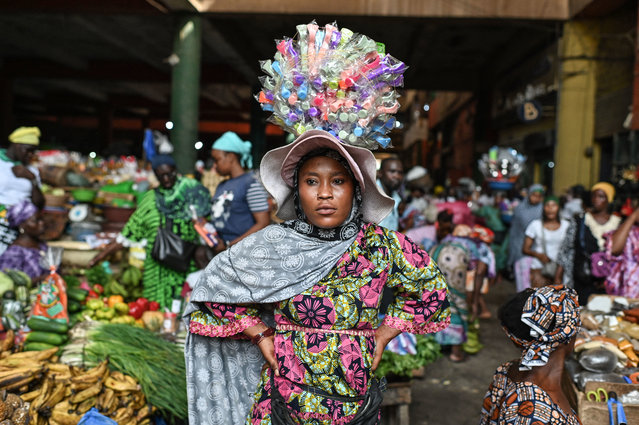
Massangbe Doumbia, 25, a street vendor, carries goods on her head at the Adjame main market in Abidjan, Ivory Coast on March 7, 2024. (Photo by Issouf Sanogo/AFP Photo)

Massangbe Doumbia, 25, a street vendor, carries goods on her head at the Adjame main market in Abidjan, Ivory Coast on March 7, 2024. (Photo by Issouf Sanogo/AFP Photo)
Details
06 Jun 2024 03:22:00


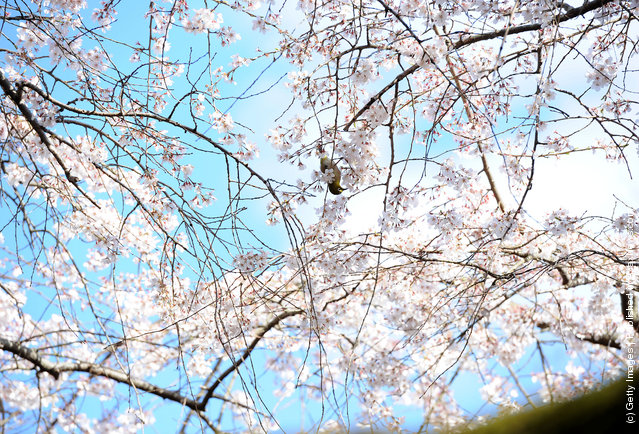
A Japanese white-eye is seen on a branch of cherry blossoms at Kyoto Imperial Palace on March 26, 2010 in Kyoto, Japan. (Photo by Akihiro I/Getty Images)
Details
26 Mar 2011 11:11:00
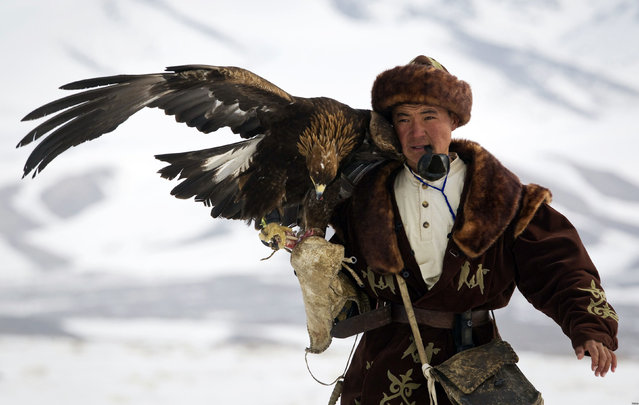
A Kazakh hunter walks with his tamed golden eagle during an annual hunting competition in Chengelsy Gorge, some 150 km (93 miles) east of Almaty February 22, 2013. (Photo by Shamil Zhumatov/Reuters)

A Kazakh hunter walks with his tamed golden eagle during an annual hunting competition in Chengelsy Gorge, some 150 km (93 miles) east of Almaty February 22, 2013. (Photo by Shamil Zhumatov/Reuters)
Details
05 Mar 2013 13:20:00