An animal rights activist washes herself with red dye to mimic blood during a protest against the testing of shampoo on animals in Barcelona. April 24, 2012. (Photo by Raul Albaledo/AFP Photo)
These Arab recruits line up in a barracks square in the British Mandate of Palestine, on December 28, 1940, for their first drill under a British solider. Some 6,000 Palestinian Arabs signed up with the British Army during the course of World War II. (AP Photo)
Mount Sinabung spews pyroclastic smoke, seen from Tiga Pancur village on October 13, 2014 in Berastagi, Karo district, North Sumatra, Indonesia. Mount Sinabung, which has lain dormant for over 400 years, has been intermittently erupting since September 15 last year, killing 15 people and forcing hundreds to flee their homes. According to The National Disaster Mitigation Agency, more than 3,000 residents are still displaced. (Photo by Ulet Ifansasti/Getty Images)
“Life in War” (FotoEvidence Press) by Iranian photographer Majid Saeedi is probably the only book about Afghanistan that doesn’t show images of war. For ten years his camera photographed daily life in the context of war. His photographs reveal the humanity of a people living through decades of war. Here: Afghan men escape increasing summer temperatures by wading in the Qarga reservoir on July 9, 2010 in a suburb of Kabul, Afghanistan. (Photo by Majid Saeedi/Getty Images)
A passenger waits after his train arrived in Nouadhibou, Mauritania’s second largest city and the main export port for the country’s iron ore industry, on June 25, 2014. The mining company’s employees proudly call their firm the lung of their nation's economy and the train that ferries the ore to the coast stretches some two kilometres, making it one of the world's longest. SNIM mines black iron ore in the northern town of Zouerate, a remote desert location which nevertheless attracts people from all over the country looking for work. (Photo by Joe Penney/Reuters)
“The nuclear football (also known as the atomic football, the president's emergency satchel, the button, the black box, or just the football) is a briefcase, the contents of which are to be used by the President of the United States of America to authorize a nuclear attack while away from fixed command centers, such as the White House Situation Room. It functions as a mobile hub in the strategic defense system of the United States. It is a metallic Zero Halliburton briefcase carried in a black leather “jacket”. The package weighs around 45 pounds (20 kilograms). A small antenna protrudes from the bag near the handle”. – Wikipedia
Photo: A U.S. Military officer carries the “football”, which carries nuclear launch codes, on South Lawn after returning with U.S. President George W. Bush to the White House January 7, 2002 in Washington, DC. (Photo by Mark Wilson/Getty Images)
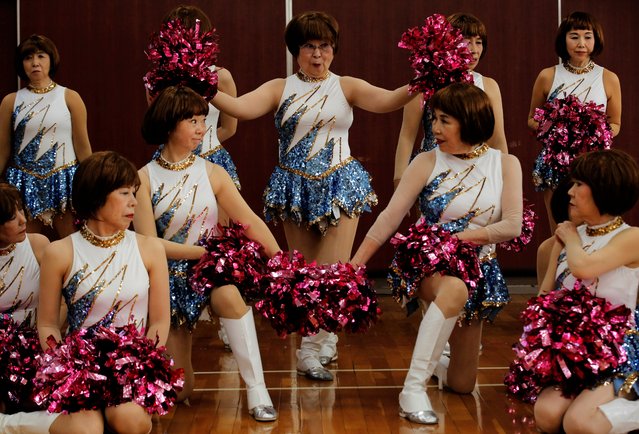
Gold medallists of China perform Synchronised Swimming Free Combination routine at the Munhak Park Tae-hwan Aquatics Center during the 17th Asian Games in Incheon September 23, 2014. (Photo by Tim Wimborne/Reuters)
“Life-size humanoid robot BERTI (Bristol EluMotion Robotic Torso number 1 or RT-1) is a self contained, fully automated Robotic Torso, designed and built by Elumotion to provide a robotic platform based on human anatomy. RT-1 is a highly articulated manipulating platform and includes novel dexterous hands that allow emulation of human gesturing”. – Elumotion.com
Photo: BERTI the robot interacts with a Sony AIBO robot dog at The Science Museum's Antenna Gallery on February 17, 2009 in London. (Photo by Peter Macdiarmid/Getty Images)