Loading...
Done


“Snowflake (c. 1964 – November 24, 2003) was an albino gorilla. He was the only known albino gorilla so far, and the most popular resident of the Barcelona Zoo in Catalonia, Spain. Originally named Nfumu Ngui in Fang language ("white gorilla") by his captor, he was then nicknamed Floquet de Neu (Catalan for little snowflake) by his keeper Jordi Sabater Pi. On his arrival to Barcelona where he was given an official reception by the then Mayor of Barcelona, Josep Maria de Porcioles, in November 1966, he was called Blancanieves (“Snow White”) in the newspaper Tele/Exprés. But he became famous with the name given to him by Sabater when National Geographic Magazine featured him on the main page in March 1967, with the English name Snowflake. This name spread among the press (Stern, Life, Paris-Match) and was later translated to Spanish as Copito de Nieve. Sabater himself called the gorilla Floquet or Copi, and in the later years Nfumu. The asteroid 95962 Copito, discovered by Catalan astronomer J. Manteca, is named in his honour”.
Details
07 Mar 2011 15:50:00


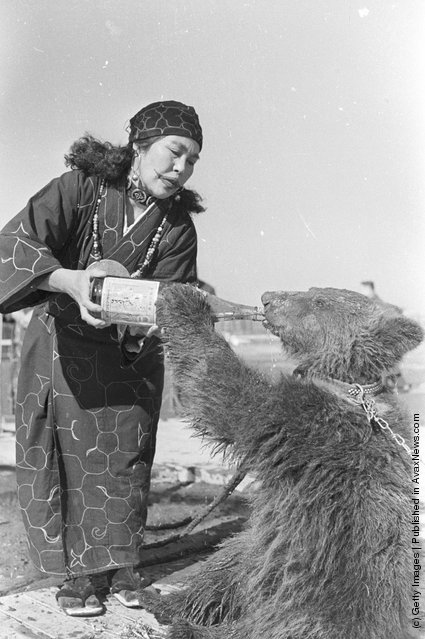
“The Ainu (アイヌ?), also called Aynu, Aino (アイノ), and in historical texts Ezo (蝦夷), are indigenous people or groups in Japan and Russia. Historically they spoke the Ainu language and related varieties and lived in Hokkaidō, the Kuril Islands, and much of Sakhalin. Most of those who identify themselves as Ainu still live in this same region, though the exact number of living Ainu is unknown. This is due to ethnic issues in Japan resulting in those with Ainu backgrounds hiding their identities and confusion over mixed heritages. In Japan, because of intermarriage over many years with Japanese, the concept of a 'pure Ainu' ethnic group is no longer feasible. Official estimates of the population are of around 25,000, while the unofficial number is upwards of 200,000 people”. – Wkipedia

Photo: A captive bear drinking from a large bottle held by an Ainu tribeswoman. (Photo by Evans/Three Lions/Getty Images). Circa 1955
Details
24 Mar 2011 14:01:00
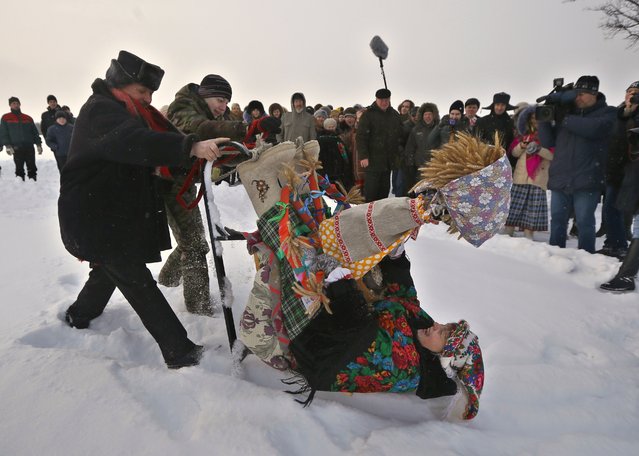
Belarusians wearing national costumes celebrate a Pull the Kolyada Up the Oak rite in the village of Martsiyanauka, some 77 km (48 miles) east of capital Minsk, Belarus, Thursday, January 21, 2016. (Photo by Sergei Grits/AP Photo)

Belarusians wearing national costumes celebrate a Pull the Kolyada Up the Oak rite in the village of Martsiyanauka, some 77 km (48 miles) east of capital Minsk, Belarus, Thursday, January 21, 2016. The merry ancient rite Pull the Kolyada Up the Oak marks the end of Orthodox Christmas celebrations in Belarus. On Jan. 21 a wheel, the so-called Kolyada, would be pulled up an oak or any old tree. The Belarusians believed that the ritual heralds a good harvest, luck and happiness for the entire year. (Photo by Sergei Grits/AP Photo)
Details
22 Jan 2016 10:13:00
Larissa Neto, a muse of the Unidos da Tijuca Samba School, poses as she wears a carnival dress in Sao Goncalo near Rio de Janeiro, Brazil, February 3, 2016. (Photo by Ricardo Moraes/Reuters)

Larissa Neto, a muse of the Unidos da Tijuca Samba School, poses as she wears a carnival dress in Sao Goncalo near Rio de Janeiro, Brazil, February 3, 2016. Rio de Janeiro's carnival parades are known the world over for the glitz and glamour, high-tech allegorical floats and shimmering bodies, which battle it out each year for the championship title. Each school is fronted by the Queen of the Drums, who dances alongside the raging percussion, and her court of sparkling, sculpted dancers known as “muses”. (Photo by Ricardo Moraes/Reuters)
Details
05 Feb 2016 10:52:00
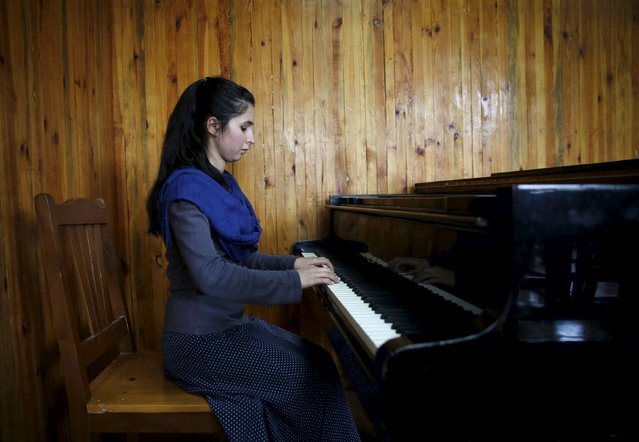
Negin Ekhpulwak, leader of the Zohra orchestra, an ensemble of 35 women, practises on a piano at Afghanistan's National Institute of Music, in Kabul, Afghanistan April 9, 2016. (Photo by Ahmad Masood/Reuters)

Negin Ekhpulwak, leader of the Zohra orchestra, an ensemble of 35 women, practises on a piano at Afghanistan's National Institute of Music, in Kabul, Afghanistan April 9, 2016. Playing instruments was banned under Taliban rule in Afghanistan, and even today, many conservative Muslims frown on most forms of music. Living in an orphanage in the capital, Kabul, 19-year-old Negin Ikhpolwak leads an ensemble of 35 women that plays both Western and Afghan musical instruments. In a country notorious internationally for harsh restrictions on women in most areas of life, Negin's story highlights a double challenge. (Photo by Ahmad Masood/Reuters)
Details
19 Apr 2016 13:47:00
Li Guoqiang talks on his phone outside his house at Guangfuli neighbourhood, in Shanghai, China, April 1, 2016. Li, 38, is a deliveryman who rents a place at Guangfuli. (Photo by Aly Song/Reuters)

Li Guoqiang talks on his phone outside his house at Guangfuli neighbourhood, in Shanghai, China, April 1, 2016. Li, 38, is a deliveryman who rents a place at Guangfuli. In a corner of Shanghai, surrounded by a cement wall, lies one of the world's most valuable fields of debris and garbage. On paper, the Guangfuli neighbourhood is a real estate investor's dream: a plot in the middle of one of the world's most expensive and fast-rising property markets. But the reality is more like a developer's nightmare, thanks to hundreds of people living there who have refused to budge from their ramshackle homes for nearly 16 years as the local authority sought to clear the land for new construction. (Photo by Aly Song/Reuters)
Details
06 May 2016 13:54:00
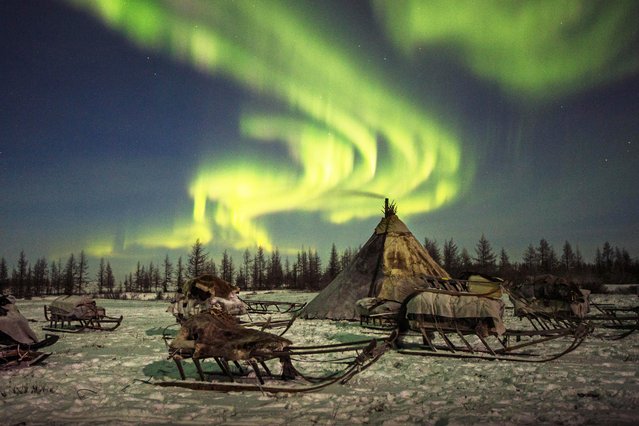
An empty camp is shown beneath a colourful sky in Siberia, December 2016. (Photo by Timothy Allen/Barcroft Productions)

A British photographer has captured life at the “edge of the world”. Timothy Allen, best known for his work on BBC's Human Planet, trekked through the freezing Siberian wilderness for 16 days as he joined part of an 800km migration of reindeer in the Yamal-Nenets region – a name that roughly translates to “edge of the world”. The stunning pictures feature the nomadic Nenets tribe, who drink blood to survive in -45°C temperatures. Timothy's epic journey, which will be revealed in an eight-minute documentary on Animal Planet USA, saw him travel across the bleak terrain of the frozen Ob River with the Nenets people in December last year. Here: An empty camp is shown beneath a colourful sky in Siberia, December 2016. (Photo by Timothy Allen/Barcroft Productions)
Details
19 Sep 2017 07:48:00
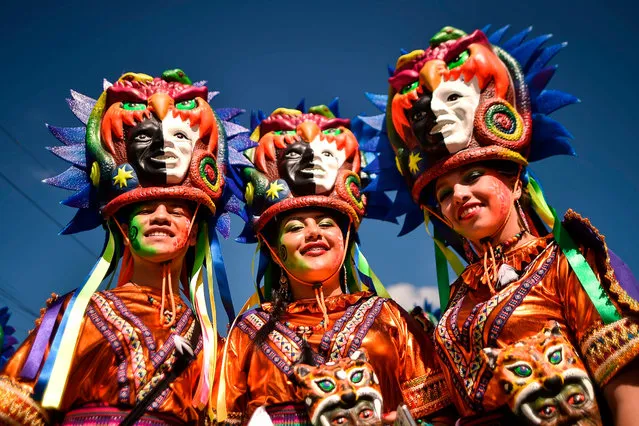
Revellers take part in the “Canto a la Tierra” parade on January 3, 2018, during the Carnival of Blacks and Whites in Pasto, Colombia, the largest festivity in the south- western region of the country. (Photo by Luis Robayo/AFP Photo)

Revellers take part in the “Canto a la Tierra” parade on January 3, 2018, during the Carnival of Blacks and Whites in Pasto, Colombia, the largest festivity in the south- western region of the country. More than 10,000 people among artists, craftsmen and revellers take part in the Blacks and Whites Carnival, which has its origins in the mix of the multiple Andean, Amazonian and Pacific cultural expressions. It is celebrated every year from January 2 to 6 in the city of Pasto and is part of UNESCO's Intangible Cultural Heritage of Humanity since 2009. (Photo by Luis Robayo/AFP Photo)
Details
10 Jan 2018 06:51:00