Loading...
Done


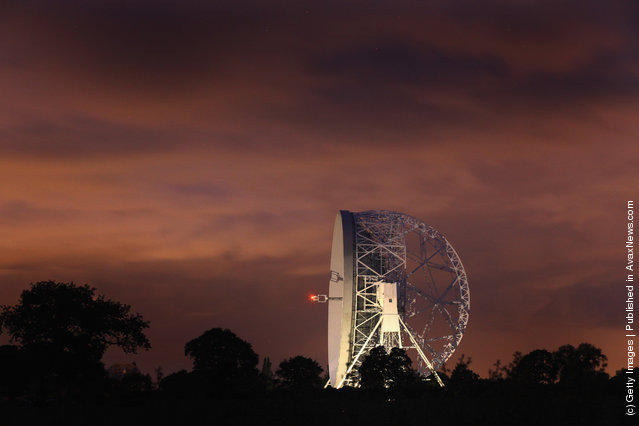
“The Lovell Telescope is a radio telescope at Jodrell Bank Observatory, near Goostrey, Cheshire in the north-west of England. When it was constructed in 1955, the telescope was the largest steerable dish radio telescope in the world at 76.2 m (250 ft) in diameter; it is now the third largest, after the Green Bank telescope in West Virginia, USA, and the Effelsberg telescope in Germany. It was originally known as the 250 ft (76 m) telescope or the Radio Telescope at Jodrell Bank, before becoming the Mark I telescope around 1961 when future telescopes (the Mark II, III, and IV) were being discussed. It was renamed to the Lovell Telescope in 1987 after Bernard Lovell, and became a Grade I listed building in 1988. The telescope forms part of the MERLIN and European VLBI Network arrays of radio telescopes”. – Wikipedia

Photo: The Lovell Telescope listens to the night sky for radio signals from space at Jodrell Bank on June 22, 2011 in Holmes Chapel, England. Jodrell Bank Centre for Astrophysics and it's world famous Lovell Telescope is on the shortlist of Britain's submission for Unesco World Heritage Site status. (Photo by Christopher Furlong/Getty Images)
Details
24 Jun 2011 09:34:00
Japan To Commemorate 6 Months Anniversary Of Earthquake And Tsunami

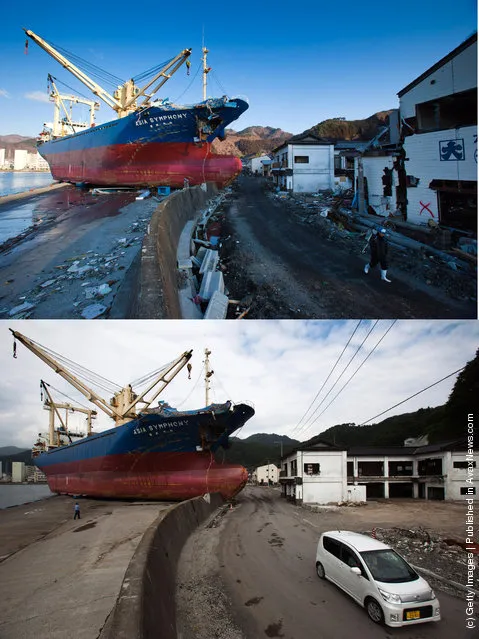
In this composite image, (Bottom Photo) a car drives past a ship called Asia Symphony that was left stranded prior to the sixth month anniversary of the March 11 earthquake and massive tsunami on September 10, 2011 in Kamaishi, Iwate Prefecture, Japan. (Top Photo) Local residents walk past the Asia Symphony, which has been left stranded after being lifted up onto the promenade of the docks March 24, 2011 in Kamaishi, Iwate Prefecture, Japan. A 9.0 magnitude strong earthquake struck Japan offshore on March 11 at 2:46pm local time, triggering a tsunami wave of up to ten metres which engulfed large parts of north-eastern Japan and also damaging the Fukushima nuclear plant, causing the worst nuclear crisis in decades. The current number of dead and missing is reportedly estimated to be 22,900. (Photo by Athit Perawongmetha/Getty Images)
Details
11 Sep 2011 10:06:00
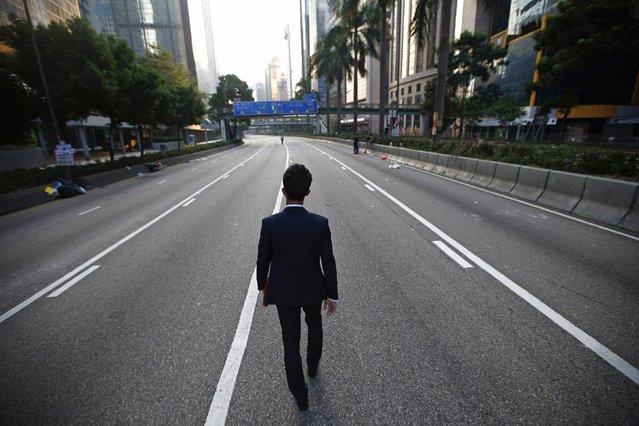
A man walks along an empty street near the central financial district in Hong Kong September 30, 2014. Tens of thousands of pro-democracy protesters extended a blockade of Hong Kong streets on Tuesday, stockpiling supplies and erecting makeshift barricades ahead of what some fear may be a push by police to clear the roads before Chinese National Day. (Photo by Carlos Barria/Reuters)

Reuters photographer Bobby Yip took a series of portraits of people taking part in the “Occupy Central” protests in Hong Kong, and asked them why they had joined the demonstrations. China rules Hong Kong under a “one country, two systems” formula that accords the territory limited democracy. Tens of thousands of mostly student protesters are demanding Beijing give them full democracy, with the freedom to nominate election candidates. The unrest is the worst in Hong Kong since China resumed its rule over the former British colony in 1997. (Photo by Carlos Barria/Reuters)
Details
30 Sep 2014 09:10:00
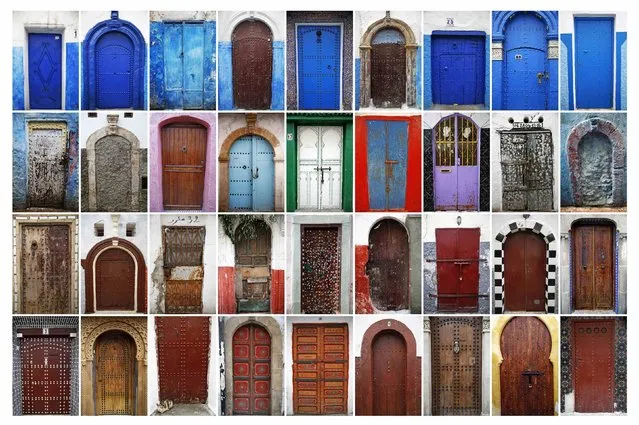
A combination photo shows some of the colourful doors seen in Rabat's Medina and Kasbah of the Udayas, September 2014. UNESCO made Rabat a World Heritage Site two years ago and media and tour operators call it a “must-see destination”. (Photo by Damir Sagolj/Reuters)

A combination photo shows some of the colourful doors seen in Rabat's Medina and Kasbah of the Udayas, September 2014. UNESCO made Rabat a World Heritage Site two years ago and media and tour operators call it a “must-see destination”. But it seems the tourist hordes have yet to find out. While visitors are getting squeezed through the better-known sites of Marrakesh and Fez, the old part of Rabat - with its beautiful Medina and Kasbah of the Udayas - remains an almost unspoiled oasis of calm. Smaller and more compact, its labyrinths of streets, passages and dead ends are a treasure trove of shapes and colours, of moments begging to be caught by the photographer's lens. (Photo by Damir Sagolj/Reuters)
Details
08 Oct 2014 12:08:00
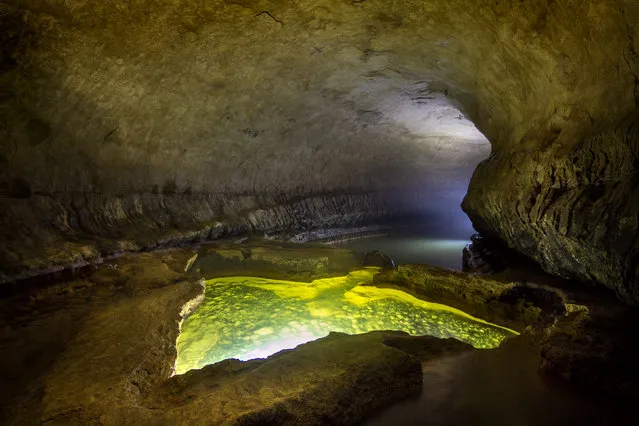
A large pool of water inside one of the tunnels. (Photo by Vladimir Mulde/Caters News)

These otherworldly images give a rare glimpse inside caves barely ever seen by the human eye. With its peculiar pools of water and strange colored sediments, the bizarre looking tunnels of the Shakuranskaya cave could be a set straight out of a science fiction film. Found in the disputed region of Abkhazia, around 75 miles outside of Sochi, Russia, it is rumored the incredible underground chambers were formed after a huge earthquake struck the area in 1892. After causing part of a nearby mountain to collapse into the Amtkel River, it is thought the dam-like affect has created a series of interconnecting underground tunnels. Here: a large pool of water inside one of the tunnels. (Photo by Vladimir Mulde/Caters News)
Details
07 Nov 2014 12:45:00
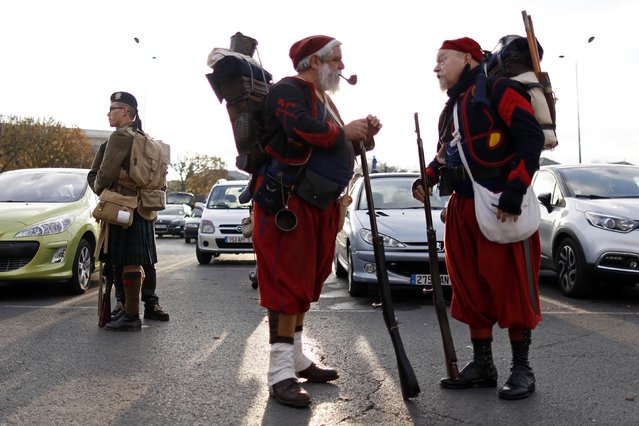
History enthusiasts of French association “Arquebusiers de l'Est”, dressed as soldiers of 3rd regiment of Zouave, attend an Armistice Day ceremony to commemorate the end of World War One at Epernay, eastern France, November 11, 2014. (Photo by Charles Platiau/Reuters)

History enthusiasts of French association “Arquebusiers de l'Est”, dressed as soldiers of 3rd regiment of Zouave, attend an Armistice Day ceremony to commemorate the end of World War One at Epernay, eastern France, November 11, 2014. More than a hundred volunteers from France, Romania, England, Belgium, Russia and Italy took part in the parade. The year 2014 marks the centennial commemoration for the soldiers who fought in the First World War (WWI). (Photo by Charles Platiau/Reuters)
Details
13 Nov 2014 13:41:00
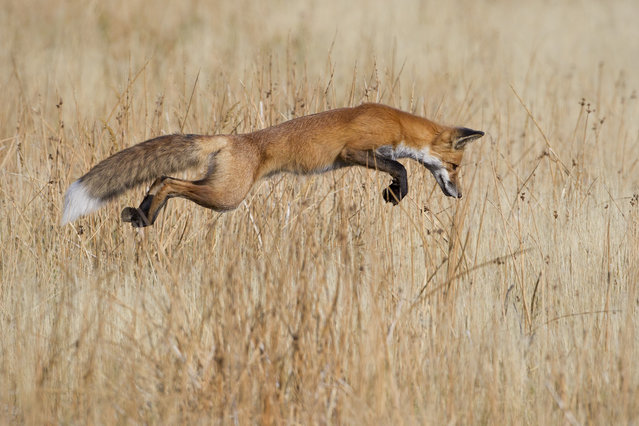
Canada: “Lucky pounce”. (Photo by Connor Stefanison/Wildlife Photographer of the Year 2013)

The winners of The London’s Natural History Museum's prestigious Wildlife Photographer of the Year for 2013 have finally been unveiled. Selected from almost 43,000 entries from 96 countries, the winners offer a glimpse of the stunning array of natural beauty on our planet. Photo: Canada: “Lucky pounce”. “Anticipating the pounce – that was the hardest part”, says Connor, who had come to Yellowstone National Park, Wyoming, USA, in search of wildlife as much as the spectacular landscape. He had found this fox, his first ever, on his last day in the park. It was so absorbed in hunting that Connor had plenty of time to get out of the car and settle behind a rock. It quartered the grassland, back and forth, and then started staring intently at a patch of ground, giving Connor just enough warning of the action to come. When it sprung up, Connor got his shot. And when it landed, the fox got his mouse. (Photo by Connor Stefanison/Wildlife Photographer of the Year 2013)
Details
17 Oct 2013 08:12:00
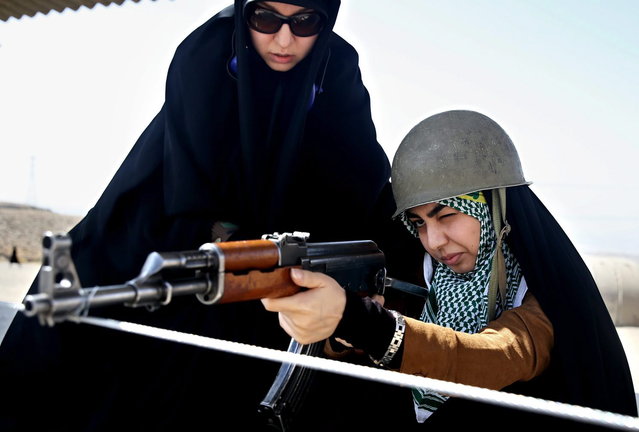
In this Thursday, August 22, 2013 photo, a female member of the Basij paramilitary militia aims a rifle as a trainer looks over her shoulder in Tehran, Iran. (Photo by Ebrahim Noroozi/AP Photo)

With a presence in nearly every city and town across Iran, the paramilitary Basij volunteer corps has an ever-increasing influence on life in the Islamic Republic. Authorities created the Basij, which means mobilization in Persian, just after the country's 1979 Islamic Republic. It is part of Iran's powerful Revolutionary Guard. Photo: In this Thursday, August 22, 2013 photo, a female member of the Basij paramilitary militia aims a rifle as a trainer looks over her shoulder in Tehran, Iran. (Photo by Ebrahim Noroozi/AP Photo)
Details
17 Jan 2014 09:19:00