Loading...
Done
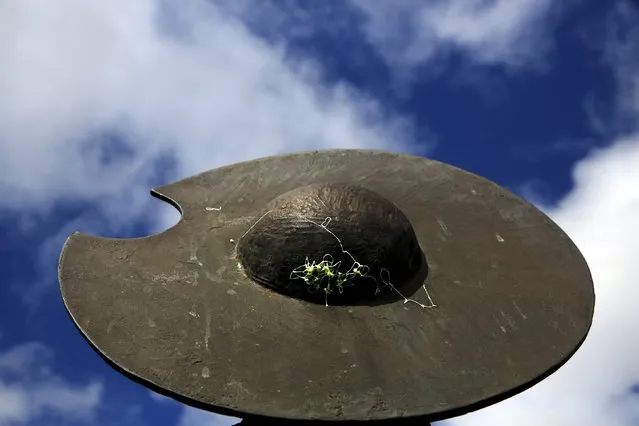
A sculpture of Don Quixote shows him wearing the basin he mistook for the enchanted helmet of the fictional Moorish king Mambrino in Alcazar de San Juan, Spain, April 5, 2016. (Photo by Susana Vera/Reuters)

A sculpture of Don Quixote shows him wearing the basin he mistook for the enchanted helmet of the fictional Moorish king Mambrino in Alcazar de San Juan, Spain, April 5, 2016. The arid central Spanish region of La Mancha is the setting for “Don Quixote”, the seventeenth-century novel by Miguel de Cervantes. Four hundred years after his death, references to the characters of Don Quixote, his loyal squire Sancho Panza and his beautiful lady Dulcinea abound in the surrounding villages from sweet treats to theatre productions involving livestock. Cervantes did not give away the name of the birthplace of Don Quixote, a middle-aged gentleman who becomes obsessed with chivalrous ideals. But many identify the village of Argamasilla de Alba as his hometown. The anniversary of Cervantes’ death is marked on the 23 April. (Photo by Susana Vera/Reuters)
Details
21 Apr 2016 12:32:00

Thomas jumps into the water from a spring board at a public swimming pool in Mengen, Germany, 28 August 2016. (Photo by Thomas Warnack/EPA)

Thomas jumps into the water from a spring board at a public swimming pool in Mengen, Germany, 28 August 2016. (Photo by Thomas Warnack/EPA)
Details
29 Aug 2016 07:45:00
A South Sudanese model applies make-up during the Festival of Fashion and Arts for Peace in Juba August 9, 2014. (Photo by Andreea Campeanu/Reuters)

A South Sudanese model applies make-up during the Festival of Fashion and Arts for Peace in Juba August 9, 2014. (Photo by Andreea Campeanu/Reuters)
Details
16 Aug 2014 10:27:00
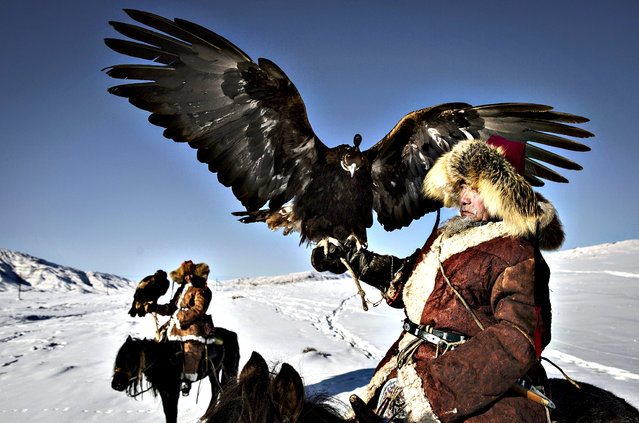
Chinese Kazakh eagle hunters sit on horseback as they travel to a local competition on January 29, 2015 in the mountains of Qinghe County, Xinjiang, northwestern China. The festival, organised by the local hunting community, is part of an effort to promote and grow traditional hunting practices for new generations in the mountainous region of western China that borders Kazakhstan, Russia and Mongolia. (Photo by Kevin Frayer/Getty Images)

Chinese Kazakh eagle hunters sit on horseback as they travel to a local competition on January 29, 2015 in the mountains of Qinghe County, Xinjiang, northwestern China. The festival, organised by the local hunting community, is part of an effort to promote and grow traditional hunting practices for new generations in the mountainous region of western China that borders Kazakhstan, Russia and Mongolia. The training and handling of the large birds of prey follows a strict set of ancient rules that Kazakh eagle hunters are preserving for future generations. (Photo by Kevin Frayer/Getty Images)
Details
07 Feb 2015 14:11:00
Children feed a giraffe at Pairi Daiza wildlife park, a zoo and botanical garden in Brugelette, Belgium, May 25, 2015. (Photo by Francois Lenoir/Reuters)

Children feed a giraffe at Pairi Daiza wildlife park, a zoo and botanical garden in Brugelette, Belgium, May 25, 2015. (Photo by Francois Lenoir/Reuters)
Details
26 May 2015 11:19:00
Skeletons are arranged in a bar scene as part of a competition to create Day of the Dead altars on pedestrian Regina Street in central Mexico City, Tuesday, November 1, 2016. The holiday honors the dead as friends and families gather in cemeteries to decorate their loved ones' graves and hold vigil through the night on Nov. 1 and 2. (Photo by Rebecca Blackwell/AP Photo)

Skeletons are arranged in a bar scene as part of a competition to create Day of the Dead altars on pedestrian Regina Street in central Mexico City, Tuesday, November 1, 2016. The holiday honors the dead as friends and families gather in cemeteries to decorate their loved ones' graves and hold vigil through the night on Nov. 1 and 2. (Photo by Rebecca Blackwell/AP Photo)
Details
03 Nov 2016 12:57:00
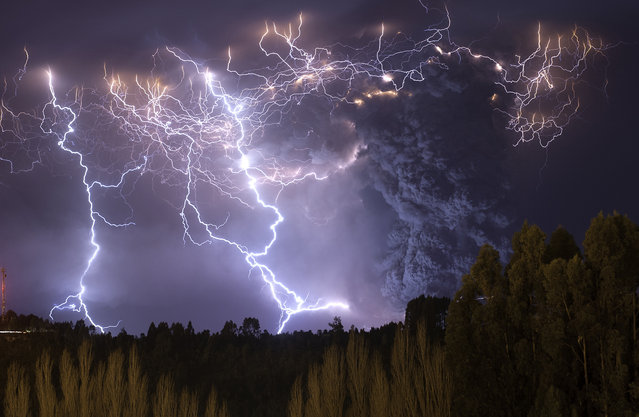
The eruption of Cordon Caulle began on June 4, 2011, located in the Region of Los Rios in Chile. For about 12 months, people and animals became accustomed to living with the daily fall of ash, which also caused problems in the air traffic in South America. The explosions and lightning during first days of the eruption could be seen from hundreds of miles around. This photograph was taken on the second night of eruption from the town of Lago Ranco. (Photo and caption by Francisco Negroni/National Geographic Traveler Photo Contest)

The eruption of Cordon Caulle began on June 4, 2011, located in the Region of Los Rios in Chile. For about 12 months, people and animals became accustomed to living with the daily fall of ash, which also caused problems in the air traffic in South America. The explosions and lightning during first days of the eruption could be seen from hundreds of miles around. This photograph was taken on the second night of eruption from the town of Lago Ranco. (Photo and caption by Francisco Negroni/National Geographic Traveler Photo Contest)

ATTENTION! All pictures are presented in high resolution. To see Hi-Res images – just TWICE click on any picture. In other words, click small picture – opens the BIG picture. Click BIG picture – opens VERY BIG picture.
Details
23 Jun 2013 11:24:00
Filipino boys play basketball at an improvised court hooked on multi-layered tombs at a public cemetery in Navotas, north of Manila, Philippines on Thursday Oct. 31, 2013. Filipinos are expected to flock to cemeteries on November 1 to remember their dead as they observe All Saints Day in this predominantly Roman Catholic country. (Photo by Aaron Favila/AP Photo)

Filipino boys play basketball at an improvised court hooked on multi-layered tombs at a public cemetery in Navotas, north of Manila, Philippines on Thursday Oct. 31, 2013. Filipinos are expected to flock to cemeteries on November 1 to remember their dead as they observe All Saints Day in this predominantly Roman Catholic country. (Photo by Aaron Favila/AP Photo)
Details
02 Nov 2013 12:07:00