Loading...
Done
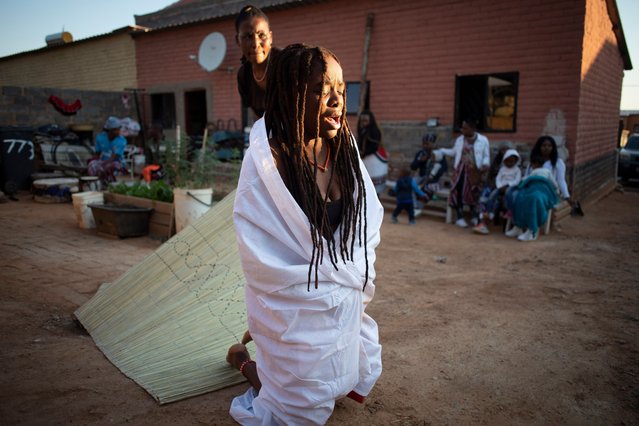
“Sangoma” initiate Dipuo Banda (C) is led out of her teachers shack while she remains in a trance like state prior to dancing during her 3 day initiation ceremony with her teacher, family, friends and students in the Alexandra Township in Johannesburg, South Africa, 14 May 2021. Sangomas, the Zulu term for Medicine Women or traditional healers, fulfill different social and political roles in the community, including divination, physical healing, emotional and spiritual illnesses, directing birth or death rituals and finding lost cattle. (Photo by Kim Ludbrook/EPA/EFE)

“Sangoma” initiate Dipuo Banda (C) is led out of her teachers shack while she remains in a trance like state prior to dancing during her 3 day initiation ceremony with her teacher, family, friends and students in the Alexandra Township in Johannesburg, South Africa, 14 May 2021. Sangomas, the Zulu term for Medicine Women or traditional healers, fulfill different social and political roles in the community, including divination, physical healing, emotional and spiritual illnesses, directing birth or death rituals and finding lost cattle. (Photo by Kim Ludbrook/EPA/EFE)
Details
28 May 2021 08:13:00
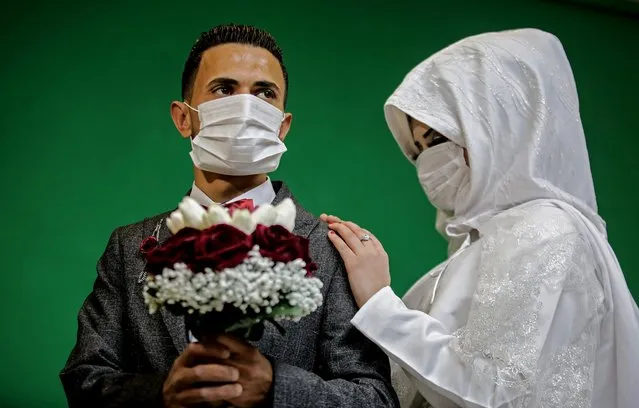
Palestinian groom Mohamed abu Daga and his bride Israa wear face masks amid the COVID-19 epidemic, during a photoshoot at a studio before their wedding ceremony in Khan Yunis in the southern Gaza Strip, on March 23, 2020. Authorities in Gaza confirmed on March 22 the first two cases of novel coronavirus, identifying them as Palestinians who had travelled to Pakistan and were being held in quarantine since their return, as the United Nations warned of potential disastrous outcomes to an outbreak given the high poverty rates and weak health system in the coastal strip, under Israeli blockade since 2007. (Photo by Said Khatib/AFP Photo)

Palestinian groom Mohamed abu Daga and his bride Israa wear face masks amid the COVID-19 epidemic, during a photoshoot at a studio before their wedding ceremony in Khan Yunis in the southern Gaza Strip, on March 23, 2020. Authorities in Gaza confirmed on March 22 the first two cases of novel coronavirus, identifying them as Palestinians who had travelled to Pakistan and were being held in quarantine since their return, as the United Nations warned of potential disastrous outcomes to an outbreak given the high poverty rates and weak health system in the coastal strip, under Israeli blockade since 2007. (Photo by Said Khatib/AFP Photo)
Details
27 Mar 2020 00:07:00
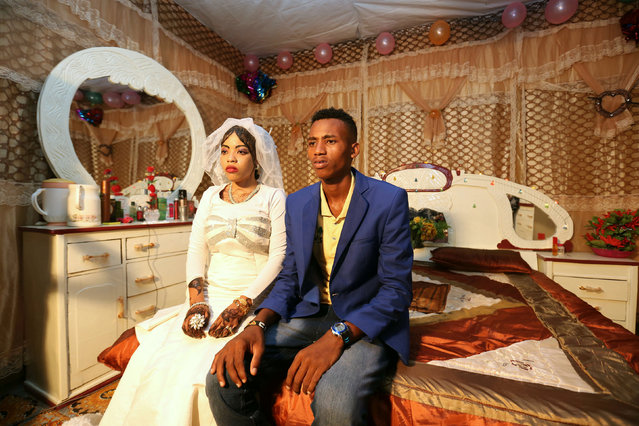
Somali couple Mohamed Noor (L) and Huda Omar pose for a photograph at their makeshift home during their wedding ceremony in Mogadishu's Rajo camp, Somalia August 17, 2016. Having met two years ago, the pair have just married at Rajo camp, where some 400 families live. Most, like Noor's parents, came here in the early 1990s to flee famine. They stayed on as years of conflict ravaged the Horn of Africa nation. As at any wedding, there is plenty of dancing and sweet treats for the young couple as they start married life in Noor's simple home, made of iron and plastic sheets. Noor works as a mason with his father. Others here are builders or sell sweets, nuts and stick toothbrushes to make money. Some beg around the seaside city, which like the rest of Somalia has been gripped by violence since the toppling of dictator Mohamed Siad Barre in 1991. (Photo by Feisal Omar/Reuters)

Somali couple Mohamed Noor (L) and Huda Omar pose for a photograph at their makeshift home during their wedding ceremony in Mogadishu's Rajo camp, Somalia August 17, 2016. Having met two years ago, the pair have just married at Rajo camp, where some 400 families live. Most, like Noor's parents, came here in the early 1990s to flee famine. (Photo by Feisal Omar/Reuters)
Details
14 Sep 2016 10:35:00
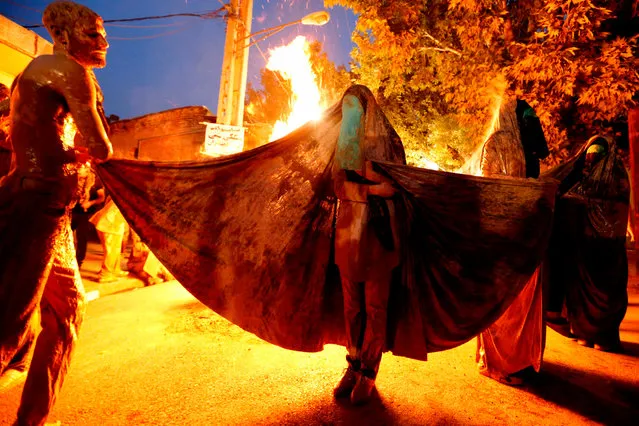
Iranian Shiite Muslim women gather around a bonfire after rubbing mud on their body during the “Kharrah Mali” (Mud Rubbing) ritual to mark the Ashura religious ceremony in the city of Khorramabad, some 470 kms southwest of Tehran, early in the morning on October 1, 2017. “Khrreh Mali” or “Mud Rubbing” is a ritual that is held in the city of Khorramabad every year to commemorate the seventh century slaying of Prophet Mohammed' s grandson Imam Hussein, in which Iranian men roll over in mud and dry themselves by gathering around the bonfires before flagellating themselves. (Photo by Atta Kenare/AFP Photo)

Iranian Shiite Muslim women gather around a bonfire after rubbing mud on their body during the “Kharrah Mali” (Mud Rubbing) ritual to mark the Ashura religious ceremony in the city of Khorramabad, some 470 kms southwest of Tehran, early in the morning on October 1, 2017. “Khrreh Mali” or “Mud Rubbing” is a ritual that is held in the city of Khorramabad every year to commemorate the seventh century slaying of Prophet Mohammed' s grandson Imam Hussein, in which Iranian men roll over in mud and dry themselves by gathering around the bonfires before flagellating themselves. (Photo by Atta Kenare/AFP Photo)
Details
02 Oct 2017 08:38:00
In this Friday, March 3, 2017 photo, a ribbon on a staff member's outfit blows in the breeze as she arrives for the opening session of the Chinese People's Political Consultative Congress (CPPCC) at the Great Hall of the People in Beijing. (Photo by Mark Schiefelbein/AP Photo)

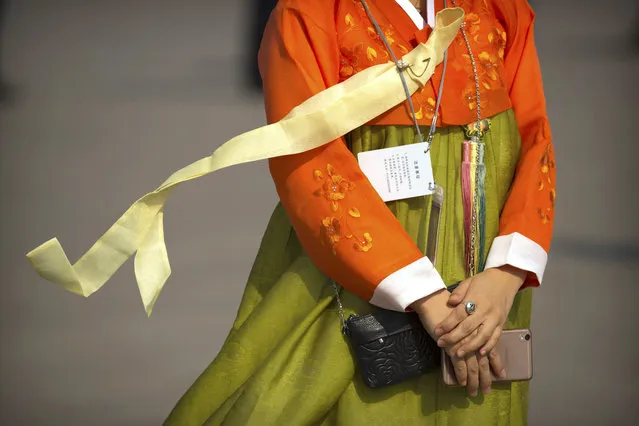
In this Friday, March 3, 2017 photo, a ribbon on a staff member's outfit blows in the breeze as she arrives for the opening session of the Chinese People's Political Consultative Congress (CPPCC) at the Great Hall of the People in Beijing. The annual session of China's ceremonial legislature is designed to awe onlookers with its size and sweep, yet the experience is also made up of tiny moments, details that point to the personalities of the participants and the event's unique, sometimes quirky, traits that a casual observer might easily miss. (Photo by Mark Schiefelbein/AP Photo)
Details
15 Mar 2017 00:05:00
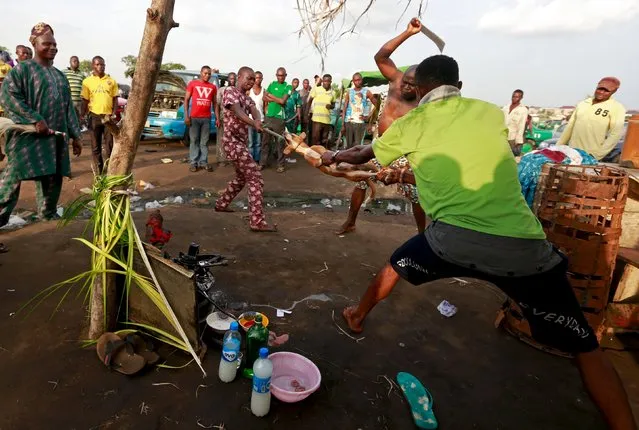
Chief priest Gbenga Saala raises a cutlass to kill a dog during an annual prayer and sacrifice celebration of the iron god Ogun in Abuja, Nigeria, June 23, 2015. (Photo by Afolabi Sotunde/Reuters)

Chief priest Gbenga Saala raises a cutlass to kill a dog during an annual prayer and sacrifice celebration of the iron god Ogun in Abuja, Nigeria, June 23, 2015. Every year worshippers offer a dog as sacrifice to Ogun, a traditional Nigerian deity, in hope of an auspicious year ahead. Taxi drivers, blacksmiths, panel beaters and mechanics – trades that depend on metal for their livelihood – pay homage to Ogun, led by high priest Gbenga Saala. As part of the ceremony, the priest pours the dog’s blood on symbols of these workers’ trade: keys, spanners and other tools piled up in a metal barrel. (Photo by Afolabi Sotunde/Reuters)
Details
15 Sep 2015 13:56:00
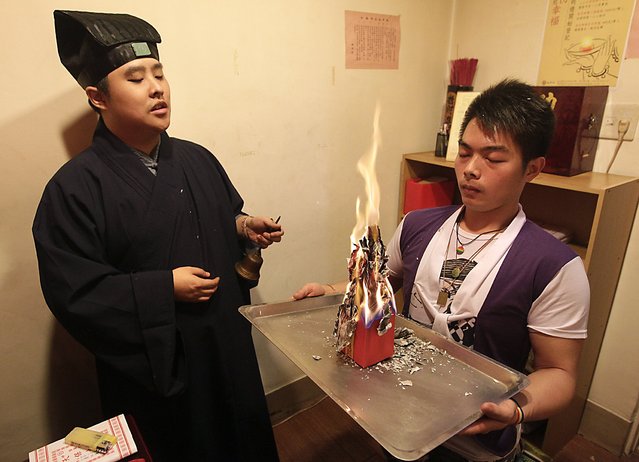
Lu Wei-ming (L), priest of the Wei-ming temple, and a worshipper burn a Taoist paper amulet during a prayer ritual at the temple in New Taipei city January 8, 2015. The shrine, down a narrow alleyway in a bustling district of the city, is dedicated to a deity who has watched over homosexuals for four centuries. (Photo by Pichi Chuang/Reuters)

Lu Wei-ming (L), priest of the Wei-ming temple, and a worshipper burn a Taoist paper amulet during a prayer ritual at the temple in New Taipei city January 8, 2015. The shrine, down a narrow alleyway in a bustling district of the city, is dedicated to a deity who has watched over homosexuals for four centuries. Priest Lu founded the temple in 2006, at a time gays were excluded from most religious ceremonies. (Photo by Pichi Chuang/Reuters)
Details
21 Jan 2015 13:06:00


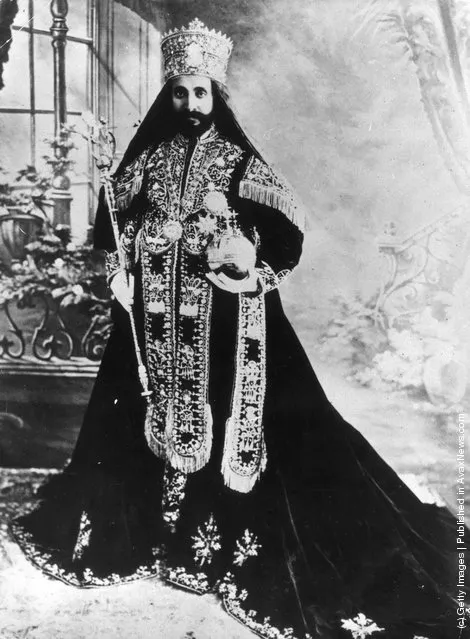
“Haile Selassie I (23 July 1892 – 27 August 1975), born Tafari Makonnen, was Ethiopia's regent from 1916 to 1930 and Emperor of Ethiopia from 1930 to 1974. The heir to a dynasty that traced its origins to the 13th century, and from there by tradition back to King Solomon and Queen Makeda, Empress of Axum, known in the Abrahamic tradition as the Queen of Sheba. Haile Selassie is a defining figure in both Ethiopian and African history.

Haile Selassie is revered as the returned Messiah of the Bible, God incarnate, among the Rastafari movement, the number of followers of which is estimated between 200,000 and 800,000. Begun in Jamaica in the 1930s, the Rastafari movement perceives Haile Selassie as a messianic figure who will lead a future golden age of eternal peace, righteousness, and prosperity. He himself remained an Ethiopian Orthodox Christian throughout his life”. – Wikipedia

Photo: Negusa Negasti, Emperor of Ethiopia Haile Selassie I, known as “Lord of Lords”, “The Conquering Lion of the tribe of Judah”, “Light of the world”, “Elect of God”, in full ceremonial regalia following his coronation. (Photo by Hulton Archive/Getty Images)
Details
21 Jun 2011 11:04:00