Loading...
Done
The best man in a wedding party, who all declined to be identified, holds an AR-10 rifle he was handed while the party was having their pre-wedding portraits taken on the steps of the capitol before a rally nearby by gun-rights advocates to protest a new expanded gun background check law in Washington state Saturday, December 13, 2014, in Olympia, Wash. (Photo by Elaine Thompson/AP Photo)

The best man in a wedding party, who all declined to be identified, stands near the bride and groom as he holds an AR-10 rifle he was handed while the party was having their pre-wedding portraits taken on the steps of the capitol before a rally nearby by gun-rights advocates to protest a new expanded gun background check law in Washington state Saturday, December 13, 2014, in Olympia, Wash. The wedding party was not part of the protest, but posed for pictures with it after being handed it by gun activist Brandon Lyons, who said “we've all just broken the law”, by handing the gun over. Saturday's protest was called the “I Will Not Comply” rally, and those attending said they will openly exchange firearms in opposition to the state's new voter-approved universal background check law, Initiative 594. The law, which took effect on December 4, requires background checks on all sales and transfers, including private transactions and many loans and gifts. (Photo by Elaine Thompson/AP Photo)
Details
15 Dec 2014 11:17:00
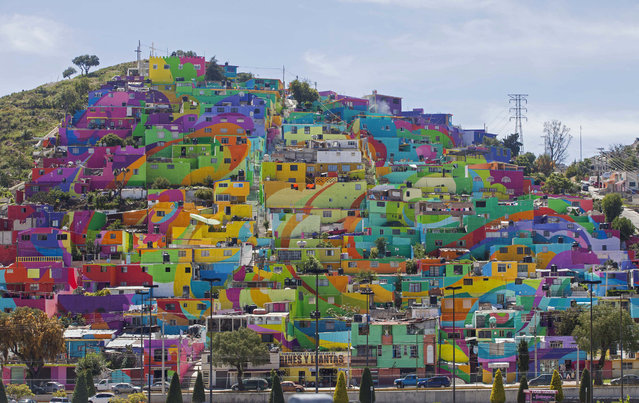
Hundreds of houses painted in bright colors in what organizers claim is Mexico's largest mural, is part of a government-sponsored project is called Pachuca Paints Itself, in the Palmitas neighborhood, in Pachuca, Mexico, Thursday, July 30, 2015. German Crew is the artist collective responsible for painting the mural project. Director Enrique Gomez, who goes by MYBE, said the crew has painted 1,500 square meters with 20,000 liters of paint. (Photo by Sofia Jaramillo/AP Photo)

Hundreds of houses painted in bright colors in what organizers claim is Mexico's largest mural, is part of a government-sponsored project is called Pachuca Paints Itself, in the Palmitas neighborhood, in Pachuca, Mexico, Thursday, July 30, 2015. German Crew is the artist collective responsible for painting the mural project. Director Enrique Gomez, who goes by MYBE, said the crew has painted 1,500 square meters with 20,000 liters of paint. Working hand-in-hand with residents, muralists have painted the facades of 200 homes bright lavender, lime green, incandescent orange – hues more commonly found in a bag of Skittles than in the drab, cement-and-cinderblock neighborhoods where many of Mexico's poor live. The project aims to bring the community together and rehabilitate the area. (Photo by Sofia Jaramillo/AP Photo)
Details
03 Aug 2015 12:02:00
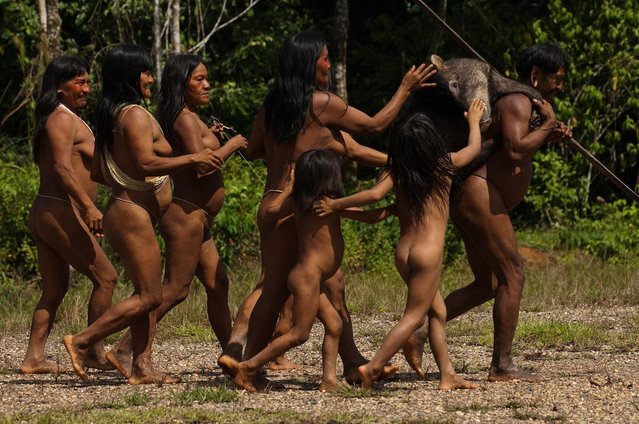
Spectacular images offering insight into the lives of the Huaorani people in the Ecuadorian Amazon have been revealed showing how they use traditional methods to hunt monkeys for food. The stunning pictures were taken by conservation photographer Pete Oxford from Torquay, Devon in the Ecuadorian Amazon. “The Huaorani Indians are a forest people highly in tune with their environment. Many are now totally acculturated since the 1950s by missionaries”, said Pete. “Today they face radical change to their culture to the proximity of oil exploration within their territory and the Yasuni National Park and Biosphere Reserve, they are vastly changed. Some still live very traditionally and for this shoot, through my Huaorani friend, a direct relative of those photographed he wanted to depict them as close to their original culture as possible. They still largely hunt with blow pipes and spears eating a lot of monkeys and peccaries”. The Huaorani are also known as the Waorani, Waodani or the Waos and are native Amerindians. Their lands are located between the Curaray and Napo rivers and speak the Huaorani language. Pete says that during his visit he was welcomed into the group and hopes that ancient cultures can be saved. Here: The tribe were seen celebrating after a hunter returned to camp with a wild pig. (Photo by Pete Oxford/Mediadrumworld.com)

Spectacular images offering insight into the lives of the Huaorani people in the Ecuadorian Amazon have been revealed showing how they use traditional methods to hunt monkeys for food. The stunning pictures were taken by conservation photographer Pete Oxford from Torquay, Devon in the Ecuadorian Amazon. Here: The tribe were seen celebrating after a hunter returned to camp with a wild pig. (Photo by Pete Oxford/Mediadrumworld.com)
Details
20 Jan 2017 07:58:00
South Korean performers participate in a re-enactment of the battle of the Korean war during the ceremony to mark the 70th anniversary of the Korean War in Cheorwon, near the border with North Korea on June 25, 2020 in Cheorwon, South Korea. Over 66,000 South Koreans have been separated from their families during the Korean War which started on June 25, 1950, and effectively split the Korean Peninsula into two over the 3-year conflict. The fighting between North and South Korea ended on July 27, 1953, with the signing of the Korean Armistice Agreement and the heavily guarded Demilitarized Zone was created, however, both countries remain technically still at war since no peace agreement was signed and many Koreans died before they could reunite with their loved ones. (Photo by Chung Sung-Jun/Getty Images)

South Korean performers participate in a re-enactment of the battle of the Korean war during the ceremony to mark the 70th anniversary of the Korean War in Cheorwon, near the border with North Korea on June 25, 2020 in Cheorwon, South Korea. Over 66,000 South Koreans have been separated from their families during the Korean War which started on June 25, 1950, and effectively split the Korean Peninsula into two over the 3-year conflict. (Photo by Chung Sung-Jun/Getty Images)
Details
27 Jun 2020 00:03:00
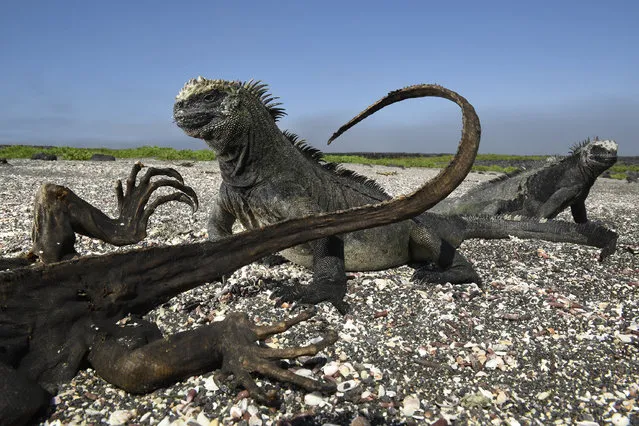
Galapagos – Rocking the Cradle: Four major ocean currents converge along the Galapagos archipelago, creating the conditions for an extraordinary diversity of animal life, April 25, 2016. The islands are home to at least 7,000 flora and fauna species, of which 97 percent of the reptiles, 80 percent of the land birds, 50 percent of the insects and 30 percent of the plants are endemic. The local ecosystem is highly sensitive to the changes in temperature, rainfall and ocean currents that characterize the climatic events known as El Niño and La Niña. These changes cause marked fluctuations in weather and food availability. Many scientists expect the frequency of El Niño and La Niña to increase as a result of climate change, making the Galapagos a possible early-warning location for its effects. (Photo by Thomas P. Peschak for National Geographic/World Press Photo)

Galapagos – Rocking the Cradle: Four major ocean currents converge along the Galapagos archipelago, creating the conditions for an extraordinary diversity of animal life, April 25, 2016. The islands are home to at least 7,000 flora and fauna species, of which 97 percent of the reptiles, 80 percent of the land birds, 50 percent of the insects and 30 percent of the plants are endemic. (Photo by Thomas P. Peschak for National Geographic/World Press Photo)
Details
16 Apr 2018 00:01:00
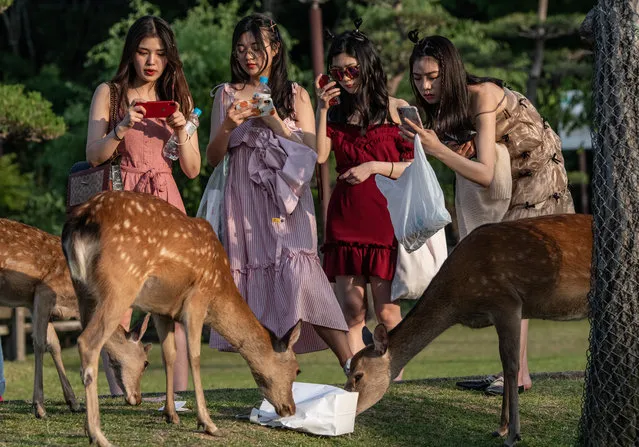
Tourists take photographs as a wild sika deer eats a bag on June 6, 2019 in Nara, Japan. Nara's free-roaming deer have become a huge attraction for tourists. However, an autopsy on a deer that was recently found dead near one of the city's famous temples discovered 3.2kg of plastic in its stomach and caused concern at the effect of tourism as Japan struggles to cope with a huge increase in domestic and international tourists. Alongside a growing Japanese tendency to holiday domestically, a record 31 million people visited the country in 2018 up 8.7 percent from the previous year, with many people now worrying about the environmental impact caused by such large visitor numbers. (Photo by Carl Court/Getty Images)

Tourists take photographs as a wild sika deer eats a bag on June 6, 2019 in Nara, Japan. Nara's free-roaming deer have become a huge attraction for tourists. However, an autopsy on a deer that was recently found dead near one of the city's famous temples discovered 3.2kg of plastic in its stomach and caused concern at the effect of tourism as Japan struggles to cope with a huge increase in domestic and international tourists. (Photo by Carl Court/Getty Images)
Details
19 Jun 2019 00:03:00
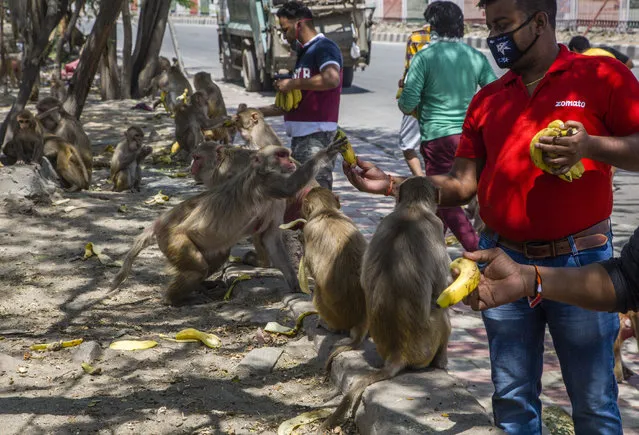
Men give bananas to monkeys gathered on the side of the road as India remains under an unprecedented lockdown over the highly contagious coronavirus (COVID-19) on April 08, 2020 in New Delhi, India. Wild animals, including monkeys, are roaming human settlements in India as people are staying indoors due to the 21-day lockdown. With India's 1.3 billion population and tens of millions of cars off the roads, wildlife is moving towards areas inhabited by humans. Wild animals in many countries have been seen roaming streets. A study says some 60 percent of the new diseases found around the globe every year are zoonotic, meaning they originate in animals and are passed on to humans. COVID-19 is a zoonotic disease that is suspected to have come from the wet markets of Wuhan, China. (Photo by Yawar Nazir/Getty Images)

Men give bananas to monkeys gathered on the side of the road as India remains under an unprecedented lockdown over the highly contagious coronavirus (COVID-19) on April 08, 2020 in New Delhi, India. Wild animals, including monkeys, are roaming human settlements in India as people are staying indoors due to the 21-day lockdown. (Photo by Yawar Nazir/Getty Images)
Details
12 Apr 2020 00:05:00
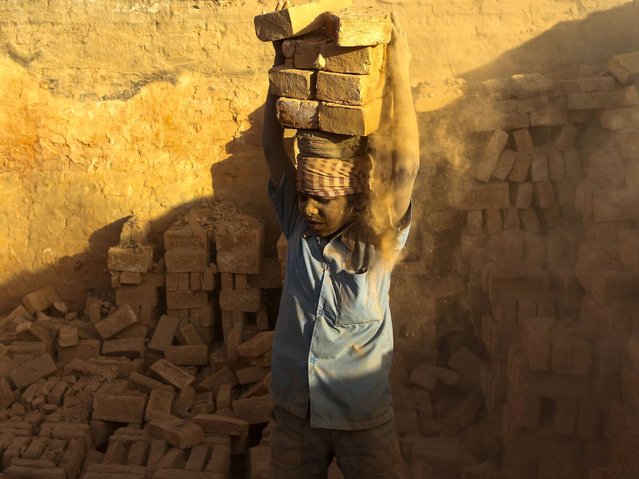
A young boy lifts heavy bricks as he works at brick factory around Kathmandu valley. (Photo by Narendra Shrestha/EPA)

A young boy lifts heavy bricks as he works at brick factory around Kathmandu valley. (Photo by Narendra Shrestha/EPA)
Details
12 Feb 2014 08:28:00