Loading...
Done


Pensioner Karl Szmolinsky, who raises a breed of rabbits called giant grays, shows Robert 2, an 8.5kg giant grey who is 74cm long and has ears 25.5cm long, in the backyard of his house on January 15, 2006 in Eberswalde, Germany. In November Szmolinsky sold eight giant greys to a delegation from North Korea, whom he said want to raise the breed as a source of meat for the North Korean population. Szmolinsky said his rabbits reach a maximum weight of 10.5 kg (23.1lbs.). (Photo by Sean Gallup/Getty Images)
Details
23 Mar 2011 10:47:00


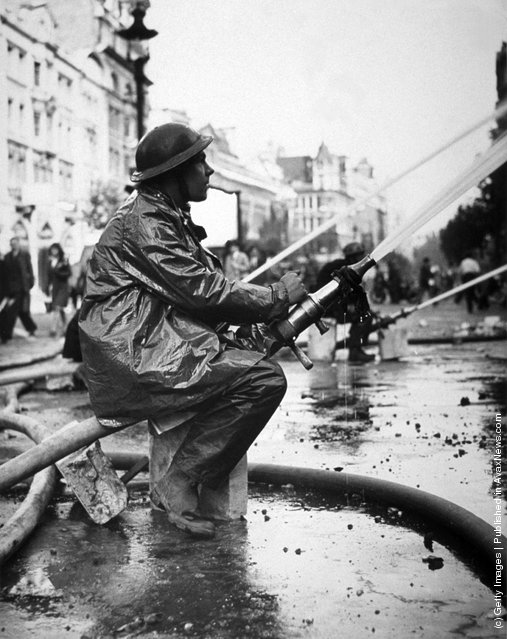
“The Blitz (from German, “Lightning”) was the sustained strategic bombing of Britain by Nazi Germany between 7 September 1940 and 10 May 1941, during the Second World War. The city of London was bombed by the Luftwaffe for 76 consecutive nights and many towns and cities across the country followed. More than one million London houses were destroyed or damaged, and more than 40,000 civilians were killed, half of them in London”. – Wikipedia

Photo: A fireman attempts to check the flames from a gas explosion, after an air raid in Central London the previous night. (Photo by Central Press/Getty Images). 1940
Details
21 Jun 2011 12:08:00
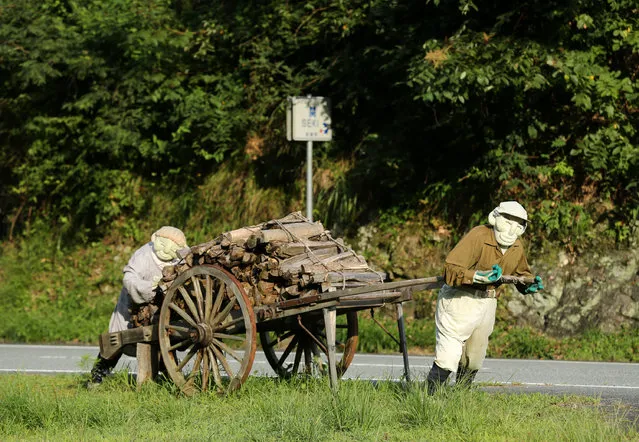
An illustration showing scarecrows pulling a firewood cart beside a road is on display at Kakashi no Sato, or the Scarecrow's Hometown on September 10, 2014 in Himeji, Japan. (Photo by Buddhika Weerasinghe/Getty Images)

An illustration showing scarecrows pulling a firewood cart beside a road is on display at Kakashi no Sato, or the Scarecrow's Hometown on September 10, 2014 in Himeji, Japan. In this district of Yasutomi in Himeji city, over 100 of scarecrows stand in farmlands and abandoned houses to illustrate the good old Japanese countryside and attract visitors. (Photo by Buddhika Weerasinghe/Getty Images)
Details
15 Sep 2014 10:37:00
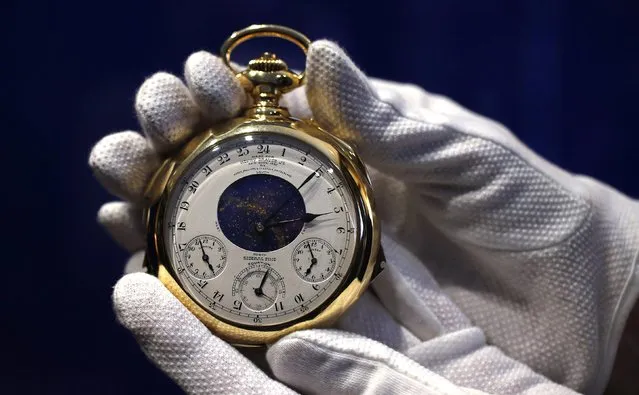
A staff member holds “The Henry Graves Supercomplication” handmade watch by Patek Philippe which was completed in 1932 at Sotheby's auction house in London October 21, 2014. (Photo by Suzanne Plunkett/Reuters)

What makes a watch the most valuable in the world? It’s supercomplicated – literally. In 1925 banker Henry Graves Jr. (considered the greatest watch collector of the 20th century) commissioned Patek Philippe to create a unique gold pocket watch. When Graves finally received it – eight years later – it was the most complex timepiece ever created by human hands... (Photo by Suzanne Plunkett/Reuters)
Details
21 Oct 2014 13:23:00
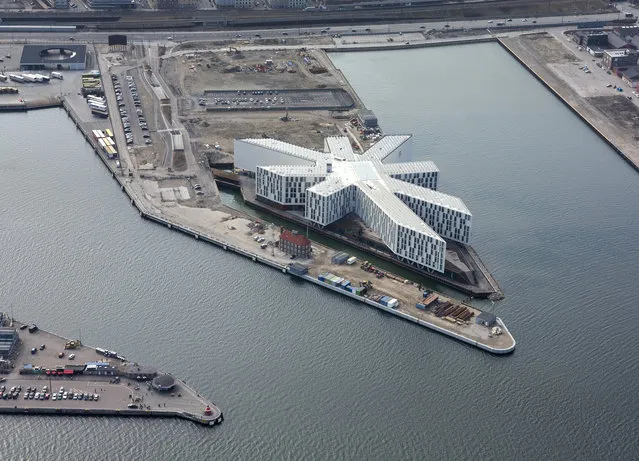
UN City In Copenhagen

Cooperation is key to success. This motto was used by the Government of Denmark when they decided to create a project that bore the name of UN City. This compound was designed to house all nine Copenhagen based UN agencies under a single roof. This embodies the core idea of the United Nations, since this project allows for better efficiency and practicality thanks to joint effort. The first plans for the UN City were hatched in 2002. After 11 years, in 2013 the first stage of the project was finally finished. Presently, Campus 1 of UN City accommodates 1,300 staff member, while Campus 2 is going to become the largest humanitarian warehouse in the whole world.
Details
28 Feb 2015 16:17:00
Inmates are seen at the transgender gallery in La Joya prison on the outskirts of Panama City, Panama February 3, 2016. (Photo by Carlos Jasso/Reuters)

Inmates are seen at the transgender gallery in La Joya prison on the outskirts of Panama City, Panama February 3, 2016. Inmates of La Joya prison on the outskirts of Panama City are housed in makeshift cells amid heavy overcrowding, living in grimy conditions and with limited medical attention. Many prisoners in the Central American nation languish for years without being sentenced. (Photo by Carlos Jasso/Reuters)
Details
14 Apr 2016 11:51:00
Local residents dressed in costumes perform during celebrations for the Malanka holiday in the village of Krasnoilsk in the Chernivtsi region of Ukraine, January 14, 2016. The Malanka traditional holiday is more popular in the western regions of the country and is also known as the Old New Year celebrated on January 13 and 14 - St. Basil's and St. Melania's Day, according to the old Julian calendar. During the celebrations, youngsters and adults wear traditional carnival costumes and masks, and visit local houses while singing carols, playing pranks or performing short plays. (Photo by Valentyn Ogirenko/Reuters)

Local residents dressed in costumes perform during celebrations for the Malanka holiday in the village of Krasnoilsk in the Chernivtsi region of Ukraine, January 14, 2016. The Malanka traditional holiday is more popular in the western regions of the country and is also known as the Old New Year celebrated on January 13 and 14 – St. Basil's and St. Melania's Day, according to the old Julian calendar. During the celebrations, youngsters and adults wear traditional carnival costumes and masks, and visit local houses while singing carols, playing pranks or performing short plays. (Photo by Valentyn Ogirenko/Reuters)
Details
16 Jan 2016 08:04:00
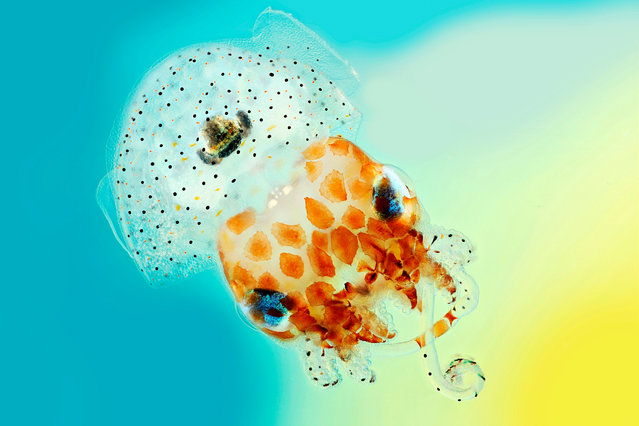
With its huge eyes, comical name and diminutive size, Mark R. Smith’s image of a baby Hawaiian bobtail squid can’t help but raise a smile. A curiously endearing creature, the cephalopod is just 1.5cm across, its mantle cavity bearing more than a passing resemblance to a rather natty shower cap. But it is also a beautiful example of symbiosis – nature’s version of “I’ll scratch your back if you scratch mine” – for on the underside of the squid is a light organ which houses bioluminescent bacteria. The squid offers the bacteria protection and food, while the bacteria emit a glow – a handy trait that the squid uses to offset its silhouette, helping it to evade predators in the depths below. Mark R. Smith’s entry combines several images of a Hawaiian bobtail squid with different focus lengths to create a final picture with greater depth of field than normal. (Photo by Mark R. Smith/Wellcome Images/Macroscopic Solutions)

With its huge eyes, comical name and diminutive size, Mark R. Smith’s image of a baby Hawaiian bobtail squid can’t help but raise a smile. A curiously endearing creature, the cephalopod is just 1.5cm across, its mantle cavity bearing more than a passing resemblance to a rather natty shower cap. But it is also a beautiful example of symbiosis – nature’s version of “I’ll scratch your back if you scratch mine” – for on the underside of the squid is a light organ which houses bioluminescent bacteria. The squid offers the bacteria protection and food, while the bacteria emit a glow – a handy trait that the squid uses to offset its silhouette, helping it to evade predators in the depths below. Mark R. Smith’s entry combines several images of a Hawaiian bobtail squid with different focus lengths to create a final picture with greater depth of field than normal. (Photo by Mark R. Smith/Wellcome Images/Macroscopic Solutions)
Details
08 Mar 2017 00:05:00