Loading...
Done
A 'Double Eagle' gold twenty dollar coin

“A Double Eagle is a gold coin of the United States with a denomination of $20. (Its gold content of 0.9675 troy oz was worth $20 at the then official price of $20.67/oz). The coins are made from a 90% gold (0.900 fine = 21.6 kt) and 10% copper alloy”. – Wikipedia

Photo: A “Double Eagle” gold twenty dollar coin is displayed above a catalogue picture showing the reverse side of the coin at Goldsmith's Hall on March 2, 2012 in London, England. Nearly half a million of these coins were originally minted in the midst of the Great Depression in the US. Only 13 are known today after the rest were melted down before they ever left the US Mint, sacrificed as part of a strategy to stabalise the American economy. In 2002 a Double Eagle sold at auction for $7.6 million. (Photo by Peter Macdiarmid/Getty Images)
Details
03 Mar 2012 10:37:00


“Snowflake (c. 1964 – November 24, 2003) was an albino gorilla. He was the only known albino gorilla so far, and the most popular resident of the Barcelona Zoo in Catalonia, Spain. Originally named Nfumu Ngui in Fang language ("white gorilla") by his captor, he was then nicknamed Floquet de Neu (Catalan for little snowflake) by his keeper Jordi Sabater Pi. On his arrival to Barcelona where he was given an official reception by the then Mayor of Barcelona, Josep Maria de Porcioles, in November 1966, he was called Blancanieves (“Snow White”) in the newspaper Tele/Exprés. But he became famous with the name given to him by Sabater when National Geographic Magazine featured him on the main page in March 1967, with the English name Snowflake. This name spread among the press (Stern, Life, Paris-Match) and was later translated to Spanish as Copito de Nieve. Sabater himself called the gorilla Floquet or Copi, and in the later years Nfumu. The asteroid 95962 Copito, discovered by Catalan astronomer J. Manteca, is named in his honour”.
Details
07 Mar 2011 15:50:00


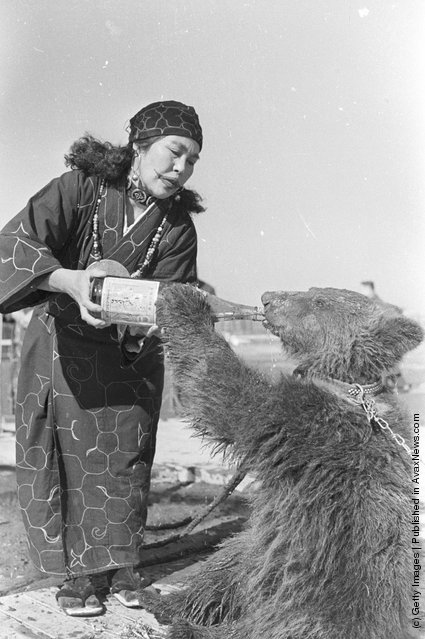
“The Ainu (アイヌ?), also called Aynu, Aino (アイノ), and in historical texts Ezo (蝦夷), are indigenous people or groups in Japan and Russia. Historically they spoke the Ainu language and related varieties and lived in Hokkaidō, the Kuril Islands, and much of Sakhalin. Most of those who identify themselves as Ainu still live in this same region, though the exact number of living Ainu is unknown. This is due to ethnic issues in Japan resulting in those with Ainu backgrounds hiding their identities and confusion over mixed heritages. In Japan, because of intermarriage over many years with Japanese, the concept of a 'pure Ainu' ethnic group is no longer feasible. Official estimates of the population are of around 25,000, while the unofficial number is upwards of 200,000 people”. – Wkipedia

Photo: A captive bear drinking from a large bottle held by an Ainu tribeswoman. (Photo by Evans/Three Lions/Getty Images). Circa 1955
Details
24 Mar 2011 14:01:00


“Nicholas II (Russian: Николай II, Николай Александрович Романов, tr. Nikolay II, Nikolay Alexandrovich Romanov) (18 May [O.S. 6 May] 1868 – 17 July 1918) was the last Emperor of Russia, Grand Prince of Finland, and titular King of Poland. His official title was Nicholas II, Emperor and Autocrat of All the Russias and he is known as Saint Nicholas the Passion-Bearer by the Russian Orthodox Church. Nicholas II, his wife, his son, his four daughters, the family's medical doctor, the Tsar's valet, the Empress' lady-in-waiting and the family's cook were murdered in the same room by the Bolsheviks on the night of 16/17 July 1918”. – Wikipedia

Photo: Tsar Nicholas II (1868–1918) with his wife. (Photo by W. & D. Downey/Getty Images). Circa 1900
Details
12 May 2011 07:26:00
A nurse helps an injured bomb victim sitting at the back of a pickup truck at the Asokoro General Hospital in Abuja, April 14, 2014. A morning rush-hour bomb killed at least 35 people at a Nigerian bus station near the capital on Monday, raising concerns about the spread of an Islamist insurgency after the first such attack on Abuja for two years. (Photo by Afolabi Sotunde/Reuters)

A nurse helps an injured bomb victim sitting at the back of a pickup truck at the Asokoro General Hospital in Abuja, April 14, 2014. A morning rush-hour bomb killed at least 35 people at a Nigerian bus station near the capital on Monday, raising concerns about the spread of an Islamist insurgency after the first such attack on Abuja for two years. Suspicion fell on Boko Haram, though there was no immediate claim of responsibility from the Islamist group mainly active in the northeast. Five hours after the blast, officials had given no death toll. Reuters journalists counted at least 35 bodies. (Photo by Afolabi Sotunde/Reuters)
Details
16 Apr 2014 10:05:00
An ATF agent holds a generic unfinished receiver, back, and one that has been machined, front, at an ATF field office, on May, 06, 2014 in Washington, DC. Unfinished receivers can be turned into working automatic weapons that are untraceable. (Photo by Bill O'Leary/The Washington Post)

An unknown number of guns are being built with the mechanisms, causing problems for the police and ATF officials. Photo: An ATF agent holds a generic unfinished receiver, back, and one that has been manufactured, front, at an ATF field office in Washington, on May 06, 2014. The ATF is trying to crack down on the trade in the makeshift guns by targeting shops and individuals who offer to turn the unfinished receivers into functional pieces for firearms. (Photo by Bill O'Leary/The Washington Post)
Details
19 May 2014 09:22:00
A beggar who lay at the side of a road pretending he had no legs was moved on by police who made him stand up and walk away. The man lay slumped on his front in Chengdu, in Sichuan Province, China, with his legs tucked under him, and his jeans stretched out to make it appear he had no legs. He is approached by a police officer, who bends down and talks to him for some moments. (Photo by Rex Features)

A beggar who lay at the side of a road pretending he had no legs was moved on by police who made him stand up and walk away. The man lay slumped on his front in Chengdu, in Sichuan Province, China, with his legs tucked under him, and his jeans stretched out to make it appear he had no legs. He is approached by a police officer, who bends down and talks to him for some moments. The officer then reaches out and helps the man to his feet before guiding him across the road. Chengdu is one of a number of cities where officials have tried to clamp down on begging. (Photo by Rex Features)
Details
29 Jul 2014 11:25:00
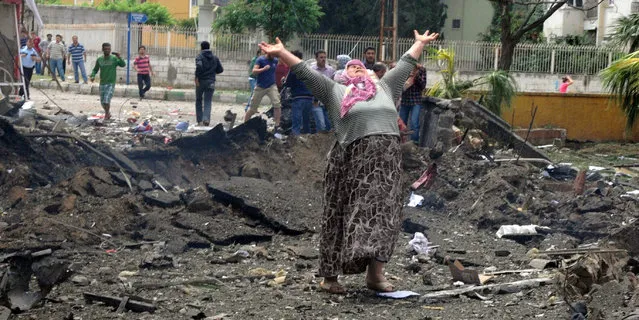
Bomb Attact At Reyhanli, Turkey

In one of the deadliest attacks in Turkey in recent years, two car bombs exploded near the border with Syria on Saturday, killing 43 and wounding 140 others. Turkish officials blamed the attack on a group linked to Syria, and a deputy prime minister called the neighboring country's intelligence service and military "the usual suspects."

The blasts, which were 15 minutes apart and hit the town of Reyhanli's busiest street, raised fears that Turkey could increasingly be drawn into Syria's brutal civil war.

Turkey already hosts Syria's political opposition and rebel commanders, has given shelter to hundreds of thousands of Syrian refugees and in the past retaliated against Syrian shells that landed in Turkey.
Details
13 May 2013 12:09:00