Loading...
Done
Sakura and Kazuhiro, Tokyo, 2015. Kazuhiro is a tattoo artist and Sakura is a photographer. They love cooking, live with their dog and two cats and each have the date of their wedding tattooed to their ring fingers. (Photo by Mami Kiyoshi/Galerie Annie Gabrielli/The Guardian)

Japanese artist Mami Kiyoshi has spent 15 years creating vivid portraits of people surrounded by their belongings – from wine bottles and violins to the odd stray pet. Mami Kiyoshi’s ongoing series “New Reading Portraits” is, in part, a nod to the mise-en-scène found in traditional woodcut printing. Here: Sakura and Kazuhiro, Tokyo, 2015. (Photo by Mami Kiyoshi/Galerie Annie Gabrielli/The Guardian)
Details
04 Aug 2017 08:48:00
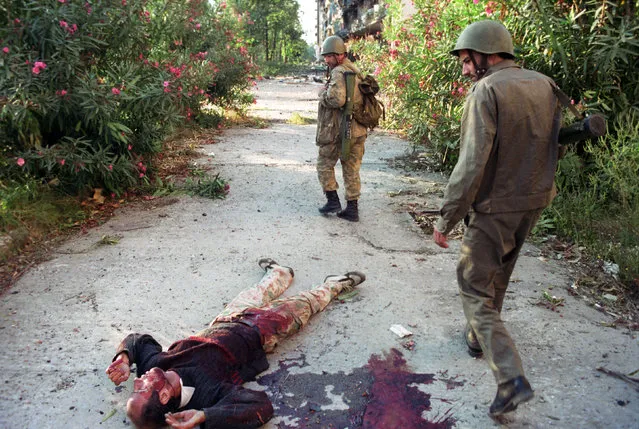
Abkhazia. Sukhumi, 1993. A house-to-house combat. (Photo by Andrei Solovyov/ITAR-TASS)

The War in Abkhazia from 1992 to 1993 was fought between Georgian government forces for the most part, and Abkhaz separatist forces, Russian armed forces and North Caucasian militants. Ethnic Georgians who lived in Abkhazia fought largely on the side of Georgian government forces. Ethnic Armenians and Russians within Abkhazia's population largely supported the Abkhazians, and many fought on their side. The separatists received support from thousands of North Caucasus and Cossack militants and from the Russian Federation forces stationed in and near Abkhazia. Here: Abkhazia. Sukhumi, 1993. A house-to-house combat. (Photo by Andrei Solovyov/ITAR-TASS)
Details
29 Sep 2017 07:31:00
“Bali Pip”. Bali street dog. Had the skin condition mange. (Photo by Alex Cearns/The Guardian)

For her book “Perfect Imperfection”, the Australian pet photographer Alex Cearns set out to capture the personalities of animals who adapt to their damaged or different bodies without complaint. Part of the proceeds from sales of Perfect Imperfection go to the Australian Animal Cancer Foundation. Here: “Bali Pip”. Bali street dog. Had the skin condition mange. (Photo by Alex Cearns/The Guardian)
Details
06 Apr 2018 00:03:00
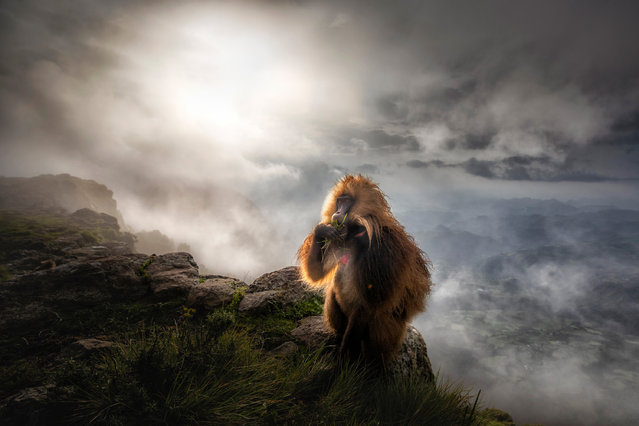
Highly commended, mammals: Gelada after the storm – Marco Gaiotti (Italy). “Gelada baboons are the only monkey species in the world that feed on grasses. They are native to the tableland of Ethiopia. Every morning large family groups wander from their sleeping places in the steep rock face, up to 1,000 metres high, to the feeding grounds at the tablelands. This image clearly depicts their feeding strategy: they pull out bunches of grass, sort the stalks and then lift them to their mouth. This shot was taken towards the end of the rainy season after a heavy storm”. (Photo by Marco Gaiotti/2019 GDT European Wildlife Photographer of the Year)

Highly commended, mammals: Gelada after the storm – Marco Gaiotti (Italy). “Gelada baboons are the only monkey species in the world that feed on grasses. They are native to the tableland of Ethiopia. Every morning large family groups wander from their sleeping places in the steep rock face, up to 1,000 metres high, to the feeding grounds at the tablelands. This image clearly depicts their feeding strategy: they pull out bunches of grass, sort the stalks and then lift them to their mouth. This shot was taken towards the end of the rainy season after a heavy storm”. (Photo by Marco Gaiotti/2019 GDT European Wildlife Photographer of the Year)
Details
31 Oct 2019 00:03:00
Military policemen try to open a path ahead for the funeral of 21-year-old Mohamed Adel, one of the army officers who died in yesterday's Sinai attacks, in Al-Kaliobeya, near Cairo, Egypt, July 2, 2015. (Photo by Mohamed Abd El Ghany/Reuters)

Military policemen try to open a path ahead for the funeral of 21-year-old Mohamed Adel, one of the army officers who died in yesterday's Sinai attacks, in Al-Kaliobeya, near Cairo, Egypt, July 2, 2015. Egypt launched air strikes on Islamist militant targets in the Sinai peninsula on Thursday, killing 23 fighters a day after the deadliest clashes in the region in years, security sources said. The sources said those killed had taken part in Wednesday's fighting in which 100 militants and 17 soldiers, including four officers, were killed, according to the army spokesman. (Photo by Mohamed Abd El Ghany/Reuters)
Details
03 Jul 2015 13:19:00
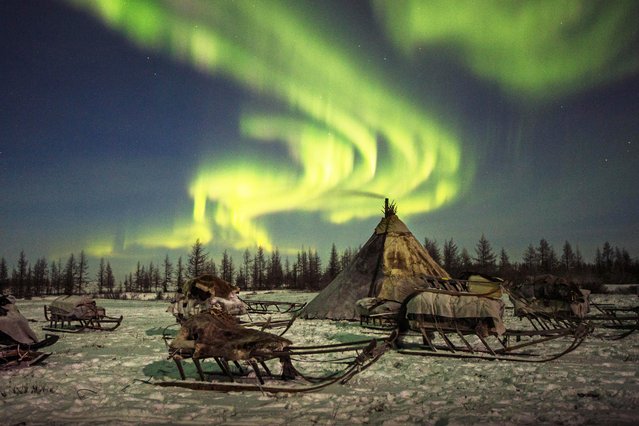
An empty camp is shown beneath a colourful sky in Siberia, December 2016. (Photo by Timothy Allen/Barcroft Productions)

A British photographer has captured life at the “edge of the world”. Timothy Allen, best known for his work on BBC's Human Planet, trekked through the freezing Siberian wilderness for 16 days as he joined part of an 800km migration of reindeer in the Yamal-Nenets region – a name that roughly translates to “edge of the world”. The stunning pictures feature the nomadic Nenets tribe, who drink blood to survive in -45°C temperatures. Timothy's epic journey, which will be revealed in an eight-minute documentary on Animal Planet USA, saw him travel across the bleak terrain of the frozen Ob River with the Nenets people in December last year. Here: An empty camp is shown beneath a colourful sky in Siberia, December 2016. (Photo by Timothy Allen/Barcroft Productions)
Details
19 Sep 2017 07:48:00
“I’m not scared of breaking the fourth wall”, Wallace has said of the photos where the subject is clearly aware of him taking the shot. “If they are looking at you in a photograph most photographers will think, oh, that’s not a good image. (But) people like to be involved and in the picture. You can see what they are thinking, see them talking”. (Photo by Dougie Wallace/The Guardian)

In Dougie Wallace’s photos of Mumbai taxis, the chatter, yelling, and constant horns of the city are almost audible. A selection of his images is on show at Gayfield Creative Spaces, Edinburgh, as part of the Retina photography festival until 30 July. For four years, the Glasgow-born Wallace focused his photos on one kind of taxi in particular: the Premier Padmini, a 1960s workhorse painted in black and yellow. Locally known as “Kaali-Peeli”, there were once more than 60,000 of them in the Indian city. But thanks to laws restricting pollution, the cars now are fast disappearing from Mumbai’s streets. (Photo by Dougie Wallace/The Guardian)
Details
13 Jul 2016 13:50:00
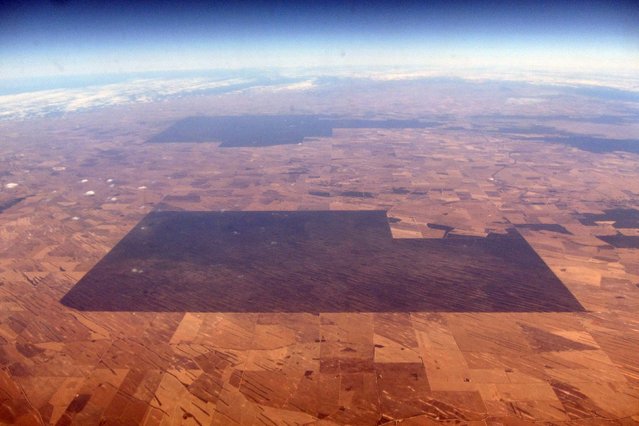
An area of vegetation can be seen amongst drought effected farmland in South Australia, November 12, 2015. (Photo by David Gray/Reuters)

An area of vegetation can be seen amongst drought effected farmland in South Australia, November 12, 2015. A pioneering Australian scheme to improve the management of water in the world's driest inhabited continent is facing its first real test as an intensifying El Nino threatens crops and builds tensions between farmers and environmentalists. An El Nino, a warming of sea-surface temperatures in the Pacific, is already causing drought and other extreme weather, affecting millions of people across parts of the world, and experts warn that the intensifying weather pattern could emerge as one of the strongest on record. (Photo by David Gray/Reuters)
Details
15 Nov 2015 08:01:00