Loading...
Done


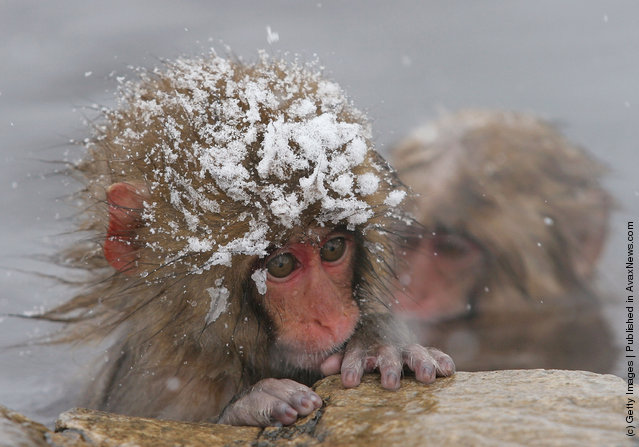
Japanese macaque monkeys enjoy sitting in the hot springs at Jigokudani-Onsen (Hell Valley) on January 23, 2005 in Jigokudani, Nagano-Prefecture, Japan. Japanese Macaques, also known as snow monkeys are the most northerly nonhuman primate in the world. In 1963 a female Macaque ventured into the hot springs to retrieve some soybeans. This behaviour was adopted by other monkeys, and eventually by the entire troop. This Macaque troop regularly visits the Jigokudani-Onsen springs to escape the cold. The hot springs are said to help relieve nerve pain and fatigue. (Photo by Koichi Kamoshida/Getty Images)
Details
20 May 2011 08:04:00
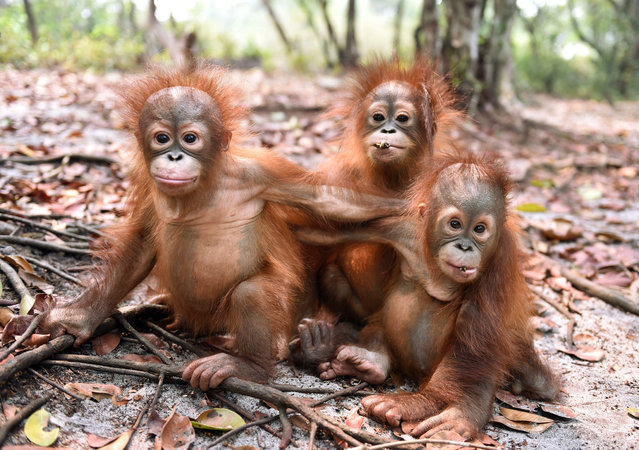
This handout picture taken and released by the Borneo Orangutan Survival Foundation (BOSF) on October 26, 2015 shows baby orangutans, which had previously suffered from respiratory problems, playing at a nursery in the rehabilitation centre operated by the BOSF on the outskirts of Palangkaraya in Central Kalimantan. (Photo by AFP Photo/Borneo Orangutan Survival Foundation/Indrayana)

This handout picture taken and released by the Borneo Orangutan Survival Foundation (BOSF) on October 26, 2015 shows baby orangutans, which had previously suffered from respiratory problems, playing at a nursery in the rehabilitation centre operated by the BOSF on the outskirts of Palangkaraya in Central Kalimantan. Endangered orangutans are falling victim to a devastating haze crisis that has left them sick, malnourished and severely traumatised as fires rage through Indonesia's forests, reducing their habitat to a charred wasteland. (Photo by AFP Photo/Borneo Orangutan Survival Foundation/Indrayana)
Details
02 Nov 2015 08:05:00
A poster for the IMAX presentation of “The Hunger Games: Catching Fire” (left), and a teaser poster for “The Hunger Games: Mockingjay, Part I”, both created by the Los Angeles-based design firm IGNITION. (Photo by Key Art Awards 2014)

A poster for the IMAX presentation of “The Hunger Games: Catching Fire” (left), and a teaser poster for “The Hunger Games: Mockingjay, Part I”, both created by the Los Angeles-based design firm IGNITION. Both are nominated for the 2014 Key Art Awards in the category of Theatrical Domestic One-Sheet. The Hollywood Reporter's annual competition for the best in film and TV advertising honors some of the most creative imagery used in movie posters. Here is a selection of some of this year's nominees. (Photo by Key Art Awards 2014)
Details
08 Oct 2014 12:25:00
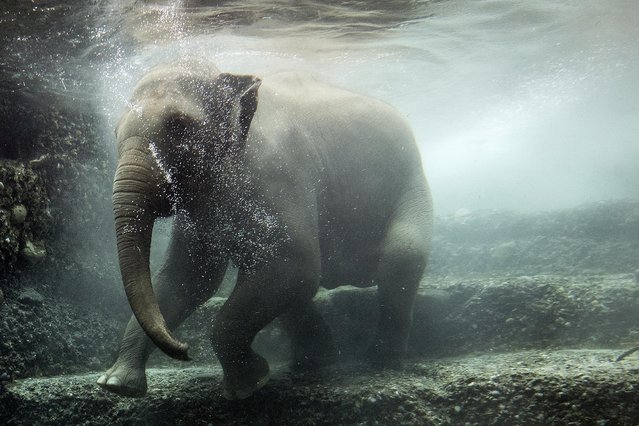
The elephant cow Omysha dives under water in its enclosure at the Zoo in Zurich, Switzerland, Wednesday, February 3, 2021. (Photo by Alexandra Wey/Keystone via AP Photo)

The elephant cow Omysha dives under water in its enclosure at the Zoo in Zurich, Switzerland, Wednesday, February 3, 2021. (Photo by Alexandra Wey/Keystone via AP Photo)
Details
14 Feb 2021 09:33:00
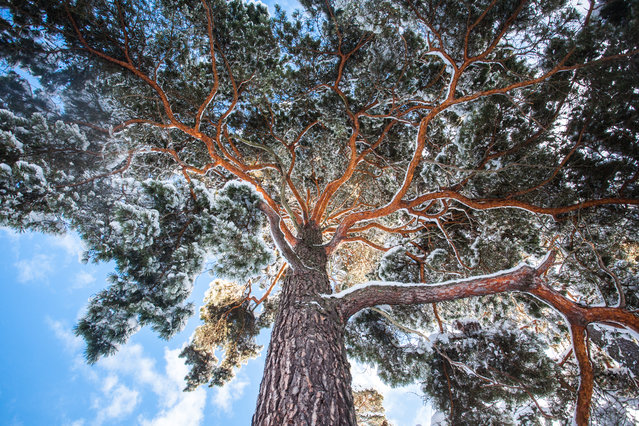
Snow covered pine tree reaches for the sky. Shot in Sweden on a crisp winter day. (Photo by Anna Rebecka Lindberg/The Guardian)

Snow covered pine tree reaches for the sky. Shot in Sweden on a crisp winter day. (Photo by Anna Rebecka Lindberg/The Guardian)
Details
20 Apr 2019 00:03:00
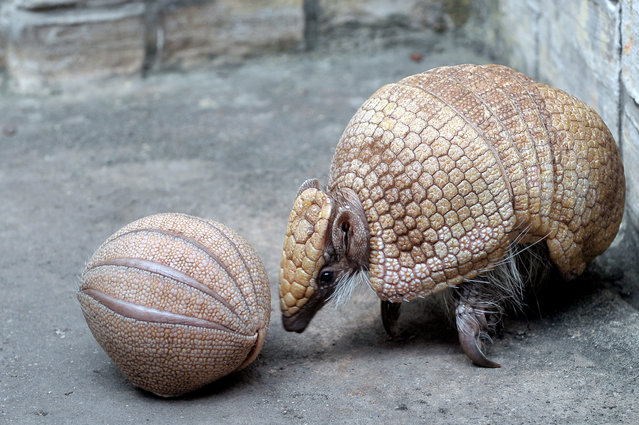
A four-week old southern three-banded armadillo (Tolypeutes matacus) is rolled up into a ball next to its mother in the tropical house of Budapest Zoo in Budapest, Hungary on May 3, 2019. The South American insect-eating mammal and its close relative, the Brasilian three-banded armadillo (Tolypeutes tricinctus) are the only two species of armadillos capable of rolling into a complete ball to defend themselves when feeling threatened. (Photo by Attila Kovács/EPA/EFE)

A four-week old southern three-banded armadillo (Tolypeutes matacus) is rolled up into a ball next to its mother in the tropical house of Budapest Zoo in Budapest, Hungary on May 3, 2019. The South American insect-eating mammal and its close relative, the Brasilian three-banded armadillo (Tolypeutes tricinctus) are the only two species of armadillos capable of rolling into a complete ball to defend themselves when feeling threatened. (Photo by Attila Kovács/EPA/EFE)
Details
05 May 2019 00:03:00
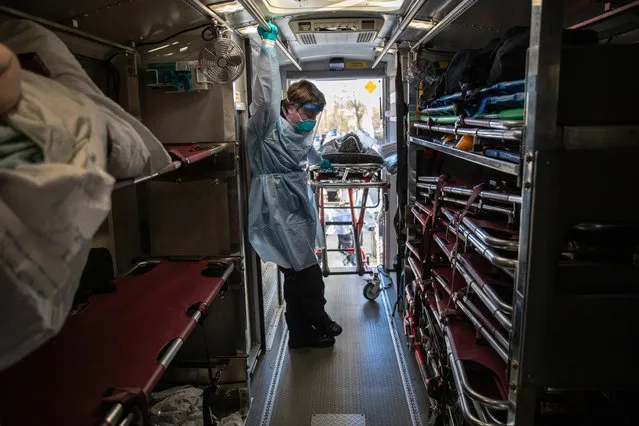
EMT Christian Amoroso, wearing personal protective equipment (PPE), pauses while unloading COVID-19 patients at the Montefiore Medical Center Wakefield Campus on April 06, 2020 in the Bronx borough of New York City. A specialized bus known as a Medical Evacuation Transport Unit (METU), caries infected patients on stretchers and benches between hospitals. The patient transfers are designed to help overwhelmed hospitals even out caseloads in Westchester County and New York City at the epicenter of the U.S. coronavirus pandemic. The patients were being transferred from the Einstein Campus, Wyler Hospital, also a Bronx Montefiore hospital. The transfers are staffed by Empress EMS, Yonkers police and hospital staff on both ends wearing PPE. (Photo by John Moore/Getty Images)

EMT Christian Amoroso, wearing personal protective equipment (PPE), pauses while unloading COVID-19 patients at the Montefiore Medical Center Wakefield Campus on April 06, 2020 in the Bronx borough of New York City. A specialized bus known as a Medical Evacuation Transport Unit (METU), caries infected patients on stretchers and benches between hospitals. (Photo by John Moore/Getty Images)
Details
19 Apr 2020 00:01:00
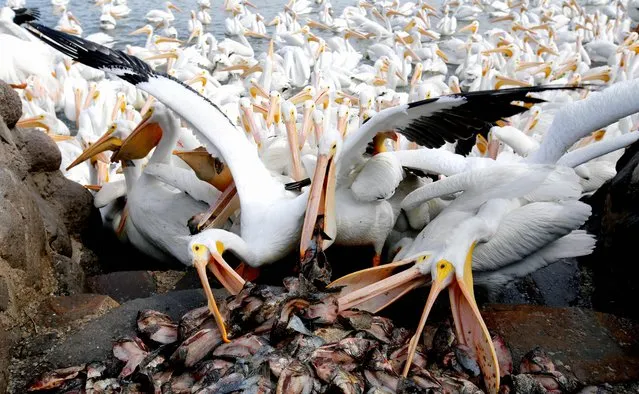
A pod of white pelicans, one of the largest birds in Canada and the US, are seen on the shore of the Chapala lagoon in Cojumatlan de Regules, Mexico, on January 28, 2022. White pelicans travel thousands of kilometers migrating from the cold temperatures of North America. (Photo by Ulises Ruiz/AFP Photo)

A pod of white pelicans, one of the largest birds in Canada and the US, are seen on the shore of the Chapala lagoon in Cojumatlan de Regules, Mexico, on January 28, 2022. White pelicans travel thousands of kilometers migrating from the cold temperatures of North America. (Photo by Ulises Ruiz/AFP Photo)
Details
06 Feb 2022 06:20:00