A woman uses a phone near the scene where many people died and were injured in a stampede during a Halloween festival in Seoul, South Korea on October 30, 2022. (Photo by Kim Hong-ji/Reuters)
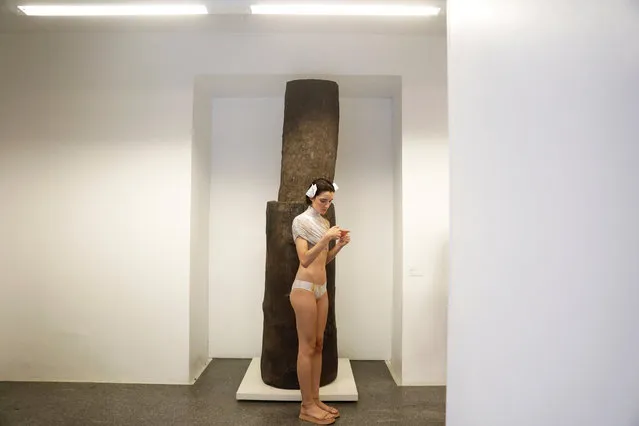
A model looks at her mobile phone backstage before Lenny Niemeyer show during Sao Paulo Fashion Week in Sao Paulo, Brazil, April 23, 2019. (Photo by Nacho Doce/Reuters)
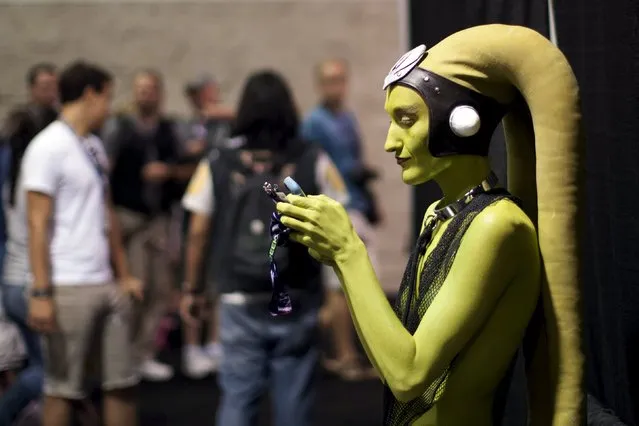
A woman in costume checks her phone at the Star Wars Celebration convention in Anaheim, California, April 16, 2015. The Star Wars Celebration runs through April 19 at the Anaheim Convention Center. (Photo by David McNew/Reuters)
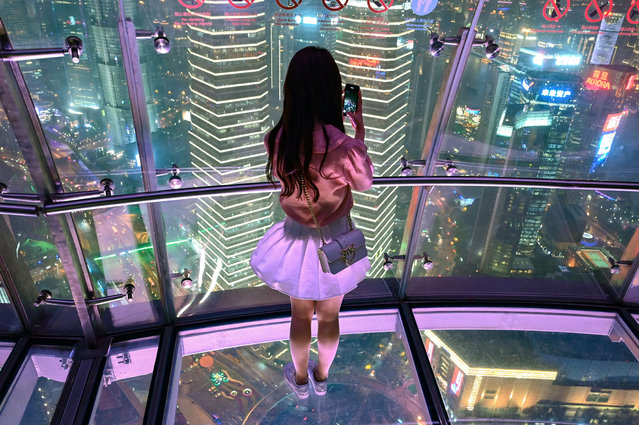
A young woman takes pictures of the city with her mobile phone, from the glass-floor observation platform, in the Oriental Pearl Tower, in the financial district of Shanghai, on May 9, 2019. (Photo by Hector Retamal/AFP Photo)
A young couple rest on a bench, as a street actor wearing an Angel costume speaks on the phone in Nikolskaya street near the Kremlin in Moscow, Russia, Wednesday, March 31, 2021. (Photo by Alexander Zemlianichenko/AP Photo)
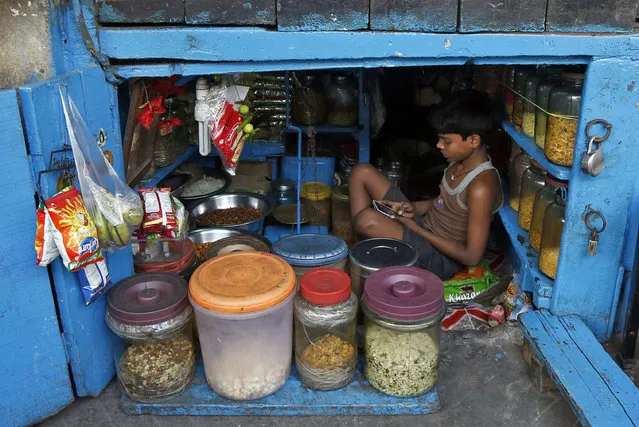
A boy uses a mobile phone as he sits inside his father's snacks shop along a road in Kolkata, India, February 22, 2016. (Photo by Rupak De Chowdhuri/Reuters)
Associated Press photographer Wong Maye-E tries to get her North Korean subjects to open up as much as is possible in an authoritarian country with no tolerance for dissent and great distrust of foreigners. She has taken dozens of portraits of North Koreans over the past three years, often after breaking the ice by taking photos with an instant camera and sharing them. Her question for everyone she photographs: What is your motto? Their answers reflect both their varied lives and the government that looms incessantly over all of them. (Photo by Wong Maye-E/AP Photo)
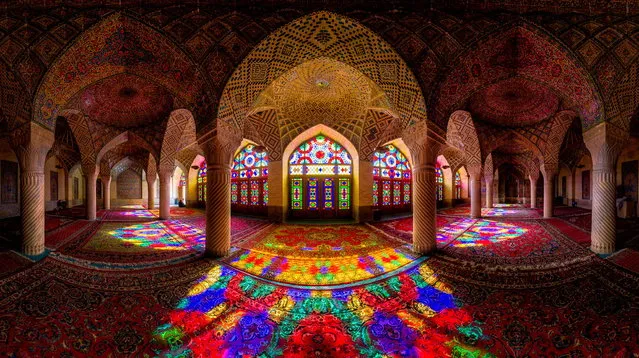
The Nasīr al-Mulk Mosque or Pink Mosque is a traditional mosque in Shiraz, Iran, located in Goade-e-Araban place (near the famous Shah Cheragh mosque). The mosque was built during the Qājār era, and is still in use under protection by Nasir al Mulk's Endowment Foundation. It was built by the order of Mirza Hasan Ali Nasir al Molk, one of the lords of the Qajar Dynasty, in 1876 and was finished in 1888. The designers were Muhammad Hasan-e-Memar and Muhammad Reza Kashi Paz-e-Shirazi. The mosque extensively uses colored glass in its facade, and displays other traditional elements such as panj kāseh-i (five concaves) in its design, it is also named in popular culture as Pink Mosque due to the usage of beautiful pink color tiles for its interior design.