Loading...
Done
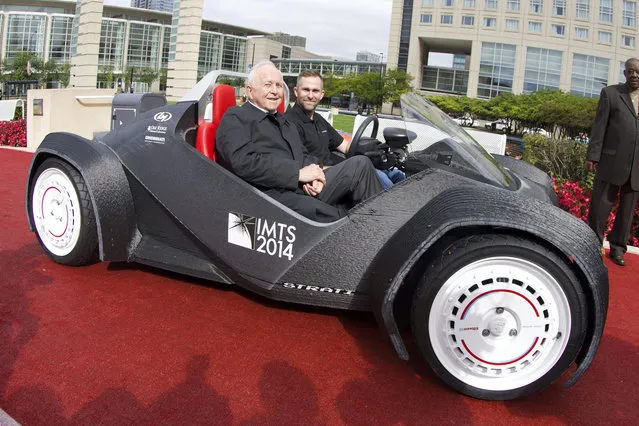
The world's first 3D printed car – the Stratti – was built in just 45 hours at the International Manufacturing Technology Show which took place between September 8 – 13, 2014. The Strati, which is Italian for layers, has a chassis body made of one solid piece and has a top speed of 40mph. (Photo by Barcroft Media/ABACAPress)

The world's first 3D printed car – the Stratti – was built in just 45 hours at the International Manufacturing Technology Show which took place between September 8 – 13, 2014. The Strati, which is Italian for layers, has a chassis body made of one solid piece and has a top speed of 40mph. The tyres, seats, wheels, battery, wiring, suspension, electric motor and window shield of the revolutionary vehicle were made using conventional methods. (Photo by Barcroft Media/ABACAPress)
Details
24 Oct 2014 12:44:00
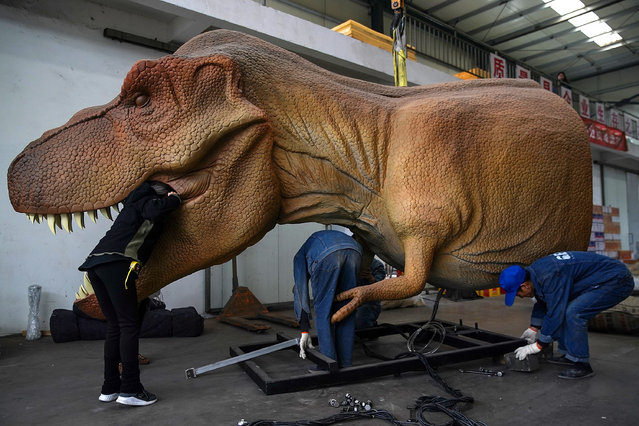
Chinese workers maintain an Animatronic Dinosaurs at Gengu Dinosaurs Science and Technology company on November 13, 2019 in Zigong, Sichuan Province, China. There are hundreds of simulated dinosaur manufacturers in Zigong City. It is the largest simulated dinosaur manufacturing in China. It accounts for 95% of mainland China's production and 85% of the world's total. Its products are exported to more than 100 countries. (Photo by Lintao Zhang/Getty Images)

Chinese workers maintain an Animatronic Dinosaurs at Gengu Dinosaurs Science and Technology company on November 13, 2019 in Zigong, Sichuan Province, China. There are hundreds of simulated dinosaur manufacturers in Zigong City. It is the largest simulated dinosaur manufacturing in China. It accounts for 95% of mainland China's production and 85% of the world's total. Its products are exported to more than 100 countries. (Photo by Lintao Zhang/Getty Images)
Details
03 Dec 2019 00:01:00
Heads of love dolls are seen on the shelf on March 9, 2017 in Tokyo, Japan. Japan's oldest and largest “love doll” maker Orient Industry, has been producing silicone love dolls since 1977, and has seen there is a trend for intimate relationships with silicone dolls in Japan. The Orient Industry's factory produces approximately 500 life size hand-made per year, and one doll, costs up to 600,000JPY (approx. 6,000 USD), takes four to five weeks to be finished. Originally, the company was marketing love dolls for disabled people, and the company continues to support the community by providing discounts and consulting their sexual urges. (Photo by Taro Karibe/Getty Images)

Heads of love dolls are seen on the shelf on March 9, 2017 in Tokyo, Japan. Japan's oldest and largest “love doll” maker Orient Industry, has been producing silicone love dolls since 1977, and has seen there is a trend for intimate relationships with silicone dolls in Japan. (Photo by Taro Karibe/Getty Images)
Details
18 Mar 2017 10:32:00


SpaceX, the space transportation company built from scratch by visionary billionaire Elon Musk, has the grand goal of space travel evolution through the use of re-usable rockets. Its technology – which has proven its worth several times – can reduce the costs of space transportation to its fraction, making it a more affordable way of reaching orbit or traveling beyond.
Details
12 Aug 2015 08:47:00
A woman surveys the damage after the earthquake on March 17, 2011 in Kensennuma, Japan. Residents were allowed back to their homes today and began the massive cleanup operation caused by a 9.0 magnitude strong earthquake that struck on March 11 off the coast of north-eastern Japan. The quake triggered a tsunami wave of up to 10 metres which engulfed large parts of north-eastern Japan. The death toll has risen past 5000 with at least 8600 people still missing. (Photo by Chris McGrath/Getty Images)

A woman surveys the damage after the earthquake on March 17, 2011 in Kensennuma, Japan. Residents were allowed back to their homes today and began the massive cleanup operation caused by a 9.0 magnitude strong earthquake that struck on March 11 off the coast of north-eastern Japan. The quake triggered a tsunami wave of up to 10 metres which engulfed large parts of north-eastern Japan. The death toll has risen past 5000 with at least 8600 people still missing. (Photo by Chris McGrath/Getty Images)
Details
13 Mar 2017 00:05:00
Mikhail Kalashnikov, the father of the world's most popular assault rifle, is handed  an AK-74 November 23, 2002 in Izhevsk,1000 East km. from Moscow. November 23 marked the 55th anniversary of the release of the first Kalashnikov gun. According to the Moscow-based Center for Analysis of Strategic and Technologies some 70 million to 100 million Kalashnikovs have been built worldwide since 1947, compared about 7 million to Kalashnikov's Western rival the M-16 assault rifles. (Photo by Oleg Nikishin/Getty Images)

Mikhail Kalashnikov, the father of the world's most popular assault rifle, is handed an AK-74 November 23, 2002 in Izhevsk,1000 East km. from Moscow. November 23 marked the 55th anniversary of the release of the first Kalashnikov gun. According to the Moscow-based Center for Analysis of Strategic and Technologies some 70 million to 100 million Kalashnikovs have been built worldwide since 1947, compared about 7 million to Kalashnikov's Western rival the M-16 assault rifles. (Photo by Oleg Nikishin/Getty Images)
Details
24 Dec 2013 09:12:00
Brain-on-a-chip. Dazzling in green and magenta this image shows the nerve fibres (in green) produced by neural stem cells (in magenta) as they grow on a synthetic gel. Captured by a technique known as confocal microscopy, the image is part of research shedding light on how tinkering with the environment can affect the way in which nerve fibres grow. (Photo by Collin Edington and Iris Lee/Massachusetts Institute of Technology/Wellcome Images)

Brain-on-a-chip. Dazzling in green and magenta this image shows the nerve fibres (in green) produced by neural stem cells (in magenta) as they grow on a synthetic gel. Captured by a technique known as confocal microscopy, the image is part of research shedding light on how tinkering with the environment can affect the way in which nerve fibres grow. (Photo by Collin Edington and Iris Lee/Massachusetts Institute of Technology/Wellcome Images)
Details
17 Mar 2017 00:01:00
A woman uses a virtual reality (VR) headset to view images by Mexican painter Frida Kahlo in Mexico City, Mexico, 23 May 2018. The technological giant Google launched the “The Faces of Frida”, an interactive digital exhibition that treasures the heartrending work of the Mexican artist to tell her story from different points of view, with attention to the invisible details. (Photo by Sashenka Gutierrez/EPA/EFE)

A woman uses a virtual reality (VR) headset to view images by Mexican painter Frida Kahlo in Mexico City, Mexico, 23 May 2018. The technological giant Google launched the “The Faces of Frida”, an interactive digital exhibition that treasures the heartrending work of the Mexican artist to tell her story from different points of view, with attention to the invisible details. (Photo by Sashenka Gutierrez/EPA/EFE)
Details
27 May 2018 07:02:00