Loading...
Done
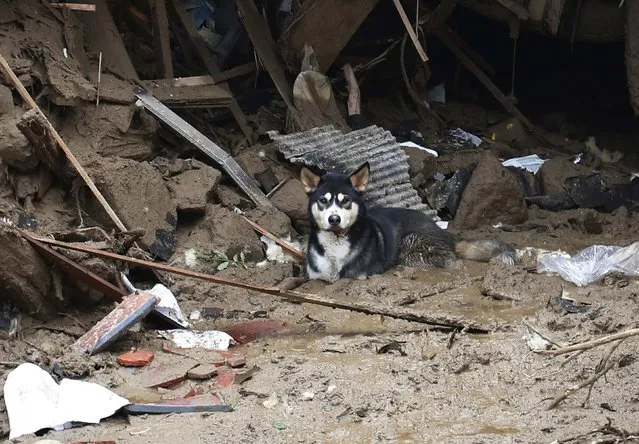
A dog takes a rest under a destroyed house at a site where a landslide swept through a residential area at Asaminami ward in Hiroshima, western Japan, August 20, 2014. (Photo by Toru Hanai/Reuters)

A dog takes a rest under a destroyed house at a site where a landslide swept through a residential area at Asaminami ward in Hiroshima, western Japan, August 20, 2014. At least 36 people, including several children, were killed in Japan on Wednesday, when landslides triggered by torrential rain slammed into the outskirts of the western city of Hiroshima, and the toll could rise further, police said. Seven people were missing after a month's worth of rain fell overnight, loosening slopes already saturated by heavy rain over the past few weeks. (Photo by Toru Hanai/Reuters)
Details
21 Aug 2014 10:13:00
Isabel Schmalenbach, an environmental scientist with the Helgoland Biological Institute (Biologische Anstalt Helgoland), part of the Alfred Wegener Institute for Polar and Marine Research, holds a one-year old baby European lobster (Homarus gammarus) raised at the institute on August 3, 2013 on Helgoland Island, Germany. (Photo by Sean Gallup/Getty Images)

Isabel Schmalenbach, an environmental scientist with the Helgoland Biological Institute (Biologische Anstalt Helgoland), part of the Alfred Wegener Institute for Polar and Marine Research, holds a one-year old baby European lobster (Homarus gammarus) raised at the institute on August 3, 2013 on Helgoland Island, Germany. Later in the day Schmalenbach and her colleagues released a total of 415 one-year old lobsters into the North Sea as part of an effort to repopulate the lobster population around Helgoland (also called Heligoland). In the 19th century local fishermen caught up to 80,000 lobsters a year in the surrounding waters, combined with the heavy allied bombing of the island during and after World War II, as well as other environmental factors, decimated the lobster population. (Photo by Sean Gallup)
Details
05 Aug 2013 08:39:00
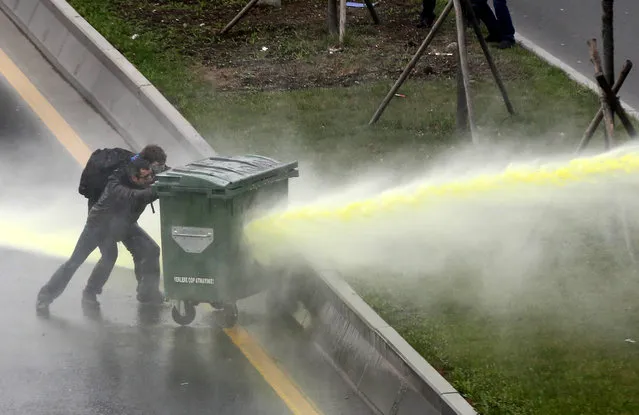
People protect themselves behind a trash can as anti-riot olice fires water cannon to disperse thousands of people demonstrating following the death of Berkin Elvan, a teenage boy wounded in mass anti-government demonstrations last year, on March 11, 2014 near the Middle East Technical University (ODTU) in Ankara. (Photo by Adem Altan/AFP Photo)

People protect themselves behind a trash can as anti-riot olice fires water cannon to disperse thousands of people demonstrating following the death of Berkin Elvan, a teenage boy wounded in mass anti-government demonstrations last year, on March 11, 2014 near the Middle East Technical University (ODTU) in Ankara. Elvan's story – he spent 269 days in a coma – gripped the nation and became a symbol of the heavy-handed tactics used by police to reign in the biggest demonstrations against Prime Minister Recep Tayyip Erdogan since he came to power in 2003. (Photo by Adem Altan/AFP Photo)
Details
13 Mar 2014 09:23:00
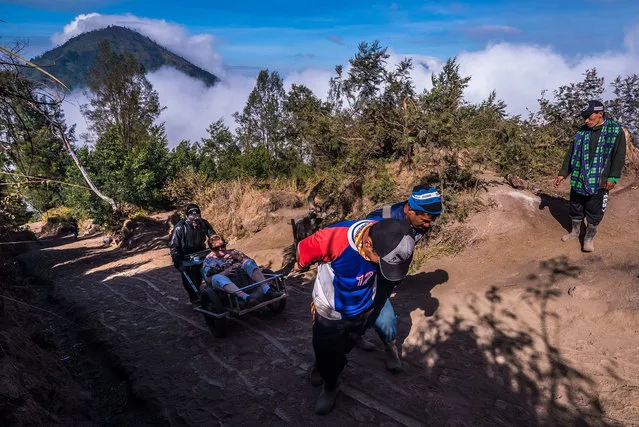
Miners pulling up lazy tourists to the rim of Kawah Ijen (Ijen Volcano), East Java, Indonesia on September 21, 2017. They will earn as much as they would bring down a load of sulfur. Nomadic Explorer, Cultural Lifestyle Photographer Claudio Sieber captured striking images of miners working at Ijen volcanic range in East Java, Indonesia. The sulphur miners risk their lives daily as they climb the active volcano carrying heavy loads, which they sell to sugar refineries. Shortly after midnight curious tourists are flocking in hundreds through the gate of Ijen's foothills to be right on time, driven by the images others took before them. Kawah Ijen is the one of the world's largest acidic volcanic crater lake; famous for its turquoise color as well as the unreal atmosphere it offers during darkness. A dusty path zigzags 3 kilometers up to the crater rim. This doesn't mean anything challenging; in particular, special sights have to be deserved anyway. The irritating smell of sulfur announces the near of the crater's existence. Arriving on the crater's rim the reward for the torture becomes visible. Blue fire darts its tongues through the fumes of sulfur dioxide. Somehow, the spectacle isn't as romantic as expected, since it is also the rough working space of approx. 150 sulfur miners who start their shift at 1 am. Lately, harvesting the abundance of devil's gold received international attention. This did obviously not really improve a miner's lifestyle; neither did it contribute to a better wage. (Photo by Claudio Sieber/Barcroft Images)

Miners pulling up lazy tourists to the rim of Kawah Ijen (Ijen Volcano), East Java, Indonesia on September 21, 2017. They will earn as much as they would bring down a load of sulfur. Nomadic Explorer, Cultural Lifestyle Photographer Claudio Sieber captured striking images of miners working at Ijen volcanic range in East Java, Indonesia. The sulphur miners risk their lives daily as they climb the active volcano carrying heavy loads, which they sell to sugar refineries. (Photo by Claudio Sieber/Barcroft Images)
Details
02 Oct 2017 08:31:00
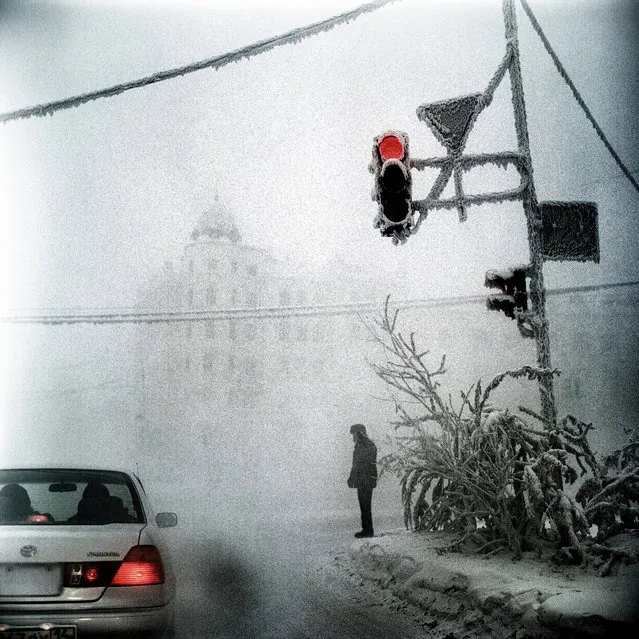
January 2013. A scene in Yakutsk, Siberia, the coldest city in the world. (Photo by Steeve Iuncker/Agence VU)

Yakutsk, a remote city in Eastern Siberia along the Lena River, is the coldest city in the world. Located 1840 km away from Irkoustk and 5000 km away from Moscow, this city founded in 1632 by the Cossacks imposes upon its inhabitants an extreme way of life. And yet, despite particularly harsh conditions, Yakutsk boasts a population of 270,000, or a quarter of the entire population of Siberia. No other place on the planet experiences the temperature extreme found here: in winter, the temperatures regularly fall to minus 40° (the coldest temperature recorded was –64°C) and in summer often reaches temperatures above 30°C. Photo: January 2013. A scene in Yakutsk, Siberia, the coldest city in the world. (Photo by Steeve Iuncker/Agence VU)
Details
29 Apr 2013 10:30:00
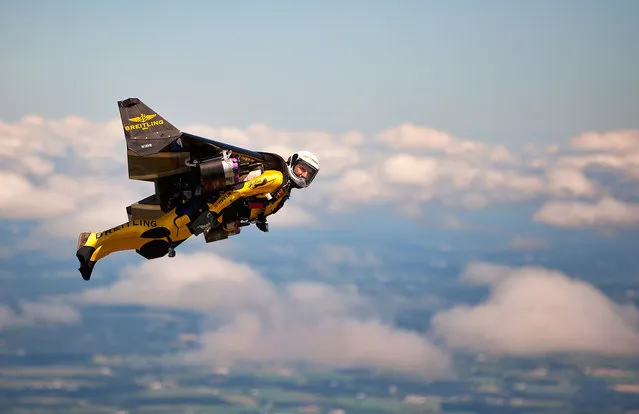
Jetman during a trial flight from Fond du Lac airport on Monday July 29, 2013. While skydiving several years ago Yves Rossy thought it would be cool to not just fall to earth but fly around with a jetpack on his back. So he invented one and will jump out of a helicopter over Oshkosh on Tuesday at AirVenture air and zoom around in his jetpack, his first public appearance in the U.S. (Photo by Mike Shore/Courtesy of Breitling)

Yves “Jetman”, Rossy made his first public performance in the United States on Tuesday during the afternoon air show at EAA AirVenture. As thousands of spectators leaned back and clicked cameras, Rossy jumped out of a helicopter with his 6-foot carbon fiber wing armed with four 45-pound-thrust JetCat engines strapped to his back. Photo: Jetman during a trial flight from Fond du Lac airport on Monday July 29, 2013. (Photo by Mike Shore/Courtesy of Breitling)
Details
31 Jul 2013 13:05:00
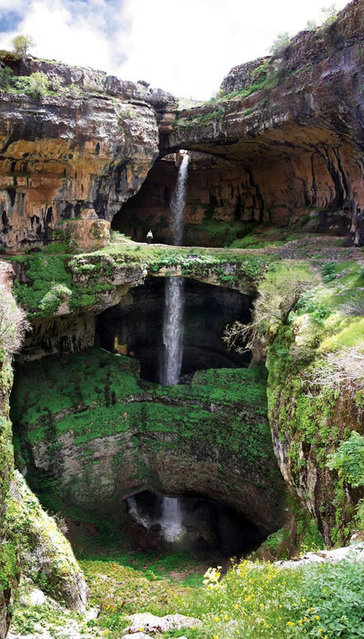
Baatara Gorge Waterfall

Discovered in 1952 by French bio-speleologist Henri Coiffait, the waterfall and accompanying sinkhole were fully mapped in the 1980s by the Spéléo club du Liban. The cave is also known as the "Cave of the Three Bridges." Traveling from Laklouk to Tannourine one passes the village of Balaa, and the "Three Bridges Chasm" (in French "Gouffre des Trois Ponts") is a five-minute journey into the valley below where one sees three natural bridges, rising one above the other and overhanging a chasm descending into Mount Lebanon. During the spring melt, a 90–100-metre (300–330 ft) cascade falls behind the three bridges and then down into the 250-metre (820 ft) chasm. A 1988 fluorescent dye test demonstrated that the water emerged at the spring of Dalleh in Mgharet al-Ghaouaghir.
Details
31 Aug 2013 11:27:00
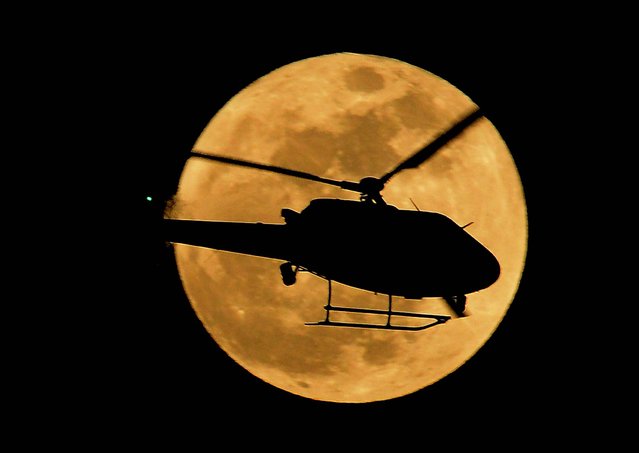
LAPD chopper flies in a foregraund of the Super Moon in Los Angeles, California on May 05, 2012

LAPD chopper flies in a foregraund of the Super Moon in Los Angeles, California on May 05, 2012. Tonight's moon is set to appear 14 percent larger and 30 percent brighter from our perspective on Earth. The Supermoon lines up much closely with perigee – the moon's closest point to Earth. The 2012 May full moon falls some six minutes after perigee, the moon's closest point to Earth for this month. At perigee, the moon lies only 221,802 miles (356,955 kilometers ) away. Later this month, on May 19, the moon will swing out to apogee – its farthest point for the month – at 252,555 miles (406,448 kilometers) distant. (Photo by AFP/File, Joe Klamar)
Details
08 May 2012 10:54:00