Loading...
Done
Women dancing at the disco club Xenon in New York City in 1978. (Photo by Waring Abbott/Getty Images)

Women dancing at the disco club Xenon in New York City, USA in 1978. Xenon was a popular disco in Manhattan in the late 1970s and early 1980s. It was the only nightclub popular enough to compete with Studio 54. (Photo by Waring Abbott/Getty Images)
Details
20 Mar 2018 00:01:00
Russian cadets march during the annual cadet schools get-together in Moscow, Russia on March 30, 2018. (Photo by Mladen Antonov/AFP Photo)

Russian cadets march during the annual cadet schools get-together in Moscow, Russia on March 30, 2018. (Photo by Mladen Antonov/AFP Photo)
Details
01 Apr 2018 07:32:00
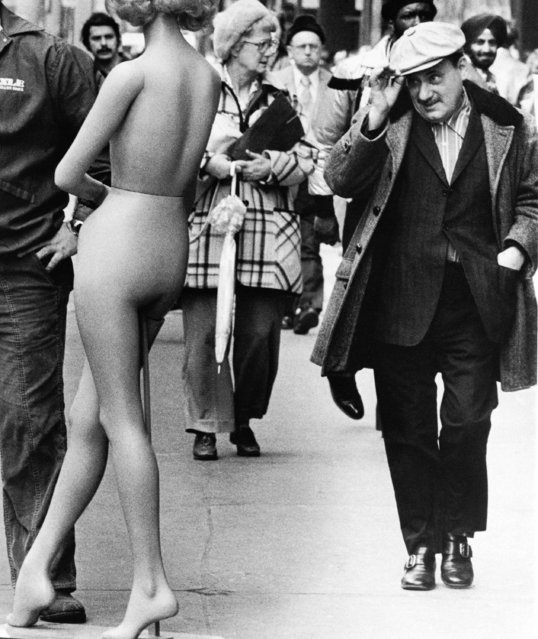
A hint of Spring Fever is evidenced by this passerby tipping his hat to a store fixture mannequin on a State St. sidewalk in downtown Chicago on March 23, 1978. The mannequin was awaiting pickup to be transported. (Photo by AP Photo)

A hint of Spring Fever is evidenced by this passerby tipping his hat to a store fixture mannequin on a State St. sidewalk in downtown Chicago on March 23, 1978. The mannequin was awaiting pickup to be transported. (Photo by AP Photo)
Details
04 Apr 2018 00:03:00
A girl paddles on her stand-up board on the waters of Guanabara bay at Bica beach in Rio de Janeiro Brazil, January 10, 2016. (Photo by Ricardo Moraes/Reuters)

A girl paddles on her stand-up board on the waters of Guanabara bay at Bica beach in Rio de Janeiro Brazil, January 10, 2016. Few features capture the beauty, or the problems, of one of the world's most dramatic urban landscapes like Guanabara Bay - the finger-like inlet that forms the shoreline and harbor for Rio de Janeiro. The bay, which carves into southeast Brazil from the Atlantic Ocean, literally gave Rio its name when Portuguese mariners mistook it for a “rio”, or “river”. Four centuries later, the bay is preparing to welcome another sort of seafarer – Olympic sailors, who will navigate the bay when the 2016 Rio Olympics kick off in August. (Photo by Ricardo Moraes/Reuters)

Details
28 Apr 2016 12:13:00
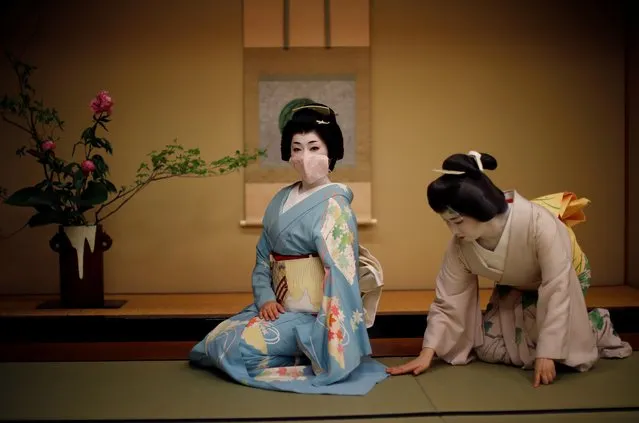
Mayu adjusts Koiku’s kimono, as Koiku wears a protective face mask while posing for a photograph, before they work at a party where they will entertain with other geisha at Japanese luxury restaurant Asada in Tokyo, Japan, June 23, 2020. The coronavirus pandemic has made Tokyo's geisha fear for their centuries-old profession as never before. Though the number of geisha - famed for their witty conversation, beauty and skill at traditional arts - has been falling for years, they were without work for months due to Japan's state of emergency and now operate under awkward social distancing rules. Engagements are down 95 percent, and come with new rules: no pouring drinks for customers or touching them even to shake hands, and sitting 2 meters apart. Masks are hard to wear with their elaborate wigs, so they mostly don't. “I was just full of anxiety”, said Mayu, 47. “I went through my photos, sorted my kimonos ... The thought of a second wave is terrifying”. (Photo by Kim Kyung-Hoon/Reuters)

Mayu adjusts Koiku’s kimono, as Koiku wears a protective face mask while posing for a photograph, before they work at a party where they will entertain with other geisha at Japanese luxury restaurant Asada in Tokyo, Japan, June 23, 2020. (Photo by Kim Kyung-Hoon/Reuters)
Details
23 Jul 2020 00:03:00
An Egyptian man shows off his motorcycle skills, following the outbreak of the coronavirus disease (COVID-19), in Cairo, Egypt on July 17, 2020. (Photo by Mohamed Abd El Ghany/Reuters)

An Egyptian man shows off his motorcycle skills, following the outbreak of the coronavirus disease (COVID-19), in Cairo, Egypt on July 17, 2020. (Photo by Mohamed Abd El Ghany/Reuters)
Details
26 Jul 2020 00:03:00
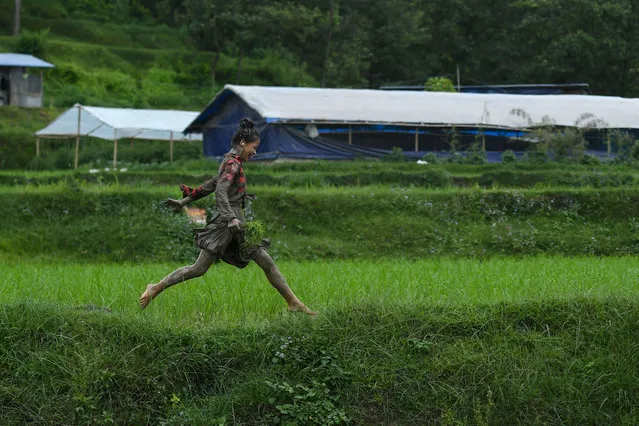
A girl walks along rice paddy fields during “National Paddy Day”, which marks the start of the annual rice planting season, in Tokha village on the outskirts of Kathmandu on June 29, 2020. Splashing mud and drinking local rice beer, Nepali farmers this week celebrated National Paddy Day to mark the beginning of the rice-planting season, despite some coronavirus lockdown measures still in place. Traditional farming songs and laughter echoed in the air as farmers waded into waterlogged fields to sow green paddy. (Photo by Prakash Mathema/AFP Photo)

A girl walks along rice paddy fields during “National Paddy Day”, which marks the start of the annual rice planting season, in Tokha village on the outskirts of Kathmandu on June 29, 2020. Splashing mud and drinking local rice beer, Nepali farmers this week celebrated National Paddy Day to mark the beginning of the rice-planting season, despite some coronavirus lockdown measures still in place. Traditional farming songs and laughter echoed in the air as farmers waded into waterlogged fields to sow green paddy. (Photo by Prakash Mathema/AFP Photo)
Details
02 Aug 2020 00:01:00
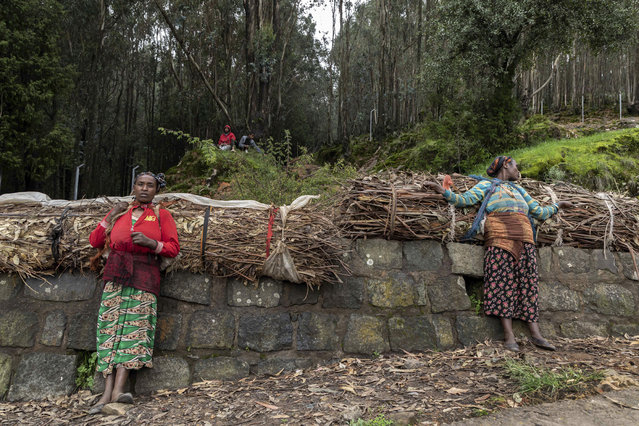
Mare Sorie, left, and her friend Tsehaynesh Golja, right, take a rest as they carry bundles of firewood from the forest around Entoto mountain near Addis Ababa, Ethiopia Friday, July 17, 2020. (Photo by Mulugeta Ayene/AP Photo)

Mare Sorie, left, and her friend Tsehaynesh Golja, right, take a rest as they carry bundles of firewood from the forest around Entoto mountain near Addis Ababa, Ethiopia Friday, July 17, 2020. (Photo by Mulugeta Ayene/AP Photo)
Details
03 Aug 2020 00:03:00