Loading...
Done
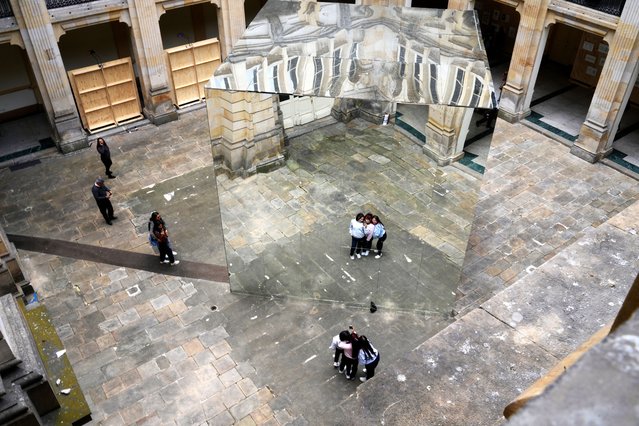
A trio poses for a photo in front of the art installation Surrender (Flag) by John Gerrard of Ireland displayed in a courtyard of the Palacio de San Francisco, as part of the first art biennial in Bogota, Colombia, Tuesday, September 23, 2025. (Photo by Fernando Vergara/AP Photo)

A trio poses for a photo in front of the art installation Surrender (Flag) by John Gerrard of Ireland displayed in a courtyard of the Palacio de San Francisco, as part of the first art biennial in Bogota, Colombia, Tuesday, September 23, 2025. (Photo by Fernando Vergara/AP Photo)
Details
18 Nov 2025 04:11:00
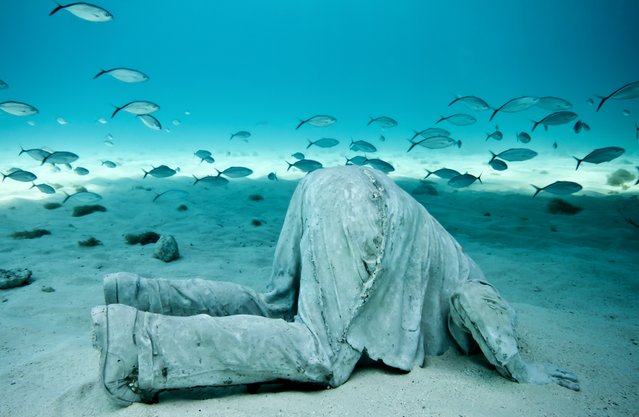
“The banker”. Underwater Sculpture, Museo Subacuático de Arte, Cancun. (Photo by Jason deCaires Taylor/UnderwaterSculpture)

“The banker”. Underwater Sculpture, Museo Subacuático de Arte, Cancun. (Photo by Jason deCaires Taylor/UnderwaterSculpture)
Details
28 Mar 2014 11:28:00
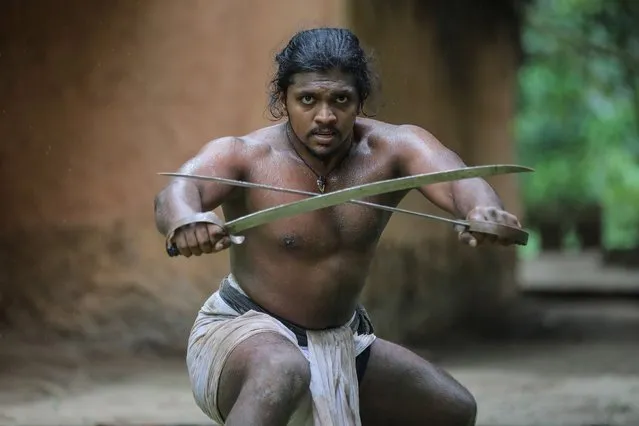
A student of the Sri Lankan ancient martial art “Angampora” performs during a practice session at the angam maduwa or fighting field, in Korathota, a suburb of Colombo, Sri Lanka, 07 September 2022. Sri Lanka's ancient martial art, Angampora, is thought to be thousands of years old. Anga translates to “body parts” and Angampora is a fighting art that uses body parts. Martial arts practitioners in Angampora were mostly in the king's service, and they were tasked with protecting the king and his kingdom. Angampora was practiced in secret for most centuries because the British, who colonized Sri Lanka, banned it in 1818 after seeing it as a threat. (Photo by Chamila Karunarathne/EPA/EFE)

A student of the Sri Lankan ancient martial art “Angampora” performs during a practice session at the angam maduwa or fighting field, in Korathota, a suburb of Colombo, Sri Lanka, 07 September 2022. Sri Lanka's ancient martial art, Angampora, is thought to be thousands of years old. Anga translates to “body parts” and Angampora is a fighting art that uses body parts. Martial arts practitioners in Angampora were mostly in the king's service, and they were tasked with protecting the king and his kingdom. Angampora was practiced in secret for most centuries because the British, who colonized Sri Lanka, banned it in 1818 after seeing it as a threat. (Photo by Chamila Karunarathne/EPA/EFE)
Details
14 Oct 2022 04:47:00


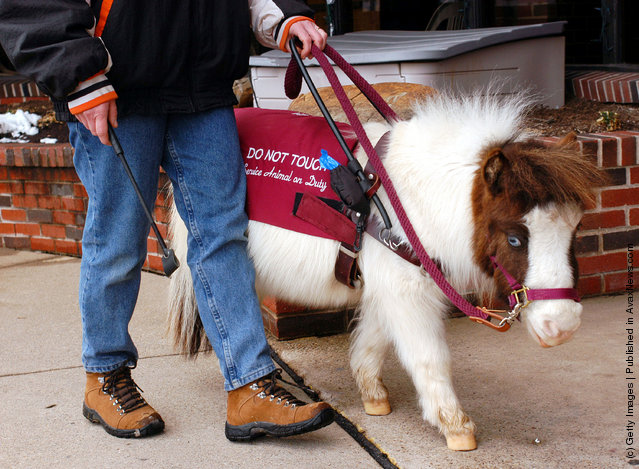
“A guide horse is an experimental mobility option for blind people who do not wish to or cannot use a guide dog. They are provided by The Guide Horse Foundation, founded in 1999 to provide miniature horses as assistance animals to blind users living in rural environments”. – Wikipedia

Photo: Shari Bernstiel, of Lansdale, Pennsylvania is helped along the sidewalk by Tonto, her guide horse March 19, 2004 in Lansdale, Pennsylvania. Tonto, a minature horse who went through one year of training, acts as Sheri's seeing eye dog and is one of three working guide horses in the United States. (Photo by William Thomas Cain/Getty Images)
Details
20 Jun 2011 14:05:00
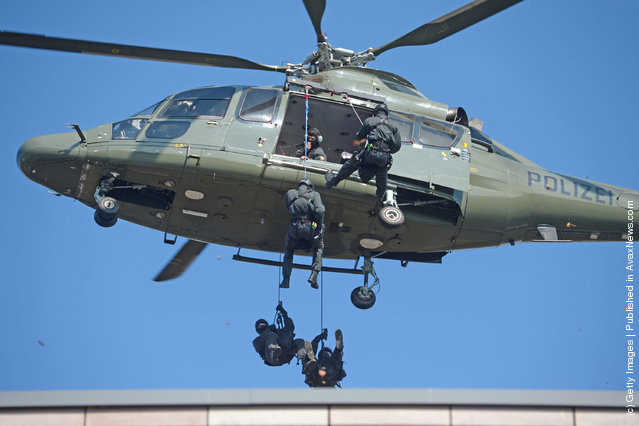
Members of Germany's elite police unit, the Spezialeinsatzkommando, or SEK, demonstrate an abseil deployment from a helicopter during a media event

Members of Germany's elite police unit, the Spezialeinsatzkommando, or SEK, demonstrate an abseil deployment from a helicopter during a media event on March 20, 2012 in Minden, Germany. The SEK is the special response team of Germany's state police force and typically deploys in high-risk situations, such as bank robberies, hostage takings and the arrest of armed and dangerous fugitives. (Photo by Thomas Starke/Getty Images)
Details
21 Mar 2012 09:01:00
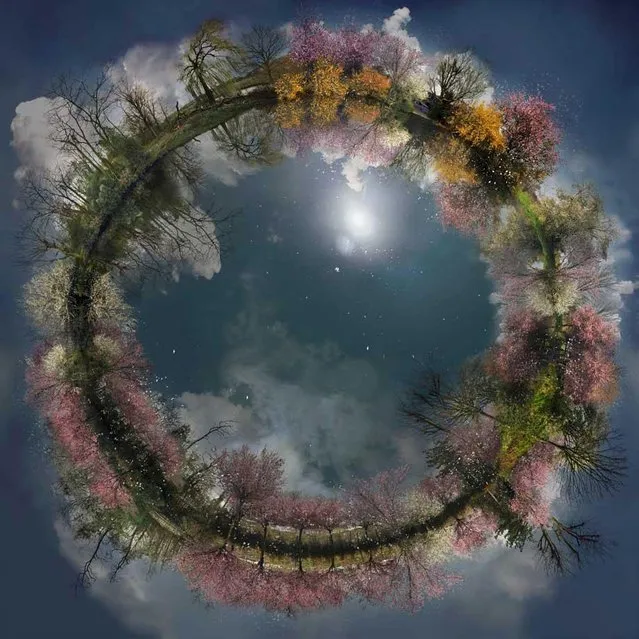
Miniature Worlds by Catherine Nelson

Catherine Nelson is a visual artist who uses the digital medium to paint images together into personal and imaginary landscapes. Trained as a painter in Sydney and London and with years of experience in the creation of visual effects for feature films like Moulin Rouge and Harry Potter, she now has dedicated her skills to her own art work combining the techniques from both these worlds into a new contemporary art medium. Her latest series have been exhibited in Australia, New Zealand, China, Korea, USA and Europe and have captivated audiences and art collectors in cities like Sydney, Paris, Los Angeles, Beijing and Seoul.
Details
26 May 2013 11:00:00
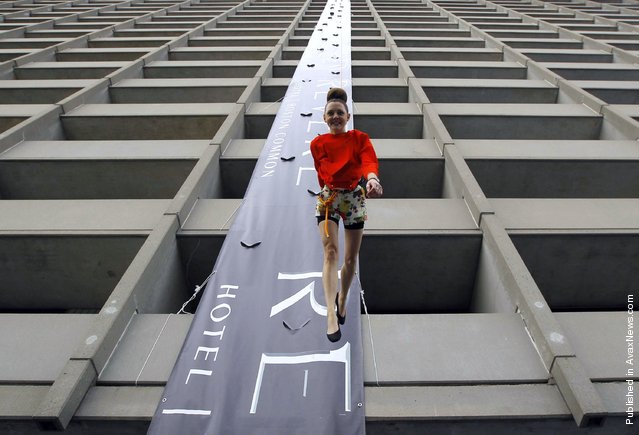
A model walks down the side of Revere Hotel in Boston during a vertical fashion show for the Massachusetts College of Art and Design

The Revere Hotel in Boston, Ma. celebrated its grand opening on April 18 with a vertical fashion show. The Boston Rock Gym provided the models who rappelled down the exterior of the 24-story hotel wearing outfits created by the students from the Massachusetts College of Arts and Design and by Ted Baker London.

Photo: A model walks down the side of Revere Hotel in Boston during a vertical fashion show for the Massachusetts College of Art and Design on April 18, 2012. (Photo by Dominick Reuter/EPA/Lauren Fish/Lauren Frohne/Globe photo)
Details
22 Apr 2012 12:41:00
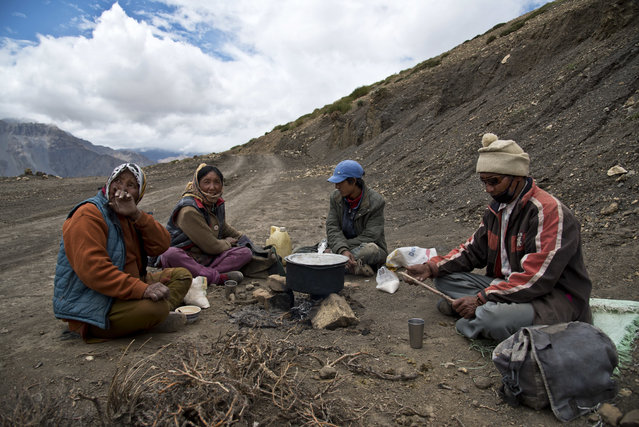
In this August 17, 2016, photo, from left to right, Chhering Chodom, 60, Tashi Yangzom, 50, Lobsang Chhering, 27, and Dorje Tandup, 58, drink milk tea on the side of the road. For centuries, the sleepy valley nestled in the Indian Himalayas remained a hidden Buddhist enclave forbidden to outsiders. Enduring the harsh year-round conditions of the high mountain desert, the people of Spiti Valley lived by a simple communal code – share the Earth's bounty, be hospitable to neighbors, and eschew greed and temptation at all turns. That's all starting to change, for better or worse. Since India began allowing its own citizens as well as outsiders to visit the valley in the early 1990s, tourism and trade have boomed. And the marks of modernization, such as solar panels, asphalt roads and concrete buildings, have begun to appear around some of the villages that dot the remote landscape at altitudes above 4,000 meters (13,000 feet). (Photo by Thomas Cytrynowicz/AP Photo)

In this August 17, 2016, photo, from left to right, Chhering Chodom, 60, Tashi Yangzom, 50, Lobsang Chhering, 27, and Dorje Tandup, 58, drink milk tea on the side of the road. For centuries, the sleepy valley nestled in the Indian Himalayas remained a hidden Buddhist enclave forbidden to outsiders. Enduring the harsh year-round conditions of the high mountain desert, the people of Spiti Valley lived by a simple communal code – share the Earth's bounty, be hospitable to neighbors, and eschew greed and temptation at all turns. That's all starting to change, for better or worse. (Photo by Thomas Cytrynowicz/AP Photo)
Details
15 Sep 2016 09:22:00