Loading...
Done
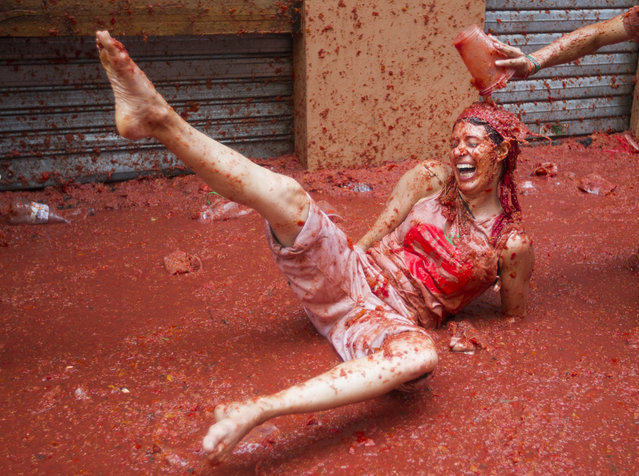
A reveller covered in tomato pulp takes part in the annual “Tomatina” festival in the eastern town of Bunol, on August 30, 2017. The iconic fiesta – which celebrates its 72nd anniversary and is billed at “the world's biggest food fight” – has become a major draw for foreigners, in particular from Britain, Japan and the United States. (Photo by Jaime Reina/AFP Photo)

A reveller covered in tomato pulp takes part in the annual “Tomatina” festival in the eastern town of Bunol, on August 30, 2017. The iconic fiesta – which celebrates its 72nd anniversary and is billed at “the world's biggest food fight” – has become a major draw for foreigners, in particular from Britain, Japan and the United States. (Photo by Jaime Reina/AFP Photo)
Details
31 Aug 2017 10:11:00
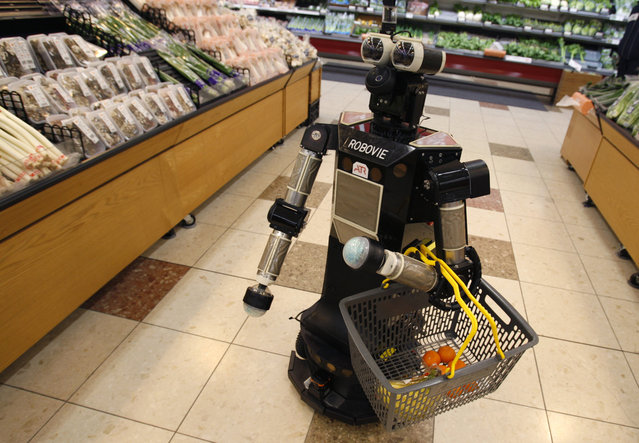
A robot named “Robovie-II”, developed by Japanese robotics research institution ATR, moves around at a grocery store during a shopping assisting experiment by utilizing the robot in an ubiquitous network technology platform in Kyoto, western Japan January 6, 2010. The robot greets the shopper at the entrance of the store, follows him to the shelves while holding a grocery basket and reminds him of the items on a shopping list, which the shopper would have entered beforehand in a specialized mobile device. The experiment is aimed to gather data in order to provide livelihood support for the elderly by using robots and network technologies, ATR's researcher Satoshi Koizumi said. (Photo by Yuriko Nakao/Reuters)

A robot named “Robovie-II”, developed by Japanese robotics research institution ATR, moves around at a grocery store during a shopping assisting experiment by utilizing the robot in an ubiquitous network technology platform in Kyoto, western Japan January 6, 2010. (Photo by Yuriko Nakao/Reuters)
Details
02 Feb 2018 06:54:00
An actor dressed as a zombie performs during a drive-in haunted house show by Kowagarasetai (Scare Squad), for people inside a car in order to maintain social distancing amid the spread of the coronavirus disease (COVID-19), at a garage in Tokyo, Japan on July 3, 2020. (Photo by Issei Kato/Reuters)

An actor dressed as a zombie performs during a drive-in haunted house show by Kowagarasetai (Scare Squad), for people inside a car in order to maintain social distancing amid the spread of the coronavirus disease (COVID-19), at a garage in Tokyo, Japan on July 3, 2020. A Japanese performance group is starting a run of drive-in horror shows for people who are scared of catching the coronavirus but still want to get close-up frights from ghouls and zombies. Audience members will drive into a garage in Tokyo, one car at a time, and listen to a murder story and sound effects blared out of speakers, as actors dressed as monsters bang on the side of the vehicle and spray fake blood over the windows. (Photo by Issei Kato/Reuters)
Details
05 Jul 2020 00:05:00
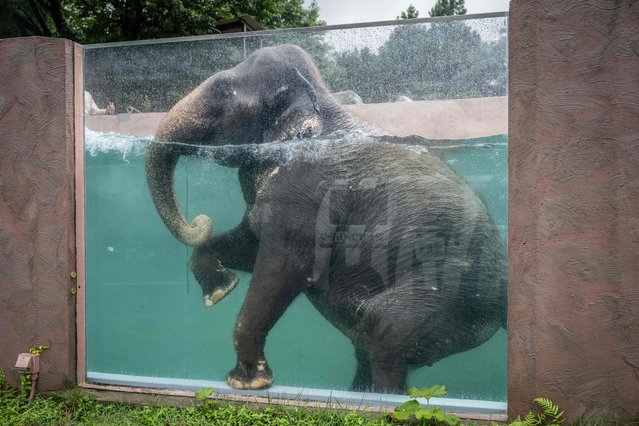
An Asian elephant swims in a pool with transparent sides at Fuji Safari Park in Susono city of Shizuoka Prefecture on August 8, 2024. Paddling with chunky legs and using their trunks as a snorkel, the elephants at Fuji Safari Park in Japan are taking a dip in their summer swimming pool – with each graceful movement visible thanks to a special see-through tank. (Photo by Yuichi Yamazaki/AFP Photo)

An Asian elephant swims in a pool with transparent sides at Fuji Safari Park in Susono city of Shizuoka Prefecture on August 8, 2024. Paddling with chunky legs and using their trunks as a snorkel, the elephants at Fuji Safari Park in Japan are taking a dip in their summer swimming pool – with each graceful movement visible thanks to a special see-through tank. (Photo by Yuichi Yamazaki/AFP Photo)
Details
06 Dec 2025 03:10:00
These black-and-white photos are taken from the new book “Armoured Warfare in the First World War 1916 – 1918” by Anthony Tucker-Jones and published by Pen & Sword Military. “Interestingly the British, French and Germans took completely different approaches with varying results”. The British military produced “Little Willie” in Autumn 1915 weighing 18 tonnes, which had a crew of two plus four gunners. “Inspired by a tracked artillery tractor “Little Willie” was referred to as a water tank – hence the name tank – to ensure secrecy”, said Anthony. “This led to the strange looking Mark I with its peculiar rhomboid shape, designed to cross trenches with guns in sponsons on either side. The Germans saw the tank as unchivalrous and were slow to grasp its utility. They favoured the Stormtrooper (specialist soldiers used to infiltrate enemy trenches) and artillery, not the tank”, said Anthony. “However, they didn’t hesitate to make use of captured British tanks. Although the tank helped secure victory and German soldiers dubbed it “Germany’s Downfall” the country was ultimately brought to its knees by the Allies blockade”. Here: British troops hitch a ride on a Mark IV after the massed tank fleet spearheading attack at Cambrai on November 20, 1917. (Photo by Anthony Tucker-Jones/Mediadrumworld.com)

These black-and-white photos are taken from the new book “Armoured Warfare in the First World War 1916 – 1918” by Anthony Tucker-Jones and published by Pen & Sword Military. Here: British troops hitch a ride on a Mark IV after the massed tank fleet spearheading attack at Cambrai on November 20, 1917. (Photo by Anthony Tucker-Jones/Mediadrumworld.com)
Details
23 Feb 2017 00:02:00


Visitors enjoy watching the Blue Nemophila flowers bloom during the Golden Week holidays, at Hitachinaka Kaihin Park on May 02, 2010 in Hitachinaka, Ibaraki, Japan. Millions of nemophilas blossom across the “Miharashi No Oka” hill at Hitachi Seaside Park for the annual “Nemophila Harmony” flower festival. (Photo by Koichi Kamoshida/Getty Images)
Details
18 Apr 2011 10:13:00
Caroline Wozniacki of Denmark serves in her match against Kaia Kanepi of Estonia

Caroline Wozniacki of Denmark serves in her match against Kaia Kanepi of Estonia during day four of the Toray Pan Pacific Open at Ariake Colosseum on September 28, 2011 in Tokyo, Japan. (Photo by Koji Watanabe/Getty Images)
Details
22 Nov 2011 14:17:00
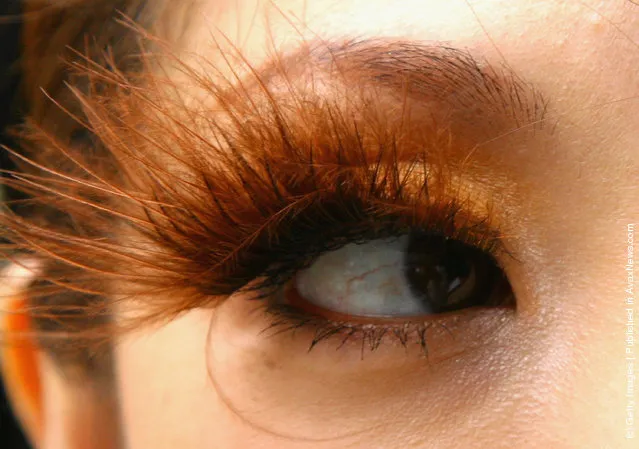
Designer False Eyelashes Remain Popular Japanese Fashion Accessory

An employee wears false eyelashes at the Shu Uemura eyelashes bar in the Omotesando district May 18, 2007 in Tokyo, Japan. 22 different false eyelash designs are available at the eyelashes bar ranging in cost from US$13 to US$43. (Photo by Koichi Kamoshida/Getty Images)
Details
02 Dec 2011 09:07:00