Loading...
Done
Mud-covered tourists pretend to be trapped inside a mud prison at the Daecheon Beach Mud Plaza in the city of Boryeong on South Korea's west coast, July 17, as they take part in the Boryeong Mud Festival, which opened that day and runs through July 26. Boryeong mud is rich in natural mineral component and is considered to prevent skin aging. (Photo by EPA/Yonhap)

Mud-covered tourists pretend to be trapped inside a mud prison at the Daecheon Beach Mud Plaza in the city of Boryeong on South Korea's west coast, July 17, as they take part in the Boryeong Mud Festival, which opened that day and runs through July 26. Boryeong mud is rich in natural mineral component and is considered to prevent skin aging. (Photo by EPA/Yonhap)
Details
18 Jul 2015 13:33:00
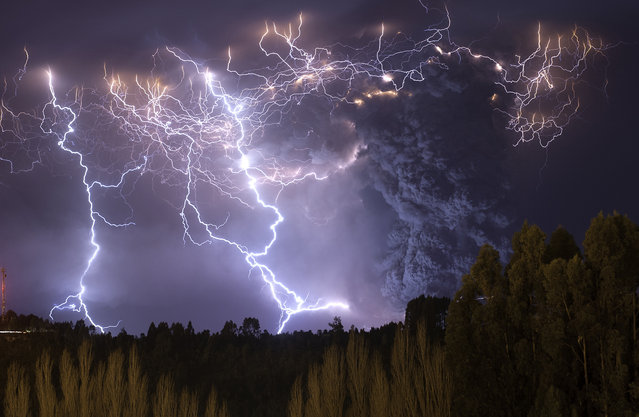
The eruption of Cordon Caulle began on June 4, 2011, located in the Region of Los Rios in Chile. For about 12 months, people and animals became accustomed to living with the daily fall of ash, which also caused problems in the air traffic in South America. The explosions and lightning during first days of the eruption could be seen from hundreds of miles around. This photograph was taken on the second night of eruption from the town of Lago Ranco. (Photo and caption by Francisco Negroni/National Geographic Traveler Photo Contest)

The eruption of Cordon Caulle began on June 4, 2011, located in the Region of Los Rios in Chile. For about 12 months, people and animals became accustomed to living with the daily fall of ash, which also caused problems in the air traffic in South America. The explosions and lightning during first days of the eruption could be seen from hundreds of miles around. This photograph was taken on the second night of eruption from the town of Lago Ranco. (Photo and caption by Francisco Negroni/National Geographic Traveler Photo Contest)

ATTENTION! All pictures are presented in high resolution. To see Hi-Res images – just TWICE click on any picture. In other words, click small picture – opens the BIG picture. Click BIG picture – opens VERY BIG picture.
Details
23 Jun 2013 11:24:00
These stunning coloured images show detailed x-ray images of everything from skulls to light bulbs. Artist Paula Fontaine, from Westminster Massachusetts, created the images using a process called digital map painting. Here: Brain storm, conceptual composite X-ray. (Photo by Paula Fontaine/Barcroft Media)

These stunning coloured images show detailed x-ray images of everything from skulls to light bulbs. Artist Paula Fontaine, from Westminster Massachusetts, created the images using a process called digital map painting. To create the images the x-ray emission source – the head of the machine on an arm which focuses the beam – is placed over the object. Paula then retreats behind a shielded screen before activating the x-ray exposure. Here: Brain storm, conceptual composite X-ray. (Photo by Paula Fontaine/Barcroft Media)
Details
27 Mar 2015 13:34:00
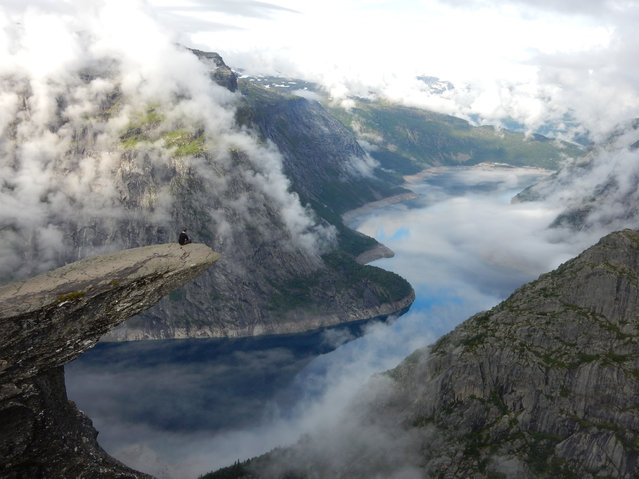
Taking it all in at Trolltunga, a piece of rock which juts horizontally out of a mountain, 700 metres above lake Ringedalsvatnet in Norway. (Photo by Sam Rogers/GuardianWitness)

Taking it all in at Trolltunga, a piece of rock which juts horizontally out of a mountain, 700 metres above lake Ringedalsvatnet in Norway. (Photo by Sam Rogers/GuardianWitness)
Details
05 May 2017 07:31:00
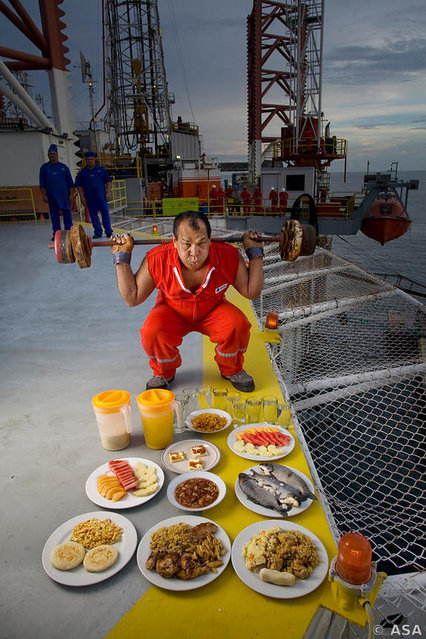
What the World Eats By Peter Menzel And Faith D'Aluisio Part 1

A stunning photographic collection featuring portraits of people from 30 countries and the food they eat in one day. In this fascinating study of people and their diets, 80 profiles are organized by the total number of calories each person puts away in a day. Featuring a Japanese sumo wrestler, a Massai herdswoman, world-renowned Spanish chef Ferran Adria, an American competitive eater, and more, these compulsively readable personal stories also include demographic particulars, including age, activity level, height, and weight. Essays from Harvard primatologist Richard Wrangham, journalist Michael Pollan, and others discuss the implications of our modern diets for our health and for the planet. This compelling blend of photography and investigative reportage expands our understanding of the complex relationships among individuals, culture, and food.
Details
23 Apr 2014 14:34:00
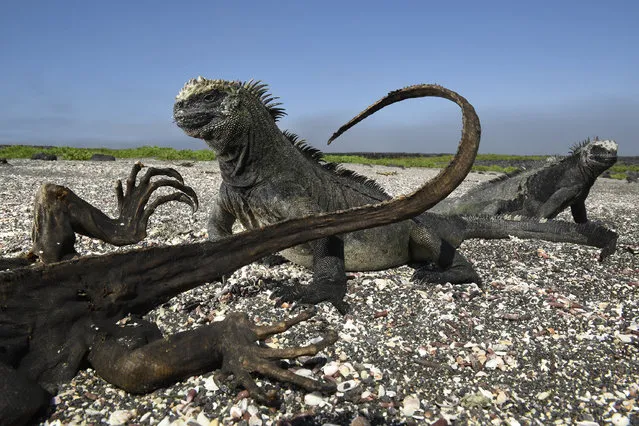
Galapagos – Rocking the Cradle: Four major ocean currents converge along the Galapagos archipelago, creating the conditions for an extraordinary diversity of animal life, April 25, 2016. The islands are home to at least 7,000 flora and fauna species, of which 97 percent of the reptiles, 80 percent of the land birds, 50 percent of the insects and 30 percent of the plants are endemic. The local ecosystem is highly sensitive to the changes in temperature, rainfall and ocean currents that characterize the climatic events known as El Niño and La Niña. These changes cause marked fluctuations in weather and food availability. Many scientists expect the frequency of El Niño and La Niña to increase as a result of climate change, making the Galapagos a possible early-warning location for its effects. (Photo by Thomas P. Peschak for National Geographic/World Press Photo)

Galapagos – Rocking the Cradle: Four major ocean currents converge along the Galapagos archipelago, creating the conditions for an extraordinary diversity of animal life, April 25, 2016. The islands are home to at least 7,000 flora and fauna species, of which 97 percent of the reptiles, 80 percent of the land birds, 50 percent of the insects and 30 percent of the plants are endemic. (Photo by Thomas P. Peschak for National Geographic/World Press Photo)
Details
16 Apr 2018 00:01:00
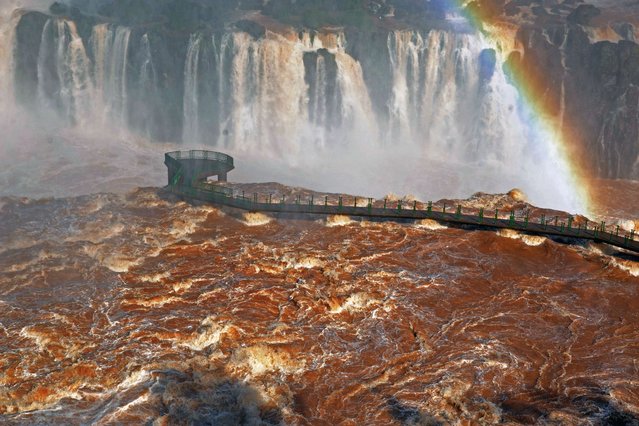
View of a damaged bridge at the Iguacu Falls on June 12, 2014, in Foz do Iguacu, Brazil, following the overflowing of the Parana river. In neighbouring Paraguay flooding has forced the evacuation of about 150,000 people in Paraguay's capital city Asuncion, authorities said. (Photo by Norberto Duarte/AFP Photo)

View of a damaged bridge at the Iguacu Falls on June 12, 2014, in Foz do Iguacu, Brazil, following the overflowing of the Parana river. In neighbouring Paraguay flooding has forced the evacuation of about 150,000 people in Paraguay's capital city Asuncion, authorities said. (Photo by Norberto Duarte/AFP Photo)
Details
28 Jul 2014 10:52:00
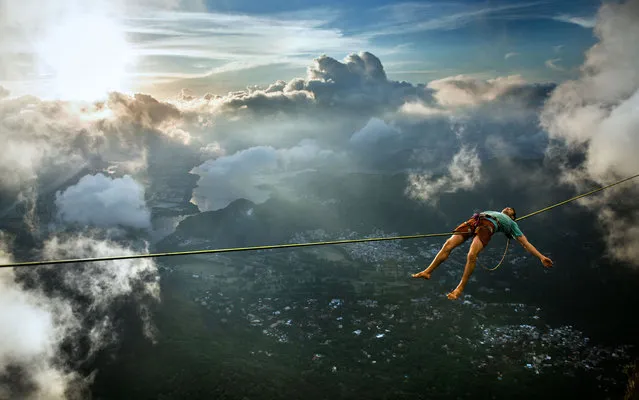
Pedra da Gavea highline, 850 meters above the city, 100 meters direct exposure, March 24, 2013. Brian Mosbaugh on the line. Carefully tiptoeing almost 3000 metres above Rio de Janeiro on a thin wire got a bit too much for this adrenaline junkie – so he decided to have a LIE DOWN. Fearless Brian Mosbaugh is so used to the perilous heights he decided he deserved a short break and proceeded to kick back and relax over the famous Brazilian city. (Photo by Scott Rogers/Caters)

Pedra da Gavea highline, 850 meters above the city, 100 meters direct exposure, March 24, 2013. Brian Mosbaugh on the line. Carefully tiptoeing almost 3000 metres above Rio de Janeiro on a thin wire got a bit too much for this adrenaline junkie – so he decided to have a LIE DOWN. Fearless Brian Mosbaugh is so used to the perilous heights he decided he deserved a short break and proceeded to kick back and relax over the famous Brazilian city. (Photo by Scott Rogers/Caters)

P.S. All pictures are presented in high resolution. To see Hi-Res images – just TWICE click on any picture. In other words, click small picture – opens the BIG picture. Click BIG picture – opens VERY BIG picture (if available; this principle works anywhere on the site AvaxNews).
Details
30 Mar 2013 12:00:00