People move on a tractor through a flooded street amid severe flooding in Feni, Bangladesh, on August 25, 2024. (Photo by Mohammad Ponir Hossain/Reuters)
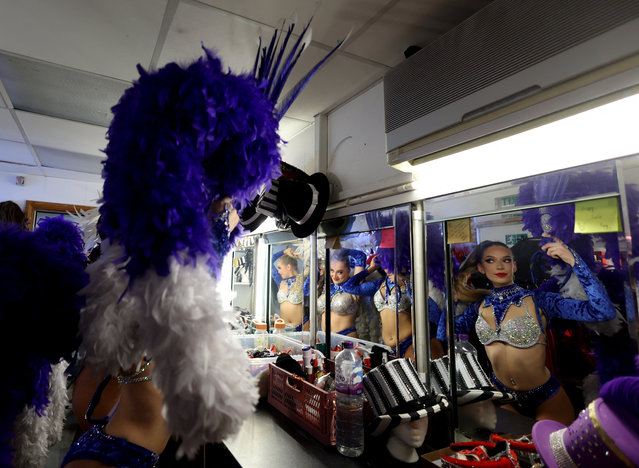
(L-R) Models Jasmine Tookes, Paloma Elsesser, Barbara Palvin and Ashley Graham prepare backstage at the Victoria's Secret Fashion Show 2024 on October 15, 2024 in New York City. (Photo by Arturo Holmes/Getty Images for Victoria's Secret)
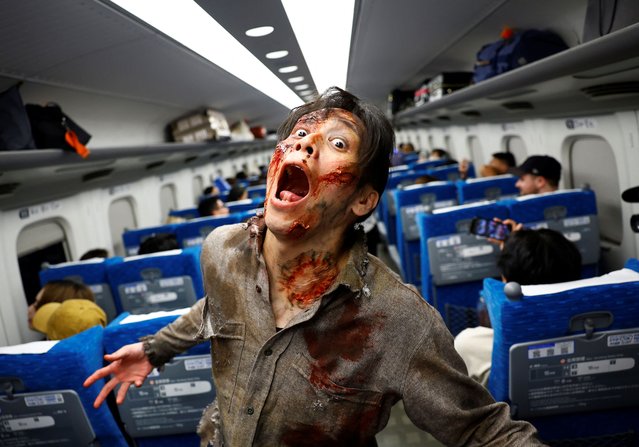
A performer dressed as a zombie performs inside a “Zombie Shinkansen” bullet train bound for Osaka from Tokyo, inspired by the South Korean movie “Train to Busan” ahead of the Halloween season, Japan, on October 19, 2024. (Photo by Kim Kyung-Hoon/Reuters)
“We've reached 40km.” – Participants run at the 40km mark of the 2025 Chosun Ilbo Chuncheon Marathon, held in Chuncheon, Gangwon Province, South Korea on the afternoon of the October 26, 2025. (Photo by Park Seong-won)
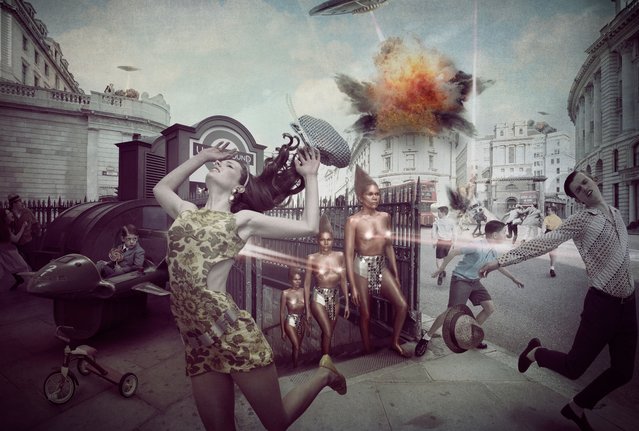
Invasion (laser girls) 2017. “I’m always thinking about my art practice, so any experience I have may spike a visual when I have an idea in mind. An example is that, when I was thinking about the Invasion series, I was inspired by Alfred Hitchcock’s movie The Birds (1963). I love Hitchcock’s other movies and have been contemplating a series based on Rear Window (1954). I also find inspiration outside the cinema in music clips and magazines”. (Photo by Michael Cook/Perimeter Books)
21 year-old Chanel Tapper, with the amazing tongue and 35 year-old Aevin Dugas, with the beautiful hair was certified as world record breakers for the world’s longest tongue and the world’s biggest afro in the Guinness Book of World Records. (Photo by Guinness World Records)
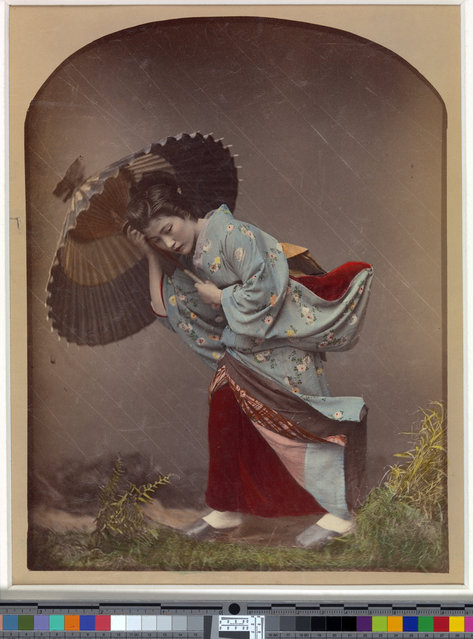
“Woman with Umbrella in Rain” by Raimund von Stillfried. Artist: Kusakabe Kimbei (Japanese, 1841–1934), 1870s. Commercial photography studios in Meiji-era Japan were renowned for the subtlety and refinement of their coloring techniques. This hand-tinted image of a young woman caught in a heavy rainstorm achieved its naturalistic effect by knitting together multiple strands of artifice: the greenery in the foreground was a studio prop; the flaps of the kimono were suspended by thin wires to create the impression of a strong wind; and long, diagonal marks were made on the negative to suggest streaks of rain. (Photo courtesy of The Metropolitan Museum of Art)