Loading...
Done
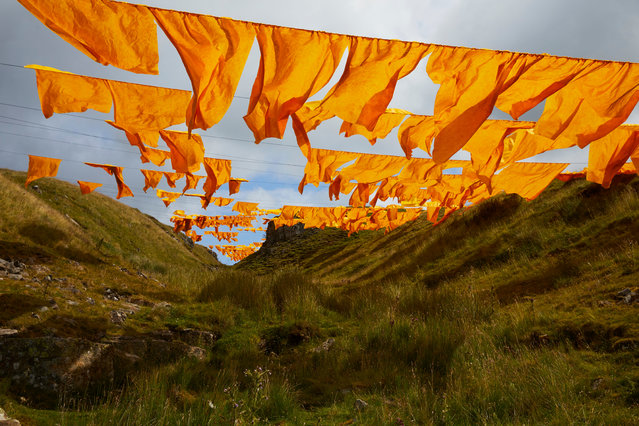
Monumental landscape artwork “Hush” by installation artist Steve Messam hangs in the moors of Teesdale on July 18, 2019 in Barnard Castle, England. The outdoor installation is inspired by the geology, mining history and landscape of the area. It hangs over Bales Hush, a deep gauge in the terrain created when miners flushed the area with water to reveal the geological riches below. Hundreds of metres of recyclable saffron yellow fabric blow in the wind. (Photo by Christopher Thomond/The Guardian)

Monumental landscape artwork “Hush” by installation artist Steve Messam hangs in the moors of Teesdale on July 18, 2019 in Barnard Castle, England. The outdoor installation is inspired by the geology, mining history and landscape of the area. It hangs over Bales Hush, a deep gauge in the terrain created when miners flushed the area with water to reveal the geological riches below. Hundreds of metres of recyclable saffron yellow fabric blow in the wind. (Photo by Christopher Thomond/The Guardian)
Details
20 Jul 2019 00:03:00
A juvenile blackcap is recorded in the soft light of morning at Minorca, UK, a former open-cast mine near Moira in the National Forest on June 18, 2025. Dr Heather Gilbert, research and evidence manager, checks mist nets among wildflowers and young trees as part of long-term monitoring that shows bird numbers have increased by 48 per cent over 30 years. (Photo by Rod Kirkpatrick/RKP Photography)

A juvenile blackcap is recorded in the soft light of morning at Minorca, UK, a former open-cast mine near Moira in the National Forest on June 18, 2025. Dr Heather Gilbert, research and evidence manager, checks mist nets among wildflowers and young trees as part of long-term monitoring that shows bird numbers have increased by 48 per cent over 30 years. (Photo by Rod Kirkpatrick/RKP Photography)
Details
29 Jun 2025 03:58:00
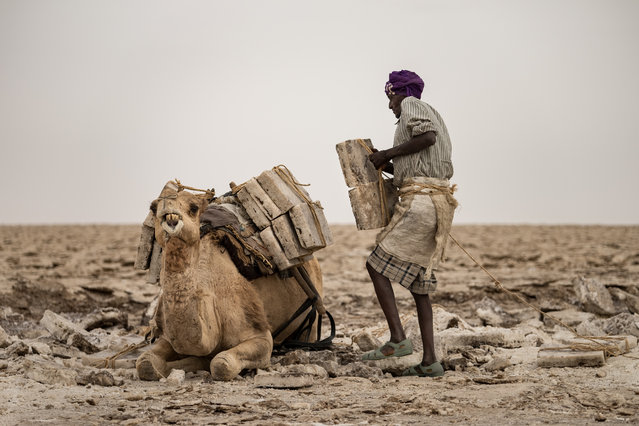
Dromedaries and donkeys are used to transport the salt. (Photo by Joel Santos/Barcroft Images)

Unforgiving temperatures of up to 60℃ (140℉) beat down on these saltminers on a daily basis. The mines, situated in the Afar Triangle in Ethiopia, stretch across 38,000 sq miles and at their lowest point are more than 300ft below sea level. Joel Santos travelled to capture the area’s dry, brutal beauty. Here: Dromedaries and donkeys are used to transport the salt. (Photo by Joel Santos/Barcroft Images)
Details
24 Aug 2016 11:31:00
Russia-backed separatists stand at the site of the crashed Malaysia Airlines Flight 17 plane, near the village of Hrabove, eastern Ukraine, Thursday, July 16, 2015. The fighters said they have arrived to protect the media and make sure the MH17 crash site is clear of ammunition and mines. (Photo by Antoine E. R. Delaunay/AP Photo)

Russia-backed separatists stand at the site of the crashed Malaysia Airlines Flight 17 plane, near the village of Hrabove, eastern Ukraine, Thursday, July 16, 2015. The fighters said they have arrived to protect the media and make sure the MH17 crash site is clear of ammunition and mines. A year since a Malaysia Airlines Boeing 777 was blown out of the sky over war-ravaged eastern Ukraine, killing 298 people, there has been little official word of progress in determining what brought down Flight MH17. (Photo by Antoine E. R. Delaunay/AP Photo)
Details
18 Jul 2015 12:55:00
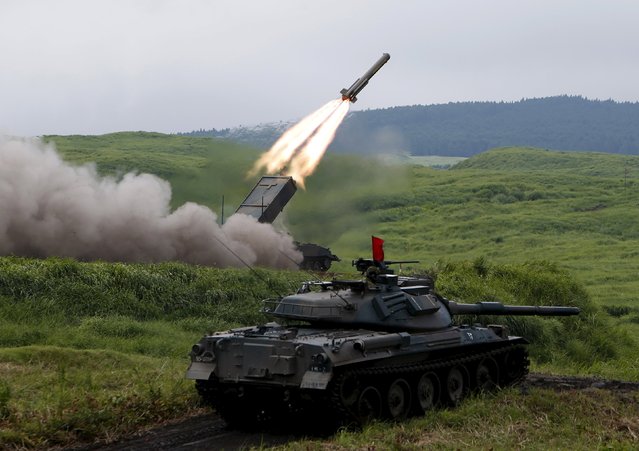
A Japanese Ground Self-Defense Force Type 92 Mine sweeping vehicle fires a rocket behind a Type 74 armoured tank during an annual training session, which is based on a scenario to defend or retake islands in Japanese territory, near Mount Fuji at Higashifuji training field in Gotemba, west of Tokyo, August 18, 2015. (Photo by Yuya Shino/Reuters)

A Japanese Ground Self-Defense Force Type 92 Mine sweeping vehicle fires a rocket behind a Type 74 armoured tank during an annual training session, which is based on a scenario to defend or retake islands in Japanese territory, near Mount Fuji at Higashifuji training field in Gotemba, west of Tokyo, August 18, 2015. (Photo by Yuya Shino/Reuters)
Details
19 Aug 2015 12:18:00
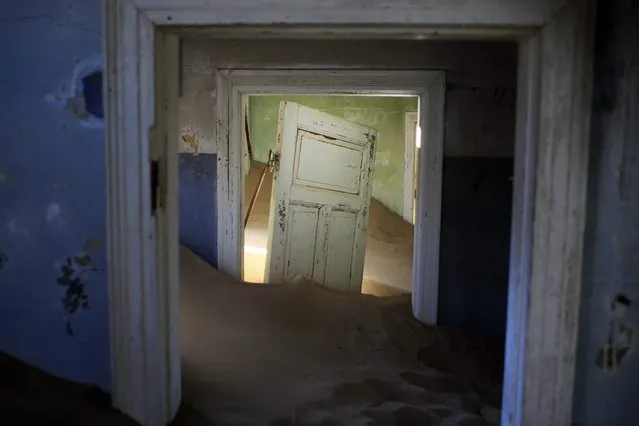
In this July 23, 2013 photo, sand fills an abandoned house in Kolmanskop, Namibia. Kolmanskop, was a diamond mining town south of Namibia, build in 1908 and deserted in 1956. SInce then, the desert slowly reclaims its territory, with sand invading the buildings where 350 German colonists and more than 800 local workers lived during its hay-days of the 1920s. (Photo by Jerome Delay/AP Photo)

In this July 23, 2013 photo, sand fills an abandoned house in Kolmanskop, Namibia. Kolmanskop, was a diamond mining town south of Namibia, build in 1908 and deserted in 1956. SInce then, the desert slowly reclaims its territory, with sand invading the buildings where 350 German colonists and more than 800 local workers lived during its hay-days of the 1920s. (Photo by Jerome Delay/AP Photo)
Details
14 Nov 2014 14:34:00
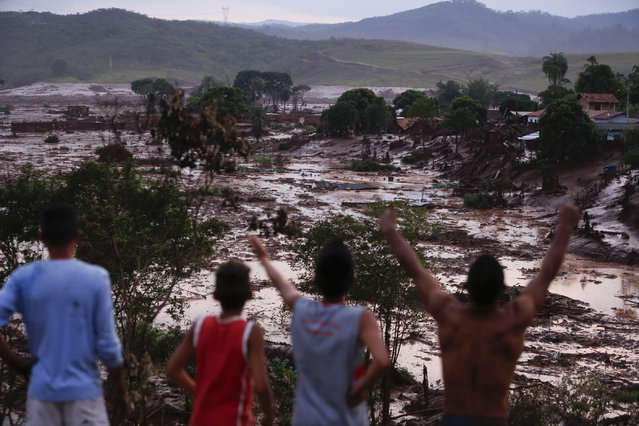
Photo taken on November 5, 2015 shows flood in Bento Rodrigues, a town in the southeastern Brazilian state of Minas Gerais, after a dam at a mining waste site burst early Thursday. An iron ore tailings dam in the southeast Brazilian state of Minas Gerais collapsed Thursday, killing at least 15 people, according to local media reports. (Photo by Agencia Estado/Xinhua Press/Corbis)

Photo taken on November 5, 2015 shows flood in Bento Rodrigues, a town in the southeastern Brazilian state of Minas Gerais, after a dam at a mining waste site burst early Thursday. An iron ore tailings dam in the southeast Brazilian state of Minas Gerais collapsed Thursday, killing at least 15 people, according to local media reports. (Photo by Agencia Estado/Xinhua Press/Corbis)
Details
08 Nov 2015 08:02:00
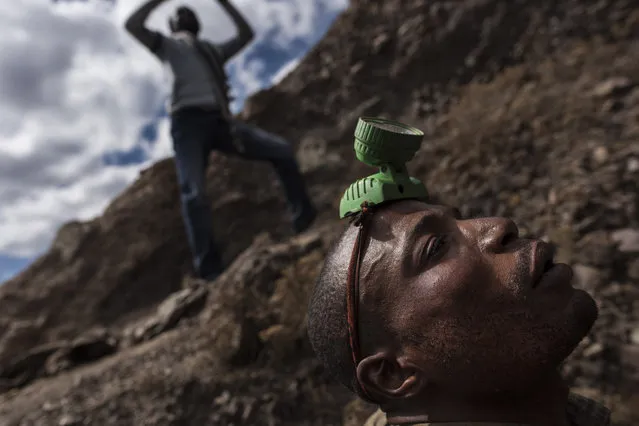
A “creuseur”, or digger, a plastic lantern on his head, readies to enter a copper and cobalt mine in Kawama, Democratic Republic of Congo on June 8, 2016. Cobalt is used in the batteries for electric cars and mobile phones. Working conditions are dangerous, often with no safety equipment or structural support for the tunnels. The diggers say they are paid on average US$2-3/day. (Photo by Michael Robinson Chavez/The Washington Post)

A “creuseur”, or digger, a plastic lantern on his head, readies to enter a copper and cobalt mine in Kawama, Democratic Republic of Congo on June 8, 2016. Cobalt is used in the batteries for electric cars and mobile phones. Working conditions are dangerous, often with no safety equipment or structural support for the tunnels. The diggers say they are paid on average US$2-3/day. (Photo by Michael Robinson Chavez/The Washington Post)
Details
30 Dec 2016 10:29:00