Loading...
Done
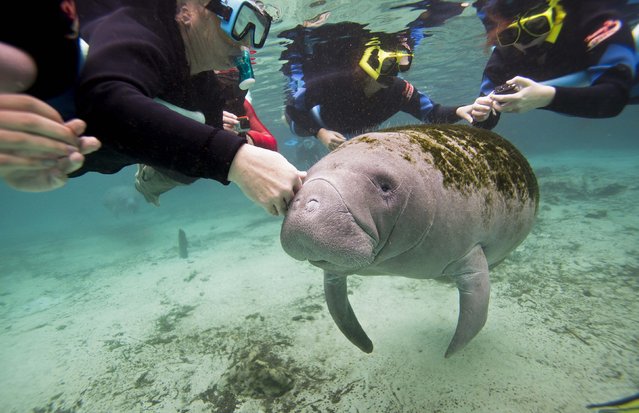
Snorkelers interact with a Florida Manatee inside of the Three Sisters Springs in Crystal River, Florida January 15, 2015. On winter days, Florida manatees flock by the hundreds to the balmy waters of Three Sisters Springs, drawing crowds of snorkelers and kayakers to the U.S. sanctuary, where people may swim with the endangered species. (Photo by Scott Audette/Reuters)

Snorkelers interact with a Florida Manatee inside of the Three Sisters Springs in Crystal River, Florida January 15, 2015. On winter days, Florida manatees flock by the hundreds to the balmy waters of Three Sisters Springs, drawing crowds of snorkelers and kayakers to the U.S. sanctuary, where people may swim with the endangered species. But as tolerant as the gentle, whiskered sea giants can be of the accidental kicks and splashes of delighted tourists, wild life regulators want to ban most canoes and paddle boards and create people-free zones to protect the wintering “sea cow”. Proposed limitations for this winter are awaiting approval by the U.S. Fish and Wildlife Service. (Photo by Scott Audette/Reuters)
Details
22 Jan 2015 13:34:00
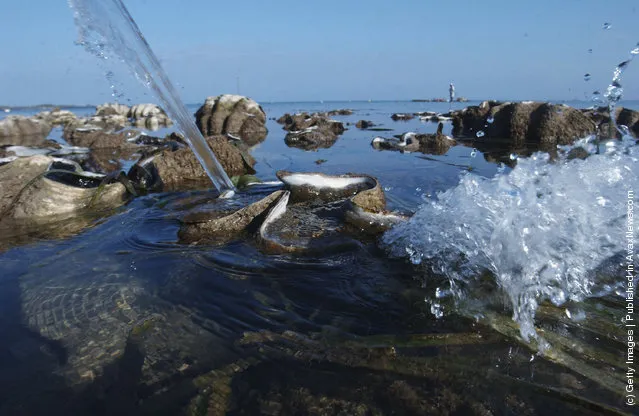
Tridacna Gigas, or Giant Clams

“The giant clam, Tridacna gigas (known as pā’ua in Cook Islands Māori), is the largest living bivalve mollusc. T. gigas is one of the most endangered clam species. It was mentioned as early as 1825 in scientific reports. One of a number of large clam species native to the shallow coral reefs of the South Pacific and Indian oceans, they can weigh more than 200 kilograms (440 lb) measure as much as 120 cm (47 in) across, and have an average lifespan in the wild of 100 years or more”. – Wikipedia

Photo: Tridacna Gigas, or Giant Clams spew water as a traditional fisherman passes by a small sanctuary on January 23, 2004 near Bolinao in the Northern Philippines. The clams, prime builders for coral reefs and providing shelter for spawning fish and other marine life, are exposed by low tides in the sanctuary. Overfishing and pollution throughout the country are not only threatening food security, but are also starting to choke one of the few working clam sanctuaries in the world. (Photo by David Greedy/Getty Images)
Details
01 Oct 2011 13:10:00
Kawakanih Yawalapiti, 9, Upper Xingu region of Mato Grosso, Brazil, 2018: Kawakanih lives with her tribe, the Yawalapiti, in Xingu national park, a preserve in the Amazon basin of Brazil. The Yawalapiti collect seeds to preserve species unique to their ecosystem, which lies between the rain forest and savannah. Kawakanih’s diet is simple, consisting mainly of fish, cassava, porridge, fruit and nuts. “It takes five minutes to catch dinner”, says Kawakanih. “When you’re hungry, you just go to the river with your net”. (Photo by Gregg Segal/The Guardian)

Photographer Gregg Segal travelled the world to document children and the food they eat in a week. Partly inspired by the increasing problems of childhood obesity, he tracked traditional regional diets as yet unaffected by globalisation, and ironically, found that the healthiest diets were often eaten by the least well off. (Photo by Gregg Segal/The Guardian)
Details
03 Jul 2019 00:03:00
Inside the new Digital Art Museum in Tokyo, Japan on June 21, 2018. (Photo by South West News Service)

Inside the new Digital Art Museum in Tokyo, Japan on June 21, 2018. These incredible photos show what it looks like inside a groundbreaking new digital art museum in Japan. A trip to the Mori Building Digital Art Museum: teamLab Borderless in Tokyo, which opened last week, can make you feel like they you are dreaming and aims to fully immerse visitors in the art. Spanning a spacious 10,000 square metres, 520 computers and 470 high-tech projectors create the illusion that the visitor is wandering through rice fields, following shoals of fish or even bouncing on a galaxy of planets. (Photo by South West News Service)
Details
29 Jun 2018 00:01:00
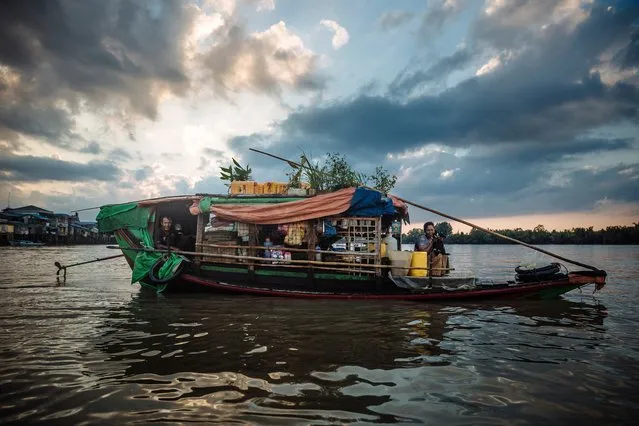
Tin and Naing win live on a small boat which they sail throughout the Delta region in Myanmar. The former gardeners once had a home on land but it was destroyed when a powerful cyclone ravaged the area in 2008. Since then, the couple have not been able to afford to rebuild their home, so they live on the boat from which they sell fish paste to make a living. (Photo by Muse Mohammed/IOM)

The ferocity of crises worldwide is forcing a record number of people to flee their homes, seeking some form of safety within their own country or across international borders. There are 65.3 million displaced people worldwide, including 21.3 million refugees. Most have lost their homes to armed conflict or natural disasters but other factors, such as extreme poverty and climate change, also drive displacement. The International Organisation for Migration commissioned photojournalist Muse Mohammed to document the plight of the displaced. (Photo by Muse Mohammed/IOM)
Details
02 Jan 2017 12:04:00
A Thai and foreign revelers battle with water guns during the annual Songkran celebration at Khaosan Road, a tourist spot in Bangkok, Thailand, 12 April 2017. (Photo by Rungroj Yongrit/EPA)

A Thai and foreign revelers battle with water guns during the annual Songkran celebration at Khaosan Road, a tourist spot in Bangkok, Thailand, 12 April 2017. The four southeast Asian nations of Myanmar, Thailand, Cambodia and Laos started the Buddhist new year, known as Thingyan in Myanmar and Songkran in Thailand, on April 13. (Photo by Rungroj Yongrit/EPA)
Details
15 Apr 2017 08:42:00
A Citroen Ami One concept car sits on display during the media day of the Auto Shanghai 2019 motor show in Shanghai, China, 16 April 2019. (Photo by Wu Hong/EPA/EFE)

A Citroen Ami One concept car sits on display during the media day of the Auto Shanghai 2019 motor show in Shanghai, China, 16 April 2019. The 18th Shanghai international automobile industry exhibition runs from 16 to 25 April. (Photo by Wu Hong/EPA/EFE)
Details
19 Apr 2019 00:05:00
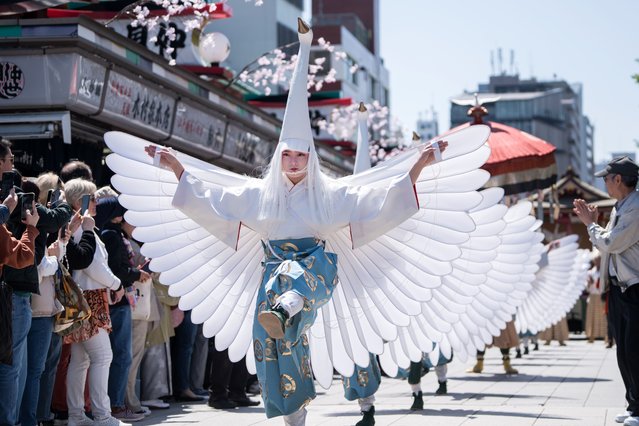
Dancers perform during the Shirasagi-no Mai, or White Heron Dance, at the Sensoji Temple on April 09, 2023 in Tokyo, Japan. The parade, which originated in the 8th-12th century in Kyoto, was revived in 1968 to celebrate Tokyo's 100th Anniversary and to wish for peace. The dance is now held twice a year, in April and November, at the Sensoji Temple in Asakusa, one of Tokyo's most popular tourist destinations for foreign visitors. (Photo by Tomohiro Ohsumi/Getty Images)

Dancers perform during the Shirasagi-no Mai, or White Heron Dance, at the Sensoji Temple on April 09, 2023 in Tokyo, Japan. The parade, which originated in the 8th-12th century in Kyoto, was revived in 1968 to celebrate Tokyo's 100th Anniversary and to wish for peace. The dance is now held twice a year, in April and November, at the Sensoji Temple in Asakusa, one of Tokyo's most popular tourist destinations for foreign visitors. (Photo by Tomohiro Ohsumi/Getty Images)
Details
25 Apr 2023 03:32:00