Loading...
Done
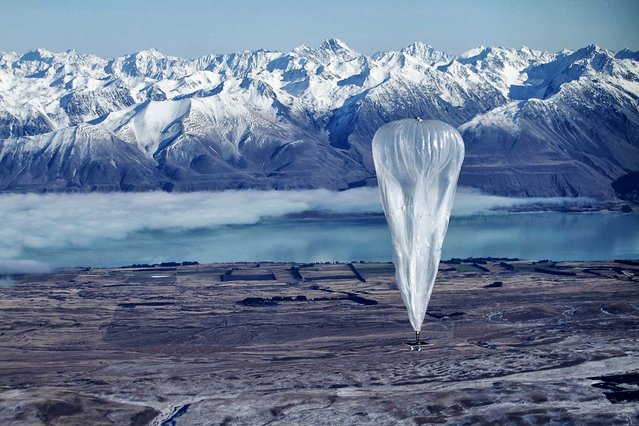
A Google balloon sails through the air with the Southern Alps mountains in the background, in Tekapo, New Zealand. (Photo by Jon Shenk/Associated Press)

“Google is launching balloons into near space to provide internet access to buildings below on the ground. About 30 of the superpressure balloons are being launched from New Zealand from where they will drift around the world on a controlled path. Attached equipment will offer 3G-like speeds to 50 testers in the country”. – BBC News. Photo: A Google balloon sails through the air with the Southern Alps mountains in the background, in Tekapo, New Zealand. (Photo by Jon Shenk/Associated Press)
Details
16 Jun 2013 10:54:00
A decades-old television. (Photo by Mark C. O'Flaherty)

The official name for this tiny speck of land – the size of 12 football pitches – is Hashima, but few call it that. In English, its most commonly used name means “Battleship Island” and, viewed from a certain angle offshore, its silhouette is uncannily dreadnought in nature. It was a mining facility until 1974, when it was abandoned to the elements, before partially reopening as a tourist attraction in 2009. Photo: A decades-old television. (Photo by Mark C. O'Flaherty)
Details
15 Jun 2014 11:24:00


Two dogs sent into outer space by the Soviet Union after their safe return to earth. They spent 22 days in orbit. (Photo by Central Press/Getty Images). 22nd March 1966
Details
12 Apr 2011 09:39:00


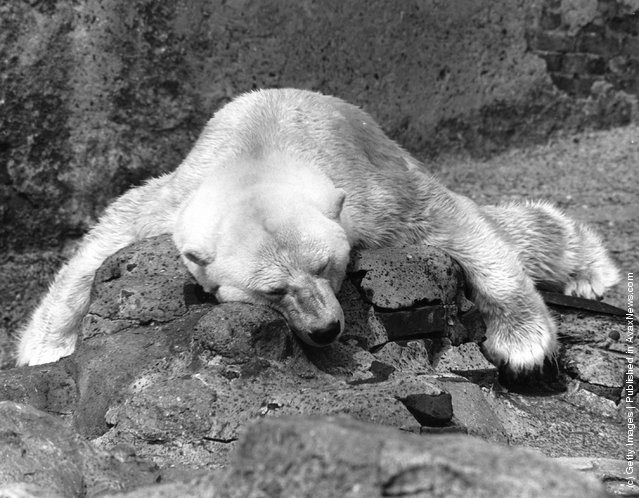
A polar bear fast asleep at London Zoo. (Photo by Fox Photos/Getty Images). 1961
Details
23 Jul 2011 12:00:00
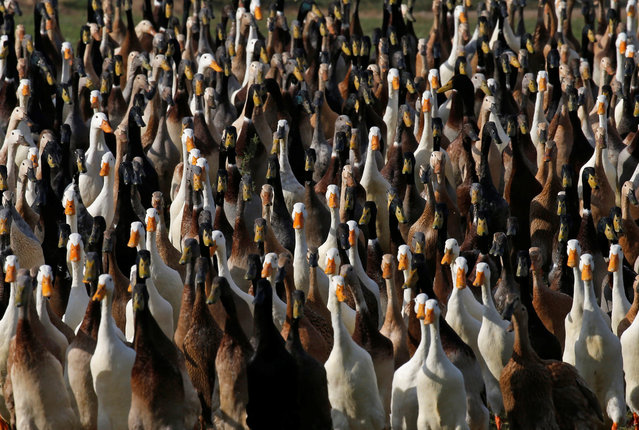
Indian Runner ducks march past farm buildings at the Vergenoegd wine estate near Cape Town, South Africa, May 16, 2016. (Photo by Mike Hutchings/Reuters)

Indian Runner ducks march past farm buildings at the Vergenoegd wine estate near Cape Town, South Africa, May 16, 2016. Each day, a quack squad of killer ducks are released for the first of two sorties at South Africa's Vergenoegd wine farm in Stellenbosch. Their mission – seek and destroy thousands of pests out to ruin the season's harvest. Fanning out across the vineyards, some 1,000 Indian Runner ducks hone in on their hidden targets with uncanny precision, locating the tiny white dune snails feasting on budding vines. (Photo by Mike Hutchings/Reuters)
Details
27 May 2016 13:06:00
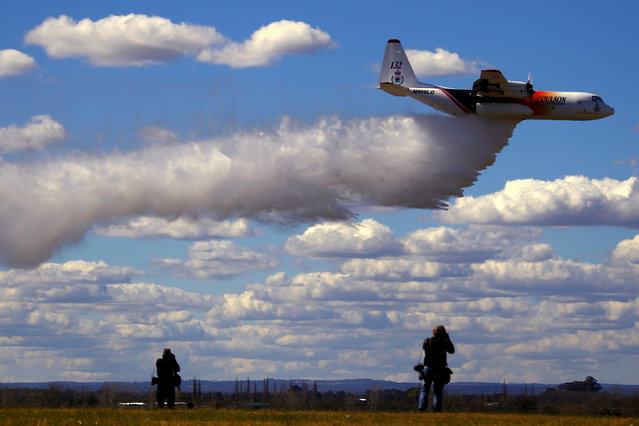
Photographers take photographs of the Large Air Tanker (LAT) C-130 Hercules, also known as “Thor”, as it drops a load of around 15,000 litres during a display by the Rural Fire Service ahead of the bushfire season at RAAF Base Richmond  Sydney, Australia, September 1, 2017. (Photo by David Gray/Reuters)

Photographers take photographs of the Large Air Tanker (LAT) C-130 Hercules, also known as “Thor”, as it drops a load of around 15,000 litres during a display by the Rural Fire Service ahead of the bushfire season at RAAF Base Richmond Sydney, Australia, September 1, 2017. (Photo by David Gray/Reuters)
Details
02 Sep 2017 06:42:00
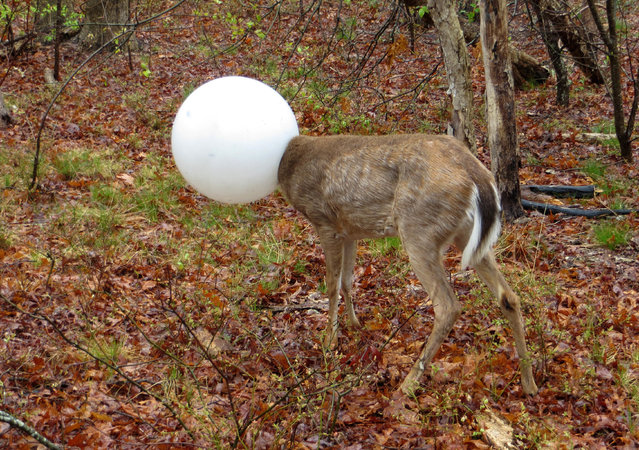
In this May 3, 2016 photo provided by the New York State Department of Environmental Conservation, a deer with its head caught in the globe from a lighting fixture over its head stands in the woods in Centereach, N.Y. The deer was able to extricate itself with the help of Environmental Conservation Officer, Jeff Hull. Hull wrestled with the deer for a while and the globe shook free in the process. (Photo by New York State Department of Environmental Conservation via AP Photo)

In this May 3, 2016 photo provided by the New York State Department of Environmental Conservation, a deer with its head caught in the globe from a lighting fixture over its head stands in the woods in Centereach, N.Y. The deer was able to extricate itself with the help of Environmental Conservation Officer, Jeff Hull. Hull wrestled with the deer for a while and the globe shook free in the process. (Photo by New York State Department of Environmental Conservation via AP Photo)

Details
08 May 2016 10:46:00
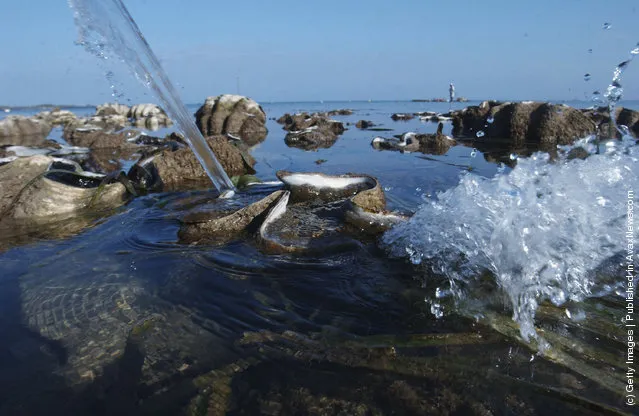
Tridacna Gigas, or Giant Clams

“The giant clam, Tridacna gigas (known as pā’ua in Cook Islands Māori), is the largest living bivalve mollusc. T. gigas is one of the most endangered clam species. It was mentioned as early as 1825 in scientific reports. One of a number of large clam species native to the shallow coral reefs of the South Pacific and Indian oceans, they can weigh more than 200 kilograms (440 lb) measure as much as 120 cm (47 in) across, and have an average lifespan in the wild of 100 years or more”. – Wikipedia

Photo: Tridacna Gigas, or Giant Clams spew water as a traditional fisherman passes by a small sanctuary on January 23, 2004 near Bolinao in the Northern Philippines. The clams, prime builders for coral reefs and providing shelter for spawning fish and other marine life, are exposed by low tides in the sanctuary. Overfishing and pollution throughout the country are not only threatening food security, but are also starting to choke one of the few working clam sanctuaries in the world. (Photo by David Greedy/Getty Images)
Details
01 Oct 2011 13:10:00