Loading...
Done
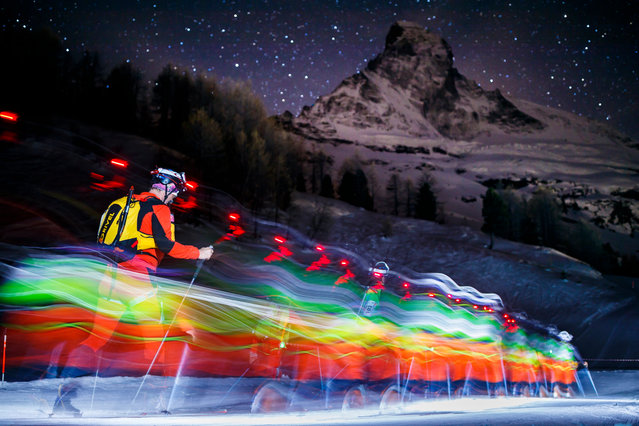
Competitors climb in front of the Matterhorn mountain at the start of the 21st Glacier Patrol race in Stafel outside the ski resort of Zermatt, Switzerland, 18 April 2018. The Glacier Patrol (Patrouille des Glaciers in French), organized by the Swiss Army, takes place from April 17 to 21. Highly-experienced hiker-skiers trek for over 53km (3994m ascent and 4090m descent) along the Haute Route along the Swiss-Italian border from Zermatt to Verbier. (Photo by Valentin Flauraud/EPA/EFE)

Competitors climb in front of the Matterhorn mountain at the start of the 21st Glacier Patrol race in Stafel outside the ski resort of Zermatt, Switzerland, 18 April 2018. The Glacier Patrol (Patrouille des Glaciers in French), organized by the Swiss Army, takes place from April 17 to 21. Highly-experienced hiker-skiers trek for over 53km (3994m ascent and 4090m descent) along the Haute Route along the Swiss-Italian border from Zermatt to Verbier. (Photo by Valentin Flauraud/EPA/EFE)
Details
19 Apr 2018 07:44:00
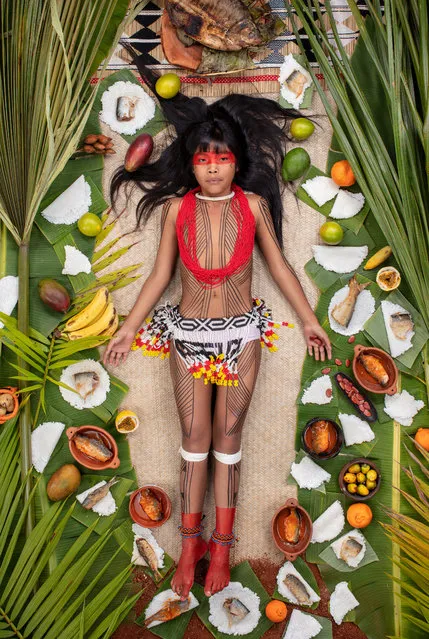
Kawakanih Yawalapiti, 9, Upper Xingu region of Mato Grosso, Brazil, 2018: Kawakanih lives with her tribe, the Yawalapiti, in Xingu national park, a preserve in the Amazon basin of Brazil. The Yawalapiti collect seeds to preserve species unique to their ecosystem, which lies between the rain forest and savannah. Kawakanih’s diet is simple, consisting mainly of fish, cassava, porridge, fruit and nuts. “It takes five minutes to catch dinner”, says Kawakanih. “When you’re hungry, you just go to the river with your net”. (Photo by Gregg Segal/The Guardian)

Photographer Gregg Segal travelled the world to document children and the food they eat in a week. Partly inspired by the increasing problems of childhood obesity, he tracked traditional regional diets as yet unaffected by globalisation, and ironically, found that the healthiest diets were often eaten by the least well off. (Photo by Gregg Segal/The Guardian)
Details
03 Jul 2019 00:03:00
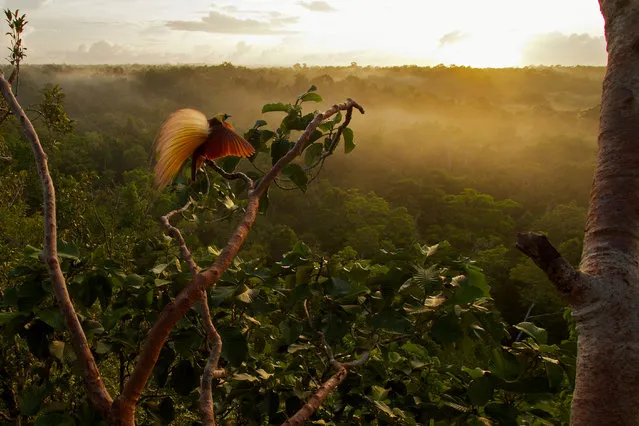
A greater bird of paradise (Paradisaea apoda) displaying in Badigaki Forest, Wokam Island (Aru Islands, Indonesia). Found here in Aru and on adjacent New Guinea, the greater bird of paradise represents about 40 different species of birds of paradise that depend on intact rainforest across the New Guinea region spanning eastern Indonesia and Papua New Guinea. With more than 80% of forest cover still intact, this region represents the largest remaining block of rainforest in the entire Asia-Pacific. (Photo by Tim Laman/naturepl.com/LDY Agency)

A greater bird of paradise (Paradisaea apoda) displaying in Badigaki Forest, Wokam Island (Aru Islands, Indonesia). Found here in Aru and on adjacent New Guinea, the greater bird of paradise represents about 40 different species of birds of paradise that depend on intact rainforest across the New Guinea region spanning eastern Indonesia and Papua New Guinea. With more than 80% of forest cover still intact, this region represents the largest remaining block of rainforest in the entire Asia-Pacific. (Photo by Tim Laman/naturepl.com/LDY Agency)
Details
14 Nov 2021 05:57:00
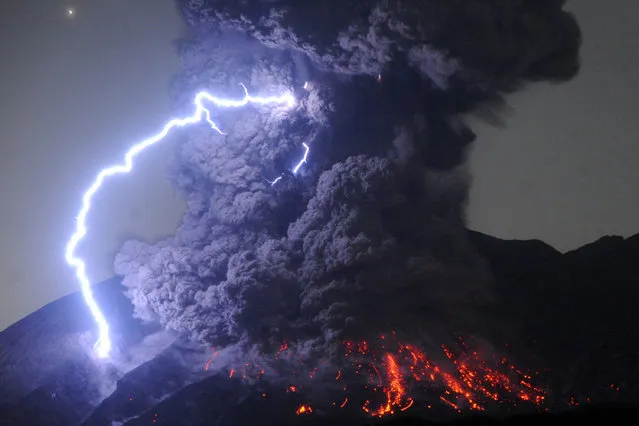
A dirty thunderstorm occurs over Mount Sakurajima as the volcano erupts violently at 12:03 am on July 26, 2016 in Tarumizu, Kagoshima, Japan. The eruption occurred at the mountain's Showa crater. This is the first time that the active volcano in southern Kyushu has spewed out a smokestack that high since an eruption on August 18, 2013, according to the Kagoshima Meteorological Office. (Photo by The Asahi Shimbun via Getty Images)

A dirty thunderstorm occurs over Mount Sakurajima as the volcano erupts violently at 12:03 am on July 26, 2016 in Tarumizu, Kagoshima, Japan. The eruption occurred at the mountain's Showa crater. This is the first time that the active volcano in southern Kyushu has spewed out a smokestack that high since an eruption on August 18, 2013, according to the Kagoshima Meteorological Office. (Photo by The Asahi Shimbun via Getty Images)
Details
24 Dec 2016 09:40:00


“Snowflake (c. 1964 – November 24, 2003) was an albino gorilla. He was the only known albino gorilla so far, and the most popular resident of the Barcelona Zoo in Catalonia, Spain. Originally named Nfumu Ngui in Fang language ("white gorilla") by his captor, he was then nicknamed Floquet de Neu (Catalan for little snowflake) by his keeper Jordi Sabater Pi. On his arrival to Barcelona where he was given an official reception by the then Mayor of Barcelona, Josep Maria de Porcioles, in November 1966, he was called Blancanieves (“Snow White”) in the newspaper Tele/Exprés. But he became famous with the name given to him by Sabater when National Geographic Magazine featured him on the main page in March 1967, with the English name Snowflake. This name spread among the press (Stern, Life, Paris-Match) and was later translated to Spanish as Copito de Nieve. Sabater himself called the gorilla Floquet or Copi, and in the later years Nfumu. The asteroid 95962 Copito, discovered by Catalan astronomer J. Manteca, is named in his honour”.
Details
07 Mar 2011 15:50:00
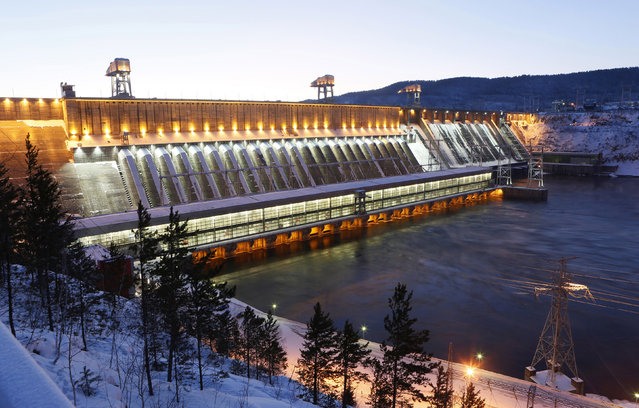
A general view shows the Krasnoyarsk hydro-electric power station on the Yenisei River near the Siberian city of Krasnoyarsk, Russia, January 13, 2016. The power plant, owned by EuroSibEnergo company, part of En+ Group, with a generating capacity of 6,000 megawatt (MW), has a ferro-concrete dam 124-metres high and 1065-metres long and is the second largest Russian hydroelectric power station. About 85% of the energy generated is intended for the Rusal Krasnoyarsk aluminium smelter, according to representatives of the power station. (Photo by Ilya Naymushin/Reuters)

A general view shows the Krasnoyarsk hydro-electric power station on the Yenisei River near the Siberian city of Krasnoyarsk, Russia, January 13, 2016. The power plant, owned by EuroSibEnergo company, part of En+ Group, with a generating capacity of 6,000 megawatt (MW), has a ferro-concrete dam 124-metres high and 1065-metres long and is the second largest Russian hydroelectric power station. About 85% of the energy generated is intended for the Rusal Krasnoyarsk aluminium smelter, according to representatives of the power station. (Photo by Ilya Naymushin/Reuters)
Details
16 Jan 2016 08:03:00
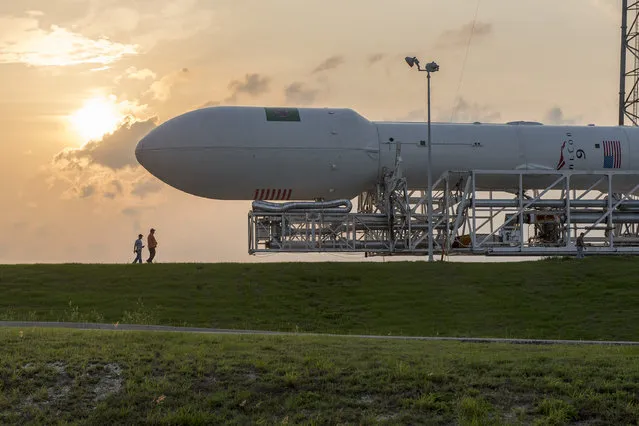
In this handout provided by the National Aeronautics and Space Administration (NASA), SpaceX's Falcon 9 is moved to the launch pad prior to the rocket's Thales Alenia Space launch attempt on April 26, 2015 in Cape Canaveral, Florida. (Photo by NASA via Getty Images)

In this handout provided by the National Aeronautics and Space Administration (NASA), SpaceX's Falcon 9 is moved to the launch pad prior to the rocket's Thales Alenia Space launch attempt on April 26, 2015 in Cape Canaveral, Florida. (Photo by NASA via Getty Images)
Details
05 Jun 2017 07:25:00
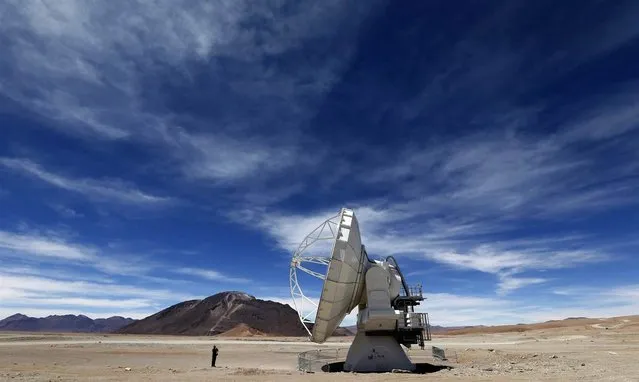
A man takes a photo of a radio antenna that's part of the Atacama Large Milimeter Array Observatory on March 12, 2013 at Llano de Chajnantor, about 43 miles (70 kilometers) from San Pedro de Atacama, Chile. The $1.5 billion ALMA facility, which had its official inauguration on March 13, is considered the world's most expensive ground-based observatory. (Photo by Felipe Trueba/EPA)

A man takes a photo of a radio antenna that's part of the Atacama Large Milimeter Array Observatory on March 12, 2013 at Llano de Chajnantor, about 43 miles (70 kilometers) from San Pedro de Atacama, Chile. The $1.5 billion ALMA facility, which had its official inauguration on March 13, is considered the world's most expensive ground-based observatory. (Photo by Felipe Trueba/EPA)
Details
03 Apr 2013 09:25:00