Loading...
Done
Baby Fennec Fox

“The fennec fox is a small nocturnal fox found in the Sahara of North Africa. Its most distinctive feature is unusually large ears. The name “fennec” comes from the Arabic word for fox, and the species name zerda has a Greek origin that refers to its habitat. The fennec is the smallest species of canid in the world; coat, ears and kidney functions have adapted to a high-temperature, low-water, desert environment. In addition, its hearing is sensitive enough to hear prey moving underground”. – Wikipedia

Photo: A Baby Fennec is seen at Sunshine International Aquarium on June 24, 2009 in Tokyo, Japan. The small nocturnal fox babies were born on May 17 2009. (Photo by Junko Kimura/Getty Images)
Details
16 Sep 2011 12:02:00
Concept Design Home Reversible Destiny Lofts MITAKA: In Memory Of Helen Keller By Reversible Destiny Foundation and Shusaku Arakawa

“The Reversible Destiny Lofts – Mitaka (In Memory of Helen Keller) is a nine-unit multiple dwelling. It was first completed example of procedural architecture put to residential use. These lofts reflexively articulate the residents’ operative tendencies and coordinating skills essential to and determinative of human thought and behavior; which means to say, the lofts manage, by virtue of how they are constructed, to reveal to their residents the ins and outs of what makes a person, in this case the resident. This is the same set of tendencies and skills to which Arakawa and Madeline Gins gave diagrammatic form in their decades-long research project The Mechanism of Meaning”. – Wikipedia

Photo: The exterior of the concept design home “Reversible Destiny Lofts MITAKA: In Memory of Helen Keller” is seen on October 27, 2005 in Tokyo, Japan. (Photo by Koichi Kamoshida/Getty Images)
Details
30 Nov 2011 11:58:00
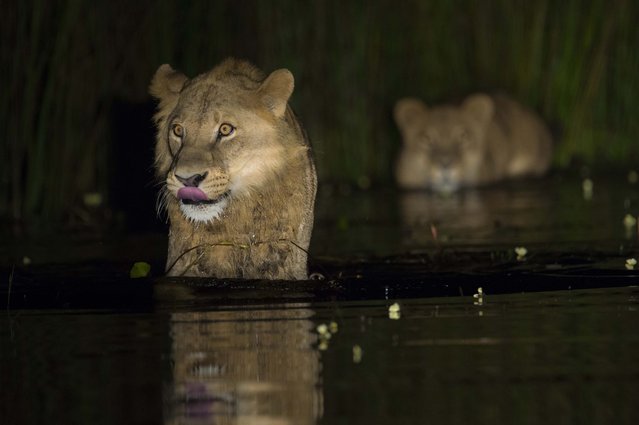
Lions submerged in water. (Photo by Wim van den Heever/Caters News)

These breath-taking photographs reveal the everyday lives of animals living in the wild. The incredible images were taken by wildlife photographer Wim van dan Heever, from Pretoria, South Africa, during trips to locations including Japan, Botswana and Svalbard. The 43-year-old has been photographing wildlife since he was a young boy and turned his passion for animals into a career and set up ODP Safaris. He has travelled across the globe to photograph wild animals – from lions and tigers, to elephants, dolphins and eagles – as they hunt, give birth and graze in their natural habitats. Here: Lions submerged in water. (Photo by Wim van den Heever/Caters News)
Details
07 Aug 2015 11:43:00
An erotic danser picks up fake 2-dollar bills during a private dance with a Yakuza customer in a strip tease bar in Kabukicho, a bar which is controlled by the ODO family – 2010. (Photo and caption by Anton Kusters)

The Belgian photographer Anton Kusters spent two years photographing the Yakuza, Japan’s most notorious gang. He returned with some amazing images that he made into a book called “Odo Yakuza Tokyo”. (Odo means “the way of the cherry blossom” and is the credo of the Yakuza family he followed. Photo: An erotic danser picks up fake 2-dollar bills during a private dance with a Yakuza customer in a strip tease bar in Kabukicho, a bar which is controlled by the ODO family – 2010. (Photo and caption by Anton Kusters)
Details
31 Aug 2014 08:42:00
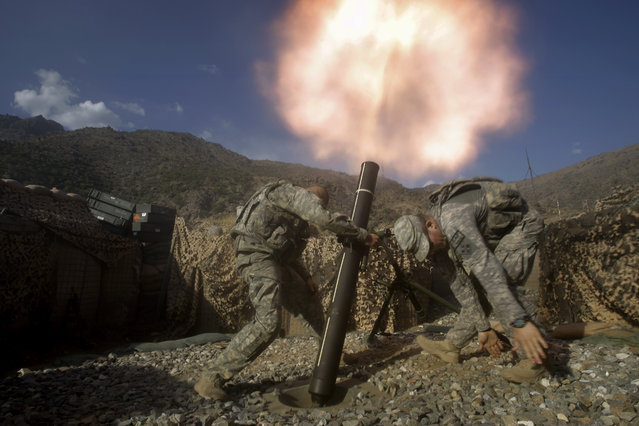
U.S. soldiers from the 2nd Battalion, 12th Infantry Regiment, 4th Brigade Combat Team, fire mortars at known enemy firing positions from a base in the Pech River Valley in Afghanistan's Kunar province, Saturday, October 24, 2009. (Photo by David Guttenfelder/AP Photo)

David Guttenfelder was born in Iowa and graduated from the University of Iowa with a Bachelor of Arts in cultural anthropology. He has worked for the AP since 1994 based in Kenya, the Ivory Coast, India and Japan. He is currently AP’s chief Asia photographer and his feature work has been used prominently in editorial publications throughout the world including Time and National Geographic. Photo: U.S. soldiers from the 2nd Battalion, 12th Infantry Regiment, 4th Brigade Combat Team, fire mortars at known enemy firing positions from a base in the Pech River Valley in Afghanistan's Kunar province, Saturday, October 24, 2009. (Photo by David Guttenfelder/AP Photo)
Details
21 Apr 2014 10:11:00
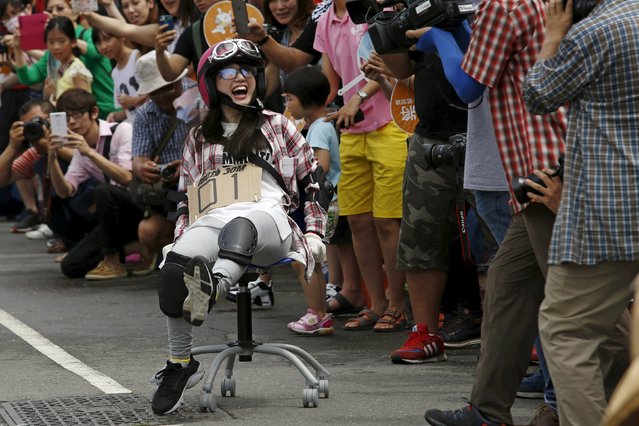
A competitor laughs while taking part in the office chair race ISU-1 Grand Prix in Tainan, southern Taiwan April 24, 2016. (Photo by Tyrone Siu/Reuters)

A competitor laughs while taking part in the office chair race ISU-1 Grand Prix in Tainan, southern Taiwan April 24, 2016. It was the first time such a race was held in Tainan, as part of the “ISU-1 GP” (Grand Prix) that began in Japan in 2010, according to businesses on Jhengsing Street and Haian Road in the city's West Central District and the city's Tourism Bureau, which organized the event. The fastest rider only took six seconds to complete the 30-meter race. (Photo by Tyrone Siu/Reuters)
Details
25 Apr 2016 09:48:00
Rescue specialists for USA-1 drill through a concrete slab to rescue a victim from the scene of a mock disaster area during a training exercise at the Guardian Center in Perry, Georgia, March 25, 2014. (Photo by Shannon Stapleton/Reuters)

Rescue specialists for USA-1 drill through a concrete slab to rescue a victim from the scene of a mock disaster area during a training exercise at the Guardian Center in Perry, Georgia, March 25, 2014. A week of field training, the first of its kind at the 830-acre training site, to be open to the media, began Monday with the arrival of USA-1 from Fairfax, Virginia along with its sister team in Los Angeles, California. USA-1 has been deployed by the U.S. Agency for International Development to 30 foreign disasters, including earthquakes in Haiti, Armenia and Iran, the tsunami in Japan and the typhoon in the Philippines. (Photo by Shannon Stapleton/Reuters)
Details
27 Mar 2014 07:05:00


“Itasha (痛車), literally “painmobile”, is a Japanese term for an otaku fad of individuals decorating the bodies of their cars with fictional characters of anime, manga, or video games (especially bishōjo game or eroge). These characters are predominately “cute” female. The decorations usually involve paint schemes and stickers. Automobiles are called Itasha, while similar motorcycles and bicycles are called itansha (痛単車) and itachari (痛チャリ), respectively”. – Wikipedia


Photo: A visitor takes pictures of an anime-decorated «Itasha» car displayed during the “Moe Fes in Washimiya” at Washimiya Town Hall on July 18, 2009 in Washimiya, Saitama, Japan. Itasha, a word derived from “itai” (painful) and “sha” (car), are vehicles decorated with mostly female characters from Japanese manga, anime and video games. (Photo by Kiyoshi Ota/Getty Images)
Details
02 May 2011 08:38:00