Loading...
Done
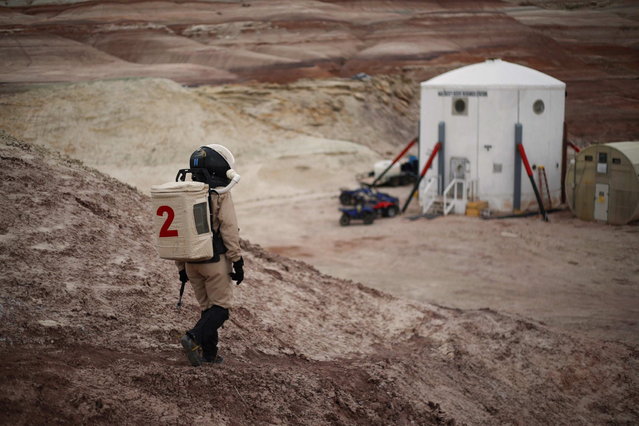
Csilla Orgel, a geologist of Crew 125 EuroMoonMars B mission, makes her way back to the Mars Desert Research Station (MDRS) in the Utah desert March 3, 2013. (Photo by Jim Urquhart/Reuters)

NASA says it could be another 20 years before humans touch down on Mars, but in a sense, the Mars Society has been exploring the red planet for more than a decade – in Utah. Photo: Csilla Orgel, a geologist of Crew 125 EuroMoonMars B mission, makes her way back to the Mars Desert Research Station (MDRS) in the Utah desert March 3, 2013. The MDRS aims to investigate the feasibility of a human exploration of Mars and uses the Utah desert's Mars-like terrain to simulate working conditions on the red planet. Scientists, students and enthusiasts work together developing field tactics and studying the terrain. All outdoor exploration is done wearing simulated spacesuits and carrying air supply packs and crews live together in a small communication base with limited amounts of electricity, food, oxygen and water. Everything needed to survive must be produced, fixed and replaced on site. (Photo by Jim Urquhart/Reuters)
Details
14 Mar 2013 12:11:00
Breath of an Arctic fox by Marco Gaiotti, Italy. Marco was watching this little Arctic fox as it incessantly called another nearby. Gradually he noticed the fox’s wet breath was quickly freezing in the air after each call. It was late winter in Spitsbergen, Svalbard, and the air was -35C (-31F). Photographing Arctic foxes is often frustrating, as they are normally running around fast in search of food, but this one was very relaxed and let Marco get close enough to focus on it, with the light glowing perfectly in the background. (Photo by Marco Gaiotti/Wildlife Photographer of the Year 2021)

Breath of an Arctic fox by Marco Gaiotti, Italy. Marco was watching this little Arctic fox as it incessantly called another nearby. Gradually he noticed the fox’s wet breath was quickly freezing in the air after each call. It was late winter in Spitsbergen, Svalbard, and the air was -35C (-31F). Photographing Arctic foxes is often frustrating, as they are normally running around fast in search of food, but this one was very relaxed and let Marco get close enough to focus on it, with the light glowing perfectly in the background. (Photo by Marco Gaiotti/Wildlife Photographer of the Year 2021)
Details
05 Dec 2021 06:36:00
In this February 2, 2015 photo, tourists jump as they pose for a picture, after disembarking from the Ocean Nova cruise ship, on King George Island, Antarctica. This tourist season, which runs November through March, more than 37,000 visitors are expected to walk on the coldest continent on Earth, about 10 percent more than the year before. (Photo by Natacha Pisarenko/AP Photo)

In this February 2, 2015 photo, tourists jump as they pose for a picture, after disembarking from the Ocean Nova cruise ship, on King George Island, Antarctica. This tourist season, which runs November through March, more than 37,000 visitors are expected to walk on the coldest continent on Earth, about 10 percent more than the year before. (Photo by Natacha Pisarenko/AP Photo)
Details
22 Mar 2015 11:31:00
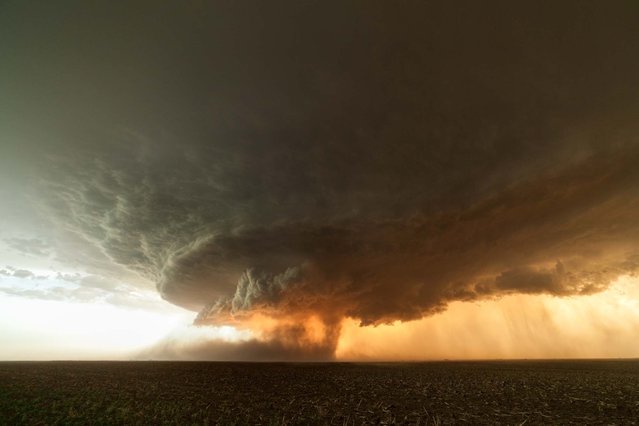
A picturesque supercell formation in the northwest of Booker, Texas from June 2013. (Photo by Mike Olbinski/Barcroft Media)

A picturesque supercell formation in the northwest of Booker, Texas from June 2013. (Photo by Mike Olbinski/Barcroft Media)
Details
24 Apr 2014 10:25:00
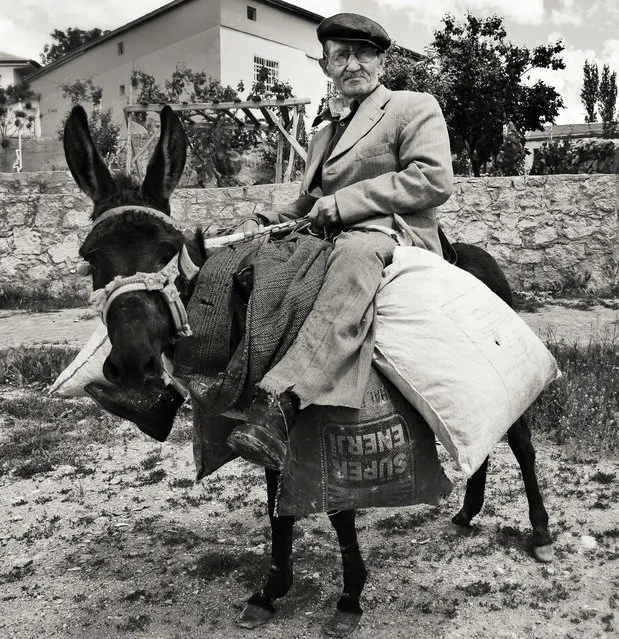
“Super Enerji”. Taken on my road trip through Turkey. (Photo and caption by Michelle Brandemuehl/National Geographic Traveler Photo Contest)

“Super Enerji”. Taken on my road trip through Turkey. (Photo and caption by Michelle Brandemuehl/National Geographic Traveler Photo Contest)

ATTENTION! All pictures are presented in high resolution. To see Hi-Res images – just TWICE click on any picture. In other words, click small picture – opens the BIG picture. Click BIG picture – opens VERY BIG picture.
Details
05 Jul 2013 11:17:00
This Thursday, January 22, 2015 photo made with a long exposure shows the glow from a Noctiluca scintillans algal bloom along the seashore in Hong Kong. The luminescence, also called Sea Sparkle, is triggered by farm pollution that can be devastating to marine life and local fisheries, according to University of Georgia oceanographer Samantha Joye. (Photo by Kin Cheung/AP Photo)

This Thursday, January 22, 2015 photo made with a long exposure shows the glow from a Noctiluca scintillans algal bloom along the seashore in Hong Kong. The luminescence, also called Sea Sparkle, is triggered by farm pollution that can be devastating to marine life and local fisheries, according to University of Georgia oceanographer Samantha Joye. Noctiluca itself does not produce neurotoxins like other similar organisms do. But its role as both prey and predator tends can eventually magnify the accumulation of toxins in the food chain, according to R. Eugene Turner at Louisiana State University. (Photo by Kin Cheung/AP Photo)
Details
23 Jan 2015 13:12:00
Revellers pose during the 24th Street Parade dance music event in Zurich, August 29, 2015. (Photo by Arnd Wiegmann/Reuters)

Revellers pose during the 24th Street Parade dance music event in Zurich, August 29, 2015. (Photo by Arnd Wiegmann/Reuters)
Details
30 Aug 2015 12:16:00
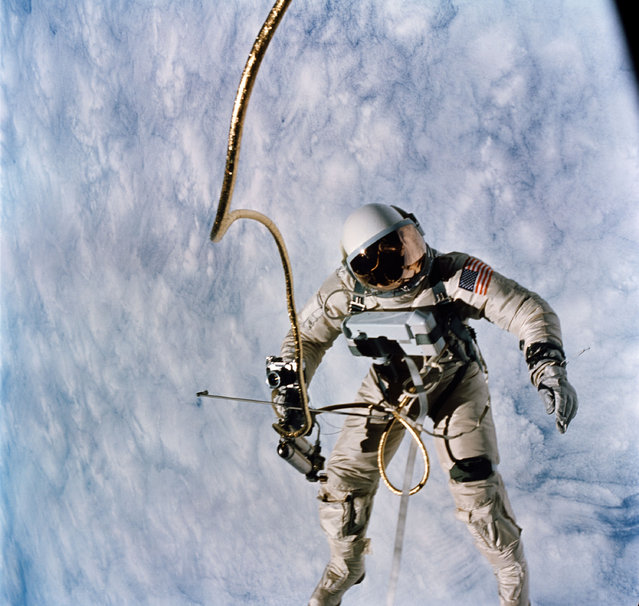
Astronaut Edward H. White II, pilot for the Gemini-Titan 4 (GT-4) spaceflight, floats in the zero-gravity of space during the third revolution of the GT-4 spacecraft on June 3, 1965. White wears a specially designed spacesuit. His face is shaded by a gold-plated visor to protect him from unfiltered rays of the sun. (Photo by NASA)

Astronaut Edward H. White II, pilot for the Gemini-Titan 4 (GT-4) spaceflight, floats in the zero-gravity of space during the third revolution of the GT-4 spacecraft on June 3, 1965. White wears a specially designed spacesuit. His face is shaded by a gold-plated visor to protect him from unfiltered rays of the sun. In his right hand he carries a Hand-Held Self-Maneuvering Unit (HHSMU) that gives him control over his movements in space. White also wears an emergency oxygen chest pack; and he carries a camera mounted on the HHSMU for taking pictures of the sky, Earth and the GT-4 spacecraft. He is secured to the spacecraft by a 25-feet umbilical line and a 23-feet tether line. Both lines are wrapped together in gold tape to form one cord. Astronaut James A. McDivitt, command pilot, remained inside the spacecraft during the extravehicular activity (EVA). Astronaut White died in the Apollo/Saturn 204 fire at Cape Kennedy on January 27, 1967. (Photo by NASA)
Details
22 Jul 2014 12:05:00