Activists from the climate action group Ocean Rebellion perform a stunt outside the Science Museum, in London, United Kingdom on May 19, 2021. (Photo by Hannah McKay/Reuters)
One woman was pictured sitting bare foot on a pavement in Leeds in the northern English county of Yorkshire on May 30, 2021. With the sun streaming down, Brits have been taking full advantage of the three-day weekend by packing out pub gardens and lining up the beers at bars. (Photo by Nb press ltd)
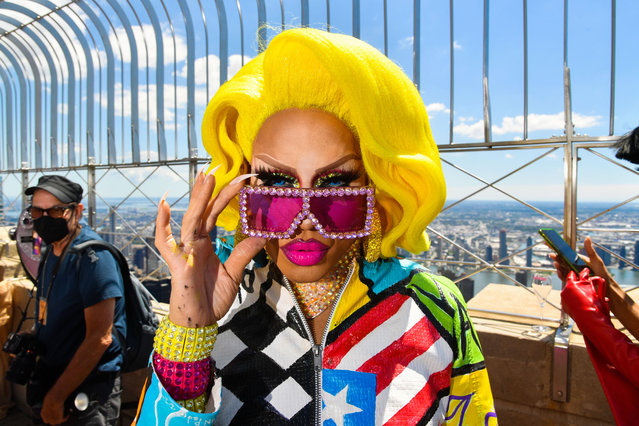
Cast member Yara Sophia of “RuPaul's Drag Race” visits the Empire State Building in New York City on June 24, 2021. (Photo by Stephen Lovekin/Rex Features/Shutterstock)
People protest getting evicted from land designated for a Petrobras refinery, at a settlement coined the “First of May Refugee Camp”, referring to the date people moved here and set up tents and shacks to live in during the new coronavirus pandemic in Itaguai, Rio de Janeiro state, Brazil, Thursday, July 1, 2021. (Photo by Silvia Izquierdo/AP Photo)
ISS Expedition 66 main crew member, actress Yulia Peresild blows a kiss through a bus window as she leaves for the Baikonur Cosmodrome in Kazakhstan on October 5, 2021. The launch of the Soyuz MS-19 mission to be involved in making the feature film “The Challenge” (working title) aboard the International Space Station is scheduled for 5 October 2021 at 11:55 Moscow time from the Baikonur Cosmodrome. (Photo by Sergei Savostyanov/TASS)
On August 31, 2012, a long filament of solar material that had been hovering in the sun's atmosphere, the corona, erupted out into space at 4:36 p.m. EDT. The coronal mass ejection, or CME, traveled at over 900 miles per second. The CME did not travel directly toward Earth, but did connect with Earth's magnetic environment, or magnetosphere, causing aurora to appear on the night of Monday, September 3. (Photo by NASA/GSFC/SDO via The Atlantic)
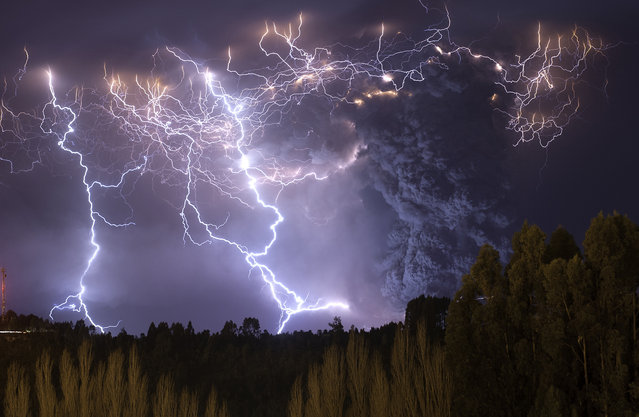
The eruption of Cordon Caulle began on June 4, 2011, located in the Region of Los Rios in Chile. For about 12 months, people and animals became accustomed to living with the daily fall of ash, which also caused problems in the air traffic in South America. The explosions and lightning during first days of the eruption could be seen from hundreds of miles around. This photograph was taken on the second night of eruption from the town of Lago Ranco. (Photo and caption by Francisco Negroni/National Geographic Traveler Photo Contest)
ATTENTION! All pictures are presented in high resolution. To see Hi-Res images – just TWICE click on any picture. In other words, click small picture – opens the BIG picture. Click BIG picture – opens VERY BIG picture.
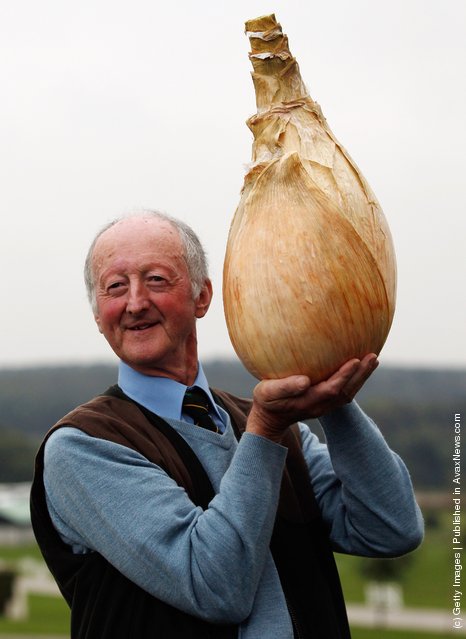
Gardener Peter Glazebrook poses for photographers with his world record breaking onion at The Harrogate Autumn Flower Show on September 16, 2011 in Harrogate, England. Peter Glazebrook from Newark, Nottinghamshire claimed a Guinness World Record with his giant onion weighing 8.150 kg. (Photo by Christopher Furlong/Getty Images)