Loading...
Done
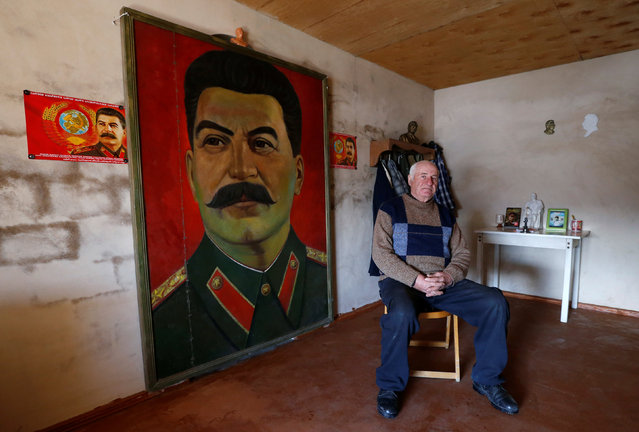
Retired builder Vasili Sidamonidze, 70, poses for a portrait at his home in Gori, Georgia, December 6, 2016. “Unfortunately, Stalin is not popular nowadays. Our people don't respect him. Only we, members of the (Communist) Party, respect him”, Sidamonidze said. “I always try to attend Stalin's birthday anniversaries in Gori. Unfortunately many people don't want to join us even if they live nearby. They look at us from their windows”. Stalin, who was born in Gori in 1878 and died in 1953, is largely reviled today in Georgia, which regained its independence during the 1991 collapse of the Soviet Union. Over the years, his memorials have been dismantled, most recently in 2010 when authorities removed a statue of the dictator from Gori's central square. But Stalin is still revered by a small group of mainly elderly supporters who stress his role in the industrialisation of the Soviet Union and in defeating Nazi Germany in World War Two. Each Dec. 21, a few dozen people mark his birthday by gathering outside a Gori museum dedicated to Stalin, where they make speeches and walk to the square where a 6-meter-high bronze statue of him once stood, calling for it to be reinstated. Opponents say it was a symbol of Moscow's still lingering shadow. In 2008, Russia fought a brief war with Georgia and recognised its breakaway regions of Abkhazia and South Ossetia as independent states. (Photo by David Mdzinarishvili/Reuters)

Retired builder Vasili Sidamonidze, 70, poses for a portrait at his home in Gori, Georgia, December 6, 2016. “Unfortunately, Stalin is not popular nowadays. Our people don't respect him. Only we, members of the (Communist) Party, respect him”, Sidamonidze said. “I always try to attend Stalin's birthday anniversaries in Gori. Unfortunately many people don't want to join us even if they live nearby. They look at us from their windows”. (Photo by David Mdzinarishvili/Reuters)
Details
17 Dec 2016 07:59:00
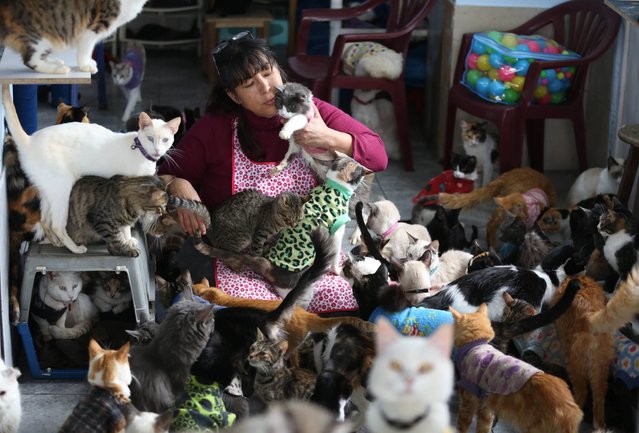
In this August 2, 2014 photo, Maria Torero, plays with a group of 175 cats with leukemia in her home in Lima, Peru. Torero says caring for cats with feline leukemia is her responsibility. Anybody else can care for healthy animals. (Photo by Martin Mejia/AP Photo)

“At her job, Maria Torero cares for sick human beings. At home, she lavishes love on slowly dying cats – 175 of them at last count. The 45-year-old nurse has turned her two-story, eight-room apartment into a hospice for cats with feline leukemia, scattering it with scores of feeding dishes and at least two dozen boxes litter boxes. Some have suggested she shelter healthy cats instead. “That's not my role”, she told The Associated Press. “I'm a nurse. My duty is to the cats that nobody cares about”. She said that “people don't adopt adult cats, especially if they are terminally ill”. – Franklin Briceno via Associated Press. (Photo by Martin Mejia/AP Photo)
Details
24 Aug 2014 09:28:00
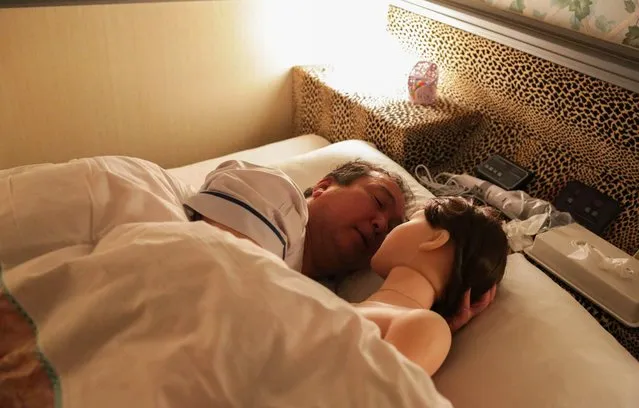
Senji Nakajima sleeps with his Love Doll “Saori” at Love Hotel on June 4, 2016 in Nagano, Japan. Senji Nakajima, 61 years old, lives with his life-size 'love doll' named “Saori” in his apartment in Tokyo, Japan. Nakajima, married with two children, who lives away from home for work, first started his life with Saori six years ago. At first, he used to imagine as if the doll was his first girl friend, and used it only for sexual purposes to fill the loneliness, but months later, he started to find Saori actually has an original personality. “She never betrays, not after only money. I'm tired of modern rational humans. They are heartless”, Nakajima says, “for me, she is more than a doll. Not just a silicon rubber. She needs much help, but still is my perfect partner who shares precious moments with me and enriches my life”. (Photo by Taro Karibe/Getty Images)

Senji Nakajima sleeps with his Love Doll “Saori” at Love Hotel on June 4, 2016 in Nagano, Japan. Senji Nakajima, 61 years old, lives with his life-size “love doll” named “Saori” in his apartment in Tokyo, Japan. Nakajima, married with two children, who lives away from home for work, first started his life with Saori six years ago. (Photo by Taro Karibe/Getty Images)
Details
07 Aug 2016 09:21:00
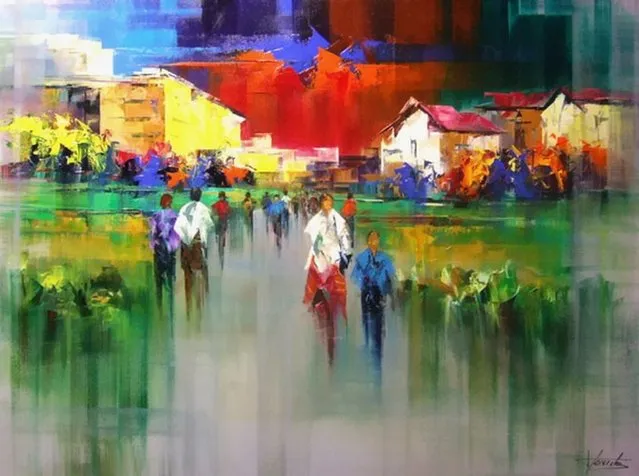
Painting By Josep Teixido

I was born in Calella (Barcelona) in 1956, and nowadays I live in Vilassar de Mar (Barcelona). Since I was a child I have been fascinated by painting and I think I'm a self-taught painter because, despite I was taught drawing at Primary School, I have acquired my knowledge thanks to my environment. Painting is my own way to express myself. I can shape my inward in the canvas with the essential help of the palette knife and the colours. As a nature’s lover and great observant, my environment has always been my source of inspiration. At present I devote myself exclusively to painting, my true passion, and that is why I feel extremely fortunate.

Josep Teixido
Details
18 Sep 2013 09:45:00
Invasion (laser girls) 2017. “I’m always thinking about my art practice, so any experience I have may spike a visual when I have an idea in mind. An example is that, when I was thinking about the Invasion series, I was inspired by Alfred Hitchcock’s movie The Birds (1963). I love Hitchcock’s other movies and have been contemplating a series based on Rear Window (1954). I also find inspiration outside the cinema in music clips and magazines”. (Photo by Michael Cook/Perimeter Books)

Invasion (laser girls) 2017. “I’m always thinking about my art practice, so any experience I have may spike a visual when I have an idea in mind. An example is that, when I was thinking about the Invasion series, I was inspired by Alfred Hitchcock’s movie The Birds (1963). I love Hitchcock’s other movies and have been contemplating a series based on Rear Window (1954). I also find inspiration outside the cinema in music clips and magazines”. (Photo by Michael Cook/Perimeter Books)
Details
09 Nov 2025 05:06:00
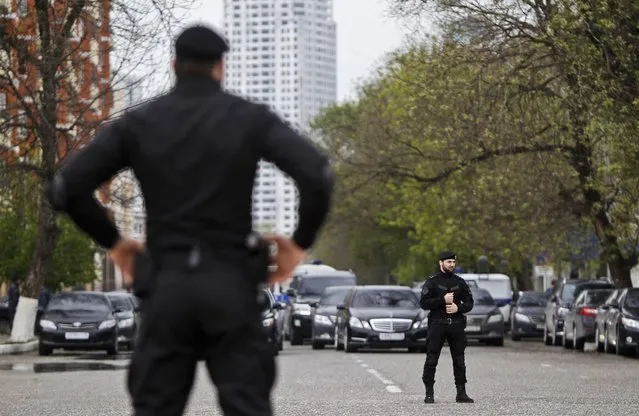
Special forces officers stand guard during a government-organised event marking Chechen language day in the centre of the Chechen capital Grozny April 25, 2013. (Photo by Maxim Shemetov/Reuters)

“What did I know about Chechnya before last week? For someone who grew up in the 1990s the very word Chechnya meant a string of grainy images on TV showing people in battered camouflage outfits, shooting at each other amid destruction and ruin. Fear, wahhabis, Shamil Basayev, terrorism, mountains: these were the words that used to spring to my mind when someone mentioned Chechnya”. – Maxim Shemetov. Photo: Special forces officers stand guard during a government-organised event marking Chechen language day in the centre of the Chechen capital Grozny April 25, 2013. (Photo by Maxim Shemetov/Reuters)
Details
14 May 2013 12:02:00
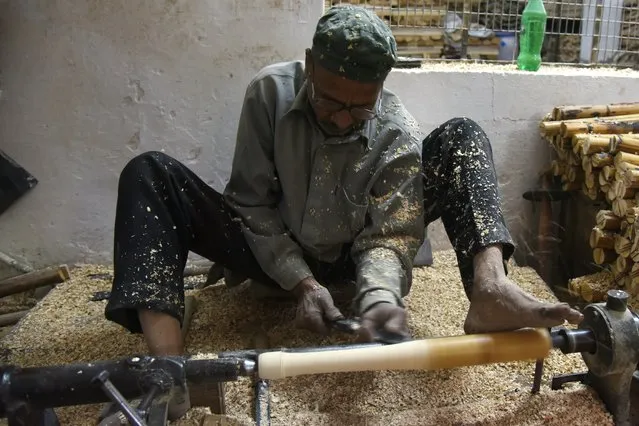
In this photograph taken on December 14, 2016, an Indian craftsman works on unfinished cricket bats in a factory in Meerut, some 70 kms north- east of New Delhi. As Indian factory worker Jitender Singh carves out another big- hitting slab of thick willow he insists MCC proposals to limit the size of cricket bats won' t tame Twenty20 marauders. “I don' t think the thickness matters. It' s more about the balance of the bat and the talent of the batsman”, says Singh, who has made bats for many stars, including South Africa's AB de Villiers. The World Cricket committee of the MCC, the guardians of the game, recommended in December 2016 that limitations be placed on the width and depth of bats because it had become too easy to smash fours and sixes. (Photo by Dominique Faget/AFP Photo)

In this photograph taken on December 14, 2016, an Indian craftsman works on unfinished cricket bats in a factory in Meerut, some 70 kms north- east of New Delhi. (Photo by Dominique Faget/AFP Photo)
Details
11 Jan 2017 14:32:00
Alexei Gruk, 45, mechanic and supporter of presidential candidate Pavel Grudinin, poses for a picture in St. Petersburg, Russia, January 31, 2018. “The most important thing for me is that our foreign policy stays the same”, said Gruk. “To hell with the sanctions… So what if they don’t bring foreign stuff here anymore? As if that means we have to give up. I don't care”. (Photo by Anton Vaganov/Reuters)

Most Russians intending to vote for Vladimir Putin in Sunday's election say stability is at the root of their faith in their candidate – though many young voters believe it's time for a change of leader. Putin, 65, is expected to win a fourth term in office with 69 percent of the vote, according to the latest survey by a state-run pollster. Reuters correspondents and photographers who travelled around the country talking to voters ahead of the March 18 election found nothing to contradict expectation of an emphatic Putin victory. (Photo by Anton Vaganov/Reuters)
Details
15 Mar 2018 00:01:00