Loading...
Done
The Lun-class Ekranoplane was used by the Soviet Navy starting in 1987, and wasn't retired until the late 1990s, after the Soviet Union's fall. (Igor113)

“The Lun-class ekranoplan (NATO reporting name Duck) was a ground effect vehicle (GEV) designed by Rostislav Evgenievich Alexeev and used by the Soviet and Russian navies from 1987 until sometime in the late 1990s. It “flew” using the lift generated by the ground effect of its large wings when close to the surface of the water – about four metres or less. Although they might look similar and/or have related technical characteristics, ekranoplans like the Lun are not aircraft, seaplanes, hovercraft, or hydrofoils – ground effect is a separate technology altogether. The International Maritime Organization classifies these vehicles as maritime ships. The name Lun comes from the Russian for harrier”. – Wikipedia (Photo by Igor113)
Details
08 Aug 2014 10:51:00
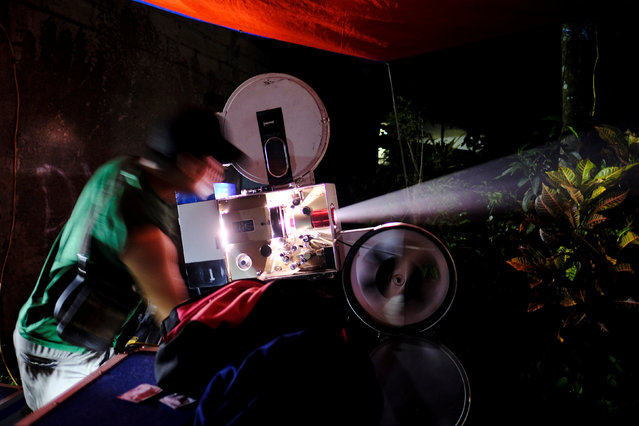
An operator adjusts a film projector during a wedding party in Bogor, Indonesia, February 18, 2017. (Photo by Reuters/Beawiharta)

An operator adjusts a film projector during a wedding party in Bogor, Indonesia, February 18, 2017. Indonesian entrepreneur Kamaluddin loves the gritty look of old 35-millimeter film so much that he spends most of his nights screening vintage movies at weddings and parties around Jakarta, the capital. (Photo by Reuters/Beawiharta)
Details
30 May 2017 08:20:00

A worker sprays disinfectant as sanitization operations against Coronavirus are carried out in the museum hosted by the Maschio Angioino medieval castle, in Naples, Italy, Tuesday, March 10, 2020. (Photo by Alessandro Pone/LaPresse via AP Photo)

A worker sprays disinfectant as sanitization operations against Coronavirus are carried out in the museum hosted by the Maschio Angioino medieval castle, in Naples, Italy, Tuesday, March 10, 2020. (Photo by Alessandro Pone/LaPresse via AP Photo)
Details
12 Mar 2020 00:07:00
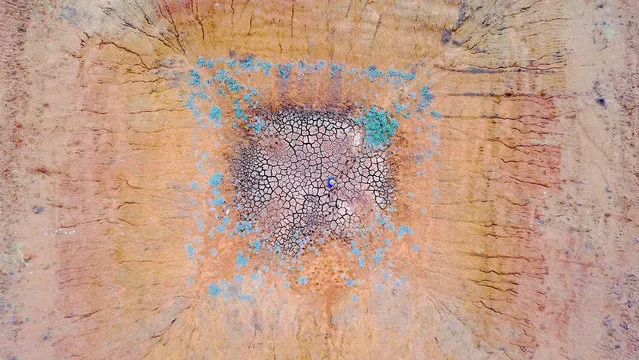
Farmer Ash Whitney stands in the middle of a dried-up dam in a drought-effected paddock on his property located west of the town of Gunnedah in New South Wales, Australia, June 3, 2018. “I have been here all my life, and this drought is feeling like it will be around a while”, said Whitney. (Photo by David Gray/Reuters)

Farmer Ash Whitney stands in the middle of a dried-up dam in a drought-effected paddock on his property located west of the town of Gunnedah in New South Wales, Australia, June 3, 2018. “I have been here all my life, and this drought is feeling like it will be around a while”, said Whitney. (Photo by David Gray/Reuters)
Details
07 Aug 2018 00:05:00
Black horoscope wheel. (Photo by Toma Petrovic)

Find out what 2014 has in store for you and your cash. Provided by Russell Grant Horoscopes. (Photo by Toma Petrovic)


Details
24 Mar 2014 08:58:00
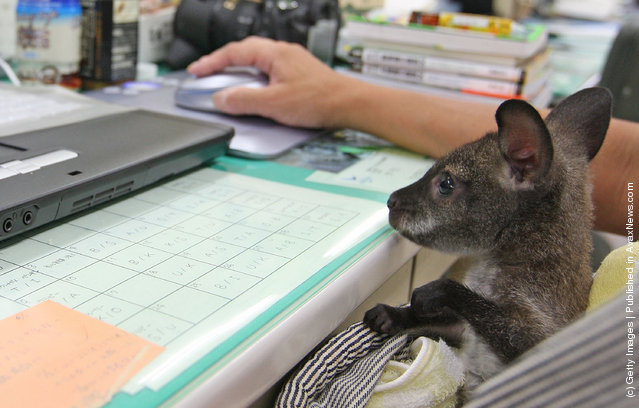
A baby wallaby

“Very small forest-dwelling wallabies are known as pademelons (genus Thylogale) and dorcopsises (genera Dorcopsis and Dorcopsulus). The name wallaby comes from the Eora Aboriginal tribe who were the original inhabitants of the Sydney area. Wallabies are herbivores whose diet consists of a wide range of grasses, vegetables, leaves, and other types of foliage”. – Wikipedia

Photo: A baby wallaby sits in a zoo attendant's lap at Edogawa Natural Zoo on August 4, 2009 in Tokyo, Japan. The staff of the zoo have raised the young wallaby after her mother neglected her. (Photo by Junko Kimura/Getty Images)
Details
07 Sep 2011 13:33:00
A woman reacts after performing Otonamaki, which translates as “adult wrapping”, a new form of therapy where people are wrapped in large swaddling cloth to alleviate posture problems and stiffness, at a session in Asaka, Saitama prefecture, Japan, February 4, 2017. (Photo by Toru Hanai/Reuters)

A woman reacts after performing Otonamaki, which translates as “adult wrapping”, a new form of therapy where people are wrapped in large swaddling cloth to alleviate posture problems and stiffness, at a session in Asaka, Saitama prefecture, Japan, February 4, 2017. (Photo by Toru Hanai/Reuters)
Details
06 Feb 2017 01:05:00
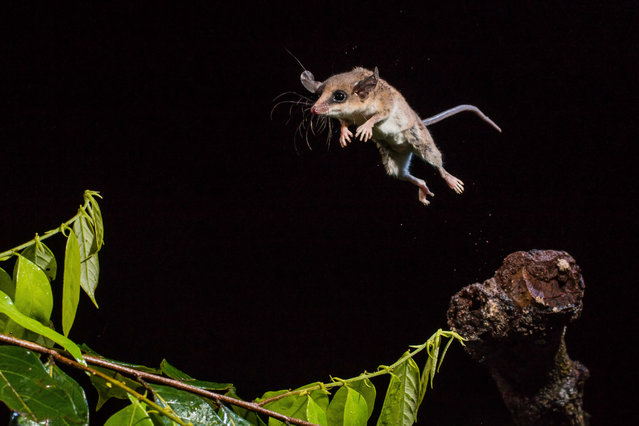
Tropical acrobatics by Adrià López Baucells in Manaus, Brazil. An unidentified South American marsupial, although the characteristic black markings on its face indicate it may be a mouse opossum. These small creatures are nocturnal and feed on bugs, fruit and bird eggs. (Photo by Adrià López Baucells/2019 Royal Society of Biology Photography Competition)

Tropical acrobatics by Adrià López Baucells in Manaus, Brazil. An unidentified South American marsupial, although the characteristic black markings on its face indicate it may be a mouse opossum. These small creatures are nocturnal and feed on bugs, fruit and bird eggs. (Photo by Adrià López Baucells/2019 Royal Society of Biology Photography Competition)
Details
10 Oct 2019 00:03:00