Loading...
Done
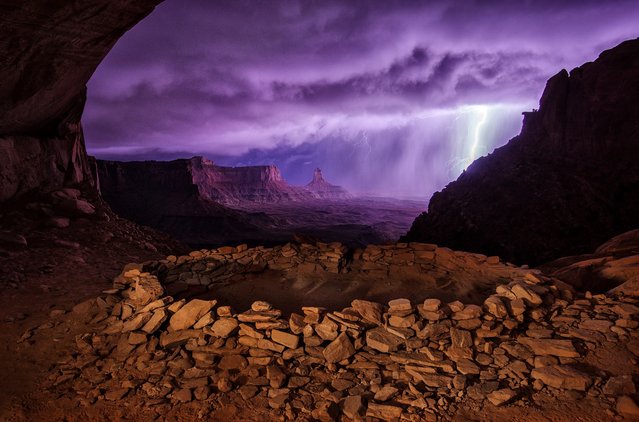
Second Place Winner: “Thunderstorm at False Kiva”. I hiked out to these ruins at night hoping to photograph them with the Milky Way, but instead a thunderstorm rolled through, creating this dramatic image. – Max Seigal. (Photo and caption by Max Seigal/National Geographic Traveler Photo Contest)

Second Place Winner: “Thunderstorm at False Kiva”. I hiked out to these ruins at night hoping to photograph them with the Milky Way, but instead a thunderstorm rolled through, creating this dramatic image. – Max Seigal. National Geographic Traveler Director of Photography Dan Westergren, one of this year's judges, shares his thoughts on the second place winner: “This photo combines two different scenes into one: the small kiva in a cliff dwelling and the grand vista of Canyonlands National Park across the valley. I really like the two different color palettes – warm inside and purple outside. This two-for-one scene was caused by the lightning storm outside the dwelling, which lit up the landscape like it was a huge electronic flash. Looking at this picture I can imagine what a wonderful sight it must have been for the ancient people who lived here. It doesn't seem too amazing now in our modern world, but might have been mind-blowing for the prehistoric residents”. Location: Utah. (Photo and caption by Max Seigal/National Geographic Traveler Photo Contest)
Details
02 Aug 2013 06:16:00
Camp director and “duck walk” inventor Rodin Gilbert Flores, 2nd R) teaches aspiring beauty queens how to “duck walk” at a beauty boot camp in Manila in this picture taken on March 8, 2015. From wading in muddy Philippine rice paddies, former housemaid Janicel Lubina now struts down runways for the country's top designers, and is poised to be crowned among the world's most beautiful. (Photo by Noel Celis/AFP Photo)

Camp director and “duck walk” inventor (Rodin Gilbert Flores, 2nd R) teaches aspiring beauty queens how to “duck walk” at a beauty boot camp in Manila in this picture taken on March 8, 2015. From wading in muddy Philippine rice paddies, former housemaid Janicel Lubina now struts down runways for the country's top designers, and is poised to be crowned among the world's most beautiful. Lubina is a star recruit in one of Manila's beauty pageant boot camps, where shy, lanky teenage girls from remote farming provinces are transformed into poised Barbie dolls who can preach about world peace in six-inch heels. (Photo by Noel Celis/AFP Photo)
Details
15 Mar 2015 06:51:00
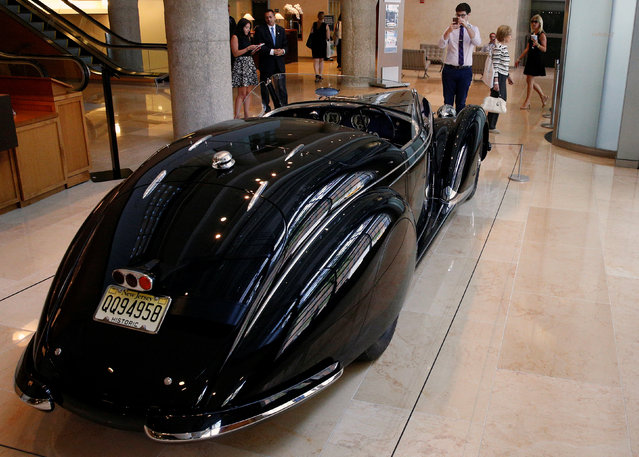
People look at a 1939 Alfa Romeo 8C 2900B Lungo Touring Spider displayed at Sotheby's in New York City, New York, U.S. July 21, 2016. The car, unveiled in a pre-publicity showing in New York on Thursday, is expected to sell for more than US$15 million – and could set a record for the most money ever paid for a pre-war auto at auction. “This is a personal favourite of mine, the 1939 Alfa Romeo is one of the grandest pre-war cars ever built”, said Ian Kelleher, managing director, RM Sotheby's US West Coast division. “You can achieve speeds in excess of 100 miles an hour in this car. (Photo by Brendan McDermid/Reuters)

People look at a 1939 Alfa Romeo 8C 2900B Lungo Touring Spider displayed at Sotheby's in New York City, New York, U.S. July 21, 2016. The car, unveiled in a pre-publicity showing in New York on Thursday, is expected to sell for more than US$15 million – and could set a record for the most money ever paid for a pre-war auto at auction. (Photo by Brendan McDermid/Reuters)
Details
22 Jul 2016 12:22:00
Britain's Mo Farah reacts as he wins the men's 5000m final at the London 2012 Olympic Games at the Olympic Stadium in Britain August 11, 2012. Lucy Nicholson: “When Mo Farah was rounding the final corner for the 5000m the huge stadium was electric, everybody was on their feet and he knew he was going to win as he came into that final stretch. All the photographers were excited because we knew he was going to react in a very dramatic way so it was a lovely sequence of photos as he crossed the finish line – he put his hands over his head, he wrapped himself in the British flag, it was a very long celebration sequence, which is all you can really wish for as a photographer”. (Photo by Lucy Nicholson/Reuters)

The Rio de Janeiro Olympics kick off on August 5 for some two weeks of competitive games drawing athletes as well as audiences from around the world. As they prepare to cover the event, Reuters photographers look back on their favourite pictures from past Olympics where they captured the action on the ground as well as the participants' tears and joy that followed. (Photo by Lucy Nicholson/Reuters)
Details
03 Aug 2016 11:19:00
A performer wearing a lion mask performs the Ise Daikagura lion dance at the remote village of Yamanawa on February 08, 2021 in Ryuo, Japan. Ise Daikagura is a group of traditional Lion Dance performers who pray in front of farmers houses and businesses for good grain harvests and disease-free lives. Performers play sacred music using drums and flutes with two lion mask dancers. A lion mask is considered a symbol of God, who enters the house and performs in front of the Shinto God, a statue placed inside the house, mostly in the kitchen. These prayers are called “Kamodo Barai”. After the prayers, they are gifted with money, rice, sake and Japanese sweets from the householders. A group can travel for more than one hundred days to thousands of households and businesses throughout rural-villages in western Japan, and pray to those who are unable to visit the country’s most sacred shrine, the Grand Ise Shrine in Mie Prefecture. The group started its performance in the Edo era between 1603 to 1868 according to Japanese history. The Japanese government designated it as an important folk cultural national property in 1981. (Photo by Buddhika Weerasinghe/Getty Images)

A performer wearing a lion mask performs the Ise Daikagura lion dance at the remote village of Yamanawa on February 08, 2021 in Ryuo, Japan. Ise Daikagura is a group of traditional Lion Dance performers who pray in front of farmers houses and businesses for good grain harvests and disease-free lives. (Photo by Buddhika Weerasinghe/Getty Images)
Details
18 Feb 2021 09:27:00
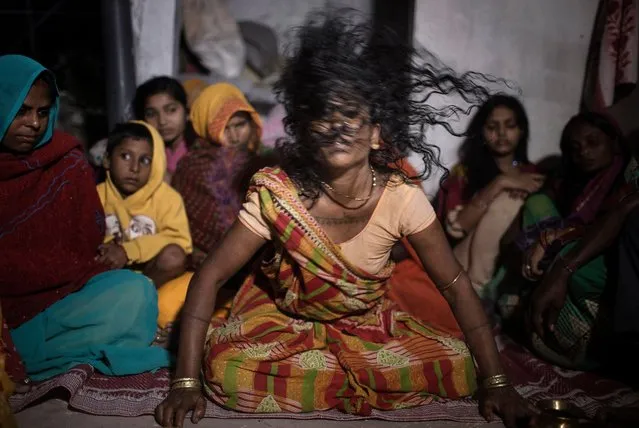
Marani Devi Chaudhary (C), aged 40, performs a ritual in front of shaman Paltan Yadav (unseen) at her home in Rajaur village in Dhanusha district, Nepal, 02 November 2017. The shaman identified Marani Devi to be possessed by their lineage god who was dissatisfied by their worship is thought by the family to have caused them misfortune and is even feared lead to their death. Therefore Marani Devi spent 1,500 USD to perform a healing ritual at the Ghost Festival held at the banks of Kamala River in Dhanusha district two days later. Every family or community has their own sacred god, called 'Kuldevta' in Nepali which means family deity or lineage god. Only family members or people within communities of the same caste can worship to the deity. They have their own rules and regulations of worship which varies from one family and community to another. Being unable to follow the rules and regulations or carry out worship is believed to cause misfortune. (Photo by Narendra Shrestha/EPA/EFE)

Marani Devi Chaudhary (C), aged 40, performs a ritual in front of shaman Paltan Yadav (unseen) at her home in Rajaur village in Dhanusha district, Nepal, 02 November 2017. The shaman identified Marani Devi to be possessed by their lineage god who was dissatisfied by their worship is thought by the family to have caused them misfortune and is even feared lead to their death. (Photo by Narendra Shrestha/EPA/EFE)
Details
17 Nov 2017 06:53:00
Spectacular images offering insight into the lives of the Huaorani people in the Ecuadorian Amazon have been revealed showing how they use traditional methods to hunt monkeys for food. The stunning pictures were taken by conservation photographer Pete Oxford from Torquay, Devon in the Ecuadorian Amazon. “The Huaorani Indians are a forest people highly in tune with their environment. Many are now totally acculturated since the 1950s by missionaries”, said Pete. “Today they face radical change to their culture to the proximity of oil exploration within their territory and the Yasuni National Park and Biosphere Reserve, they are vastly changed. Some still live very traditionally and for this shoot, through my Huaorani friend, a direct relative of those photographed he wanted to depict them as close to their original culture as possible. They still largely hunt with blow pipes and spears eating a lot of monkeys and peccaries”. The Huaorani are also known as the Waorani, Waodani or the Waos and are native Amerindians. Their lands are located between the Curaray and Napo rivers and speak the Huaorani language. Pete says that during his visit he was welcomed into the group and hopes that ancient cultures can be saved. Here: The tribe were seen celebrating after a hunter returned to camp with a wild pig. (Photo by Pete Oxford/Mediadrumworld.com)

Spectacular images offering insight into the lives of the Huaorani people in the Ecuadorian Amazon have been revealed showing how they use traditional methods to hunt monkeys for food. The stunning pictures were taken by conservation photographer Pete Oxford from Torquay, Devon in the Ecuadorian Amazon. Here: The tribe were seen celebrating after a hunter returned to camp with a wild pig. (Photo by Pete Oxford/Mediadrumworld.com)
Details
20 Jan 2017 07:58:00
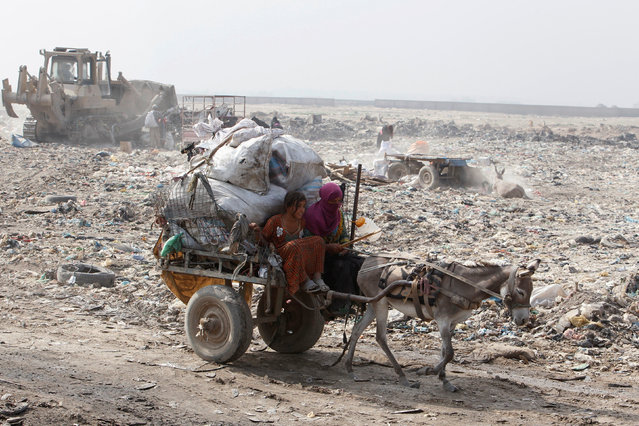
Garbage pickers collect ride on donkey cart while looking for recyclable materials at a rubbish dump in the outskirts of Baghdad, Iraq, August 23, 2016. Despite its huge untapped oil and gas reserves and steadily rising oil output and revenue, 23 percent of the population live below the poverty line, according to the Ministry of Planning. Eg, for 12-year-old Mohammed, life in Sadr City means long days during his school holidays scrabbling through the refuse in the scorching summer heat before selling his daily haul to a middleman. He sells each kilogram (2.2 lb) of plastic bottles or soda cans for 250 Iraqi dinars (around 20 U.S. cents), earning between 2,000 to 4,000 dinars ($1.50–$3) a day. A International Labor Organization report listing dangerous jobs in which children are engaged across the world mentioned collecting garbage as one of the activities in which minors risked suffering violence and injury. (Photo by Khalid al Mousily/Reuters)

Garbage pickers collect ride on donkey cart while looking for recyclable materials at a rubbish dump in the outskirts of Baghdad, Iraq, August 23, 2016. Despite its huge untapped oil and gas reserves and steadily rising oil output and revenue, 23 percent of the population live below the poverty line, according to the Ministry of Planning. (Photo by Khalid al Mousily/Reuters)
Details
24 Aug 2016 11:52:00