Loading...
Done
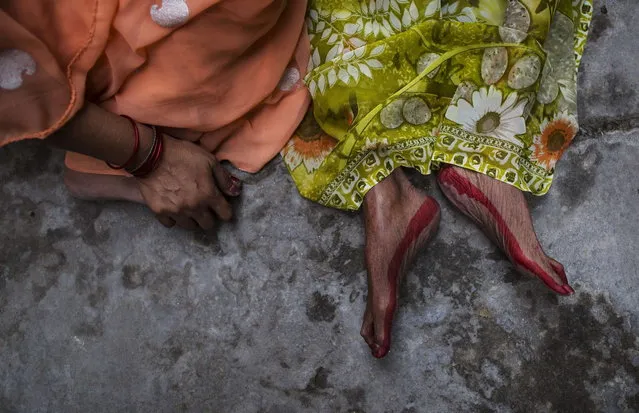
A relative (L) of Champa Devi, 88, sits next to her body, minutes after her death at Mukti Bhavan (Salvation House) at Varanasi, in the northern Indian state of Uttar Pradesh, June 21, 2014. (Photo by Danish Siddiqui/Reuters)

A relative (L) of Champa Devi, 88, sits next to her body, minutes after her death at Mukti Bhavan (Salvation House) at Varanasi, in the northern Indian state of Uttar Pradesh, June 21, 2014. The city of Varanasi, on the banks of the River Ganges, is widely considered Hinduism's holiest city and many Hindus believe that dying there and having their remains scattered in the Ganges allows their soul to escape a cycle of death and rebirth, attaining “moksha” or salvation. “Mukti Bhavan” or “Salvation House”, is a charity-run hostel that caters for people who wish to come to Varanasi to die. Guests can normally stay up to two weeks after which, if they haven't yet passed away, they are gently asked to leave. (Photo by Danish Siddiqui/Reuters)
Details
24 Jul 2014 12:32:00
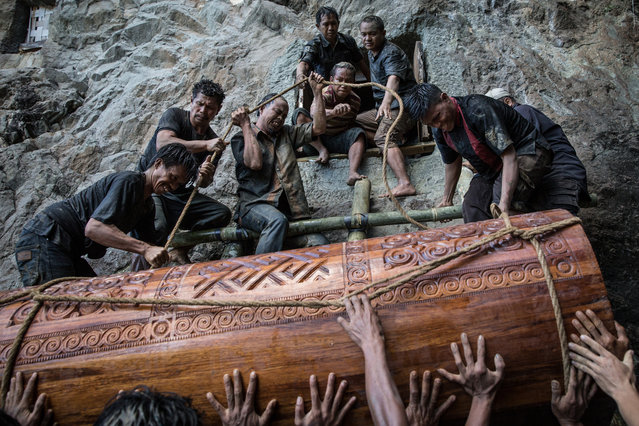
It is said that Torajans are people who “live to die”. For this Indonesian ethnic group, funerals are such extravagant events that they sometimes attract tourists. Families can postpone burials years (and the deceased are considered sick and hosted at home until the funeral) until the family can raise enough money and gather as many relatives as possible. And then it’s a jubilant multiday social event with a parade, dances and animal sacrifices. Agung Parameswara photographed these funerary practices when he traveled to South Sulawesi province, where the Torajans live. But often, their funeral isn’t the last time the dead are seen. In August, crypts are opened, coffins are slid back out and bodies delicately unsheathed. This tender ritual is known as Ma’Nene, which is customarily performed every few years. (Photo by Agung Parameswara/The Washington Post)

It is said that Torajans are people who “live to die”. For this Indonesian ethnic group, funerals are such extravagant events that they sometimes attract tourists. Families can postpone burials years (and the deceased are considered sick and hosted at home until the funeral) until the family can raise enough money and gather as many relatives as possible. And then it’s a jubilant multiday social event with a parade, dances and animal sacrifices. Agung Parameswara photographed these funerary practices when he traveled to South Sulawesi province, where the Torajans live. (Photo by Agung Parameswara/The Washington Post)
Details
06 Oct 2016 09:15:00
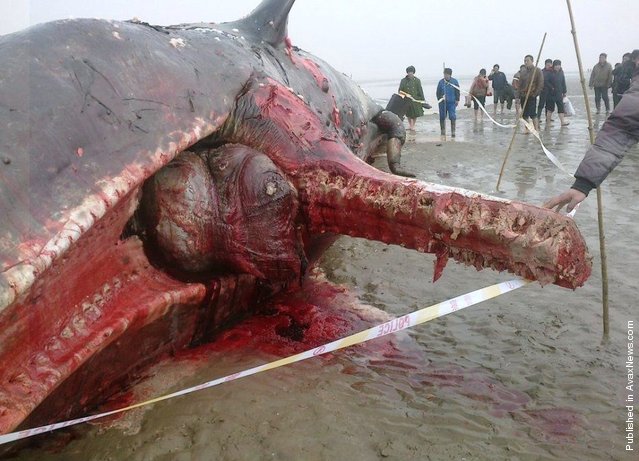
A dead sperm whale is seen on the beach on March 18, 2012 in Yancheng, Jiangsu Province of China

A dead sperm whale is seen on the beach on March 18, 2012 in Yancheng, Jiangsu Province of China. Four giant sperm whales, which were found beached on the beach of Xintan Salt Field on Friday, died on Saturday despite rescue efforts. (Photo by ChinaFotoPress)
Details
19 Mar 2012 12:30:00
Wild Musk Oxen in Arctic Prairie in Russia

Vitaly Gorshkov, a wildlife photographer, captured these animals in their natural habitat. He says that these animals are so hairy that it is difficult to distinguish the front from the back. The oxen aren’t really afraid of humans that is why it is easy to approach them and take pictures.
Details
25 Apr 2014 12:10:00
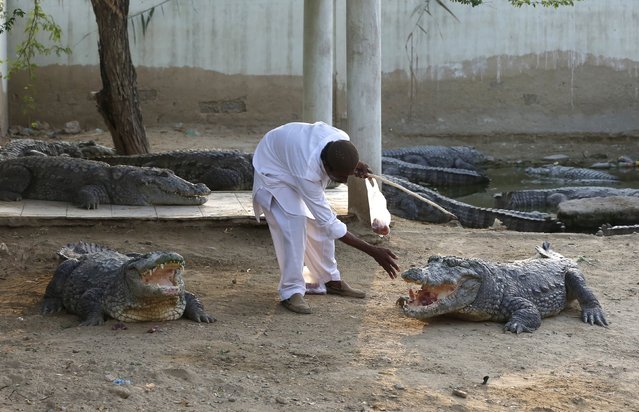
Caretaker Khalifa Sajad feeds crocodiles at the Sufi shrine of Hasan-al-Maroof Sultan Manghopir, better known as the Crocodile Shrine, on the outskirts of Karachi, Pakistan October 11, 2015. Pakistani Sheedi pilgrims are once again flocking to the shrine in Karachi that has been shunned for years amid fears of Taliban attacks. (Photo by Akhtar Soomro/Reuters)

Caretaker Khalifa Sajad feeds crocodiles at the Sufi shrine of Hasan-al-Maroof Sultan Manghopir, better known as the Crocodile Shrine, on the outskirts of Karachi, Pakistan October 11, 2015. Pakistani Sheedi pilgrims are once again flocking to the shrine in Karachi that has been shunned for years amid fears of Taliban attacks. (Photo by Akhtar Soomro/Reuters)
Details
18 Oct 2015 08:00:00
Rescue workers help the injured at the site of a multi-storey building collapse  in the capital Nairobi, Kenya Sunday, January 4, 2015. (Photo by AP Photo)

Rescue workers help the injured at the site of a multi-storey building collapse in the capital Nairobi, Kenya Sunday, January 4, 2015. The residential building in the Huruma neighborhood of Nairobi collapsed on Sunday and according to the Kenya Red Cross, a dozen people have so far been rescued but an unknown number are still feared trapped. (Photo by AP Photo)
Details
05 Jan 2015 13:06:00
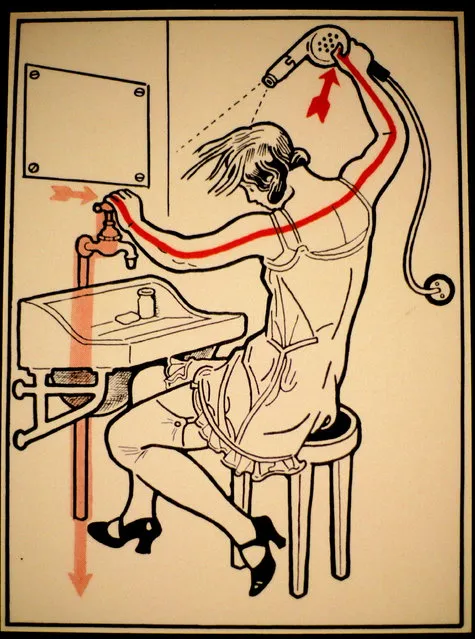
The book “Elektroschutz in 132 Bildern” (Electrical Protection in 132 Pictures) was published in Vienna in the early 1900s by a Viennese physician named Stefan Jellinek (1878-1968, a founder of the Electro-Pathological Museum). The pictures are nice and direct and unambiguous; they teach, graphically, that the surest way to kill yourself with electricity is to form a complete path from source (usually the bright red arrow) to ground (the screened back, pink arrow). Arrowheads provide the path for current flow. (Photo by The Vienna Technical Museum)

The book “Elektroschutz in 132 Bildern” (Electrical Protection in 132 Pictures) was published in Vienna in the early 1900s by a Viennese physician named Stefan Jellinek (1878-1968, a founder of the Electro-Pathological Museum). The pictures are nice and direct and unambiguous; they teach, graphically, that the surest way to kill yourself with electricity is to form a complete path from source (usually the bright red arrow) to ground (the screened back, pink arrow). Arrowheads provide the path for current flow. (Photo by The Vienna Technical Museum)
Details
11 Aug 2014 11:10:00


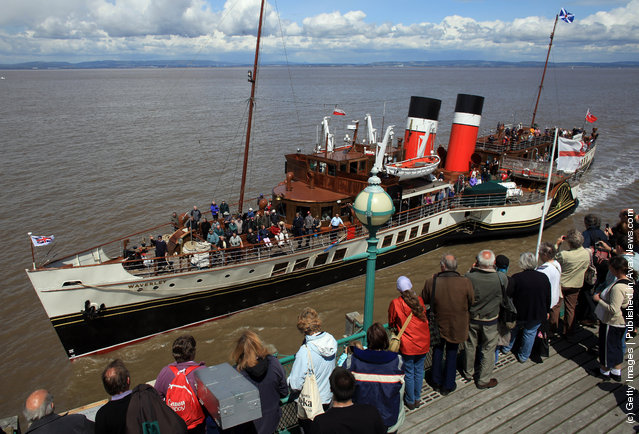
Passengers watch as The Waverley, the world's last remaining seagoing passenger paddle steamer arrives at Clevedon Pier on June 10, 2011 in Clevedon, England. Built in 1946, the trust which owns and operates the Waverley, is warning that this could be the last season for the vessel and is appealling for more public funding saying it is struggling to make ends meet in the current financial climate due in part to rising fuel costs. Restored in 1973 after service on Loch Long in Scotland, since 2003, Waverley has been listed in the British National Register of Historic Ships core collection as 'a vessel of pre-eminent national importance'. (Photo by Matt Cardy/Getty Images)
Details
11 Jun 2011 12:02:00