Loading...
Done
Tea ceremony in Kobe, Japan

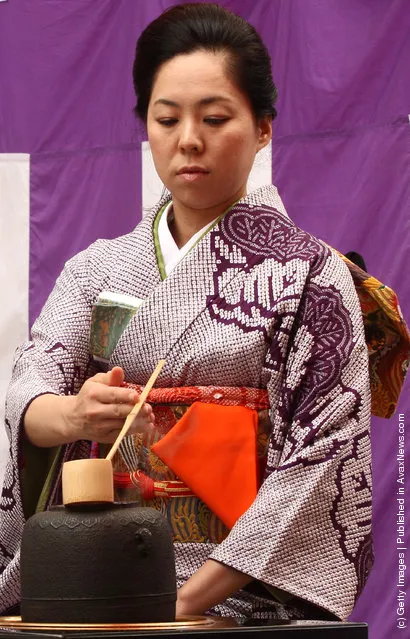
A tea ceremony master use the Hishaku made by bamboo and makes a tea during the outdoor tea ceremony at Zuihoji Temple Park on November 3, 2011 in Kobe, Japan. The tea ceremony began in 1950 to commemorate the 14th century governor Toyotomi Hideyoshi and his tea master Sen no Rikyu, who are said to visit this area and enjoyed tea ceremonies. (Photo by Buddhika Weerasinghe/Getty Images)
Details
04 Nov 2011 13:34:00
A British woman plays a piano designed especially for people who are confined to bed. Date: 1935. (Photo by Mary Evans Picture Library/Caters News)

A British woman plays a piano designed especially for people who are confined to bed. Date: 1935. (Photo by Mary Evans Picture Library/Caters News)
Details
20 Apr 2014 11:01:00
Tao Xiangli gets out of his homemade submarine after operating it in a lake on the outskirts of Beijing September 3, 2009. Amateur inventor Tao, 34,  made a fully functional submarine, which has a periscope, depth control tanks, electric motors, manometer, and two propellers, from old oil barrels and tools which he bought at a second-hand market. He took 2 years to invent and test the submarine which costs 30,000 yuan ($4,385). (Photo by Christina Hu/Reuters)

Tao Xiangli gets out of his homemade submarine after operating it in a lake on the outskirts of Beijing September 3, 2009. Amateur inventor Tao, 34, made a fully functional submarine, which has a periscope, depth control tanks, electric motors, manometer, and two propellers, from old oil barrels and tools which he bought at a second-hand market. He took 2 years to invent and test the submarine which costs 30,000 yuan ($4,385). (Photo by Christina Hu/Reuters)
Details
05 May 2013 12:06:00
Yu Jietao, 26-year-old wood carver, sits in his homemade wooden car along a street in Guangfeng county of Shangrao, Jiangxi province, China February 9, 2015. The car can travel as fast as 30 km (18.6 miles) per hour, local media reported. (Photo by Reuters/Stringer)

Yu Jietao, 26-year-old wood carver, sits in his homemade wooden car along a street in Guangfeng county of Shangrao, Jiangxi province, China February 9, 2015. The car can travel as fast as 30 km (18.6 miles) per hour, local media reported. (Photo by Reuters/Stringer)
Details
13 May 2015 10:51:00
Meital Ben Ari, a co-founder of “Freedom Farm” pats Gary, a sheep with leg braces, at the farm which serves as a refuge for mostly disabled animals in Moshav Olesh, Israel on March 7, 2019. (Photo by Nir Elias/Reuters)

Meital Ben Ari, a co-founder of “Freedom Farm” pats Gary, a sheep with leg braces, at the farm which serves as a refuge for mostly disabled animals in Moshav Olesh, Israel on March 7, 2019. (Photo by Nir Elias/Reuters)
Details
15 Mar 2019 00:03:00
The OMG Wall (Groningen, Groningen, NL). (Photo by Wout)

The “OMG Wall” (Groningen, NL). (Photo by Wout)
Details
07 Jun 2013 11:56:00
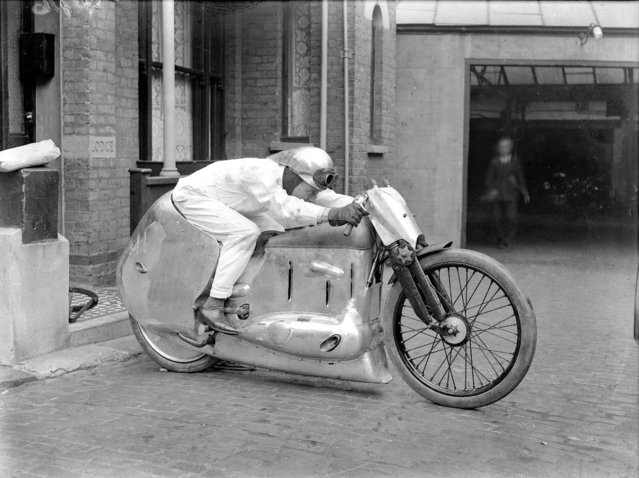
Handout photo issued by Easyart of an experimental motorcycle as an archive of weird and wacky innovations has been unearthed by an amateur historian as he trawled through a collection of images spanning the last 100 years. (Photo by Easyart/PA Wire)

Handout photo issued by Easyart of an experimental motorcycle as an archive of weird and wacky innovations has been unearthed by an amateur historian as he trawled through a collection of images spanning the last 100 years. (Photo by Easyart/PA Wire)
Details
06 Oct 2014 09:01:00
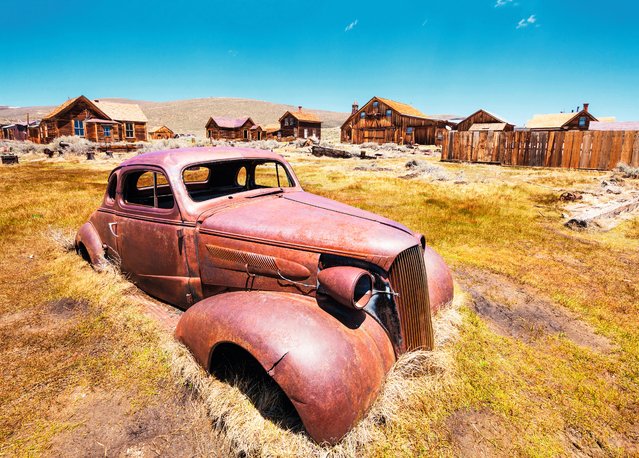
Bodie, Mono County, California. Gold was discovered at Bodie in 1859 (just after the initial California gold rush) and it went from mining camp to boomtown. Its decline began in 1880, when word spread of new boomtowns elsewhere. The Standard Consolidated Mine closed in 1913, and four years later the Bodie Railway was abandoned. By 1940 the population was down to 40. Today, Bodie is maintained in a state of arrested decay as a visitor attraction. (Photo by Alamy Stock Photo)

Kieron Connolly’s new book of photographs of more than 100 once-busy and often elegant buildings gives an idea of how the world might look if humankind disappeared. Here: Bodie, Mono County, California. Gold was discovered at Bodie in 1859 (just after the initial California gold rush) and it went from mining camp to boomtown. Its decline began in 1880, when word spread of new boomtowns elsewhere. The Standard Consolidated Mine closed in 1913, and four years later the Bodie Railway was abandoned. By 1940 the population was down to 40. Today, Bodie is maintained in a state of arrested decay as a visitor attraction. (Photo by Alamy Stock Photo)
Details
07 Sep 2016 09:50:00