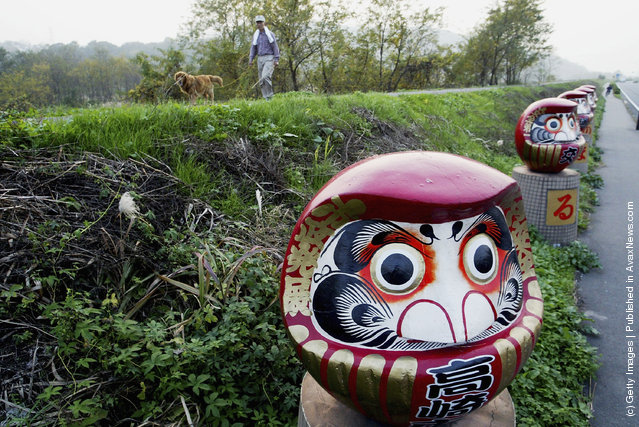
A series of Japanese good luck charms, called “Daruma”, are lined up ahead of the major national elections November 9, 2003 in Takasaki, Japan. The Daruma is said to bring exceptional good luck in all walks of life, but is used especially during election time by all candidates. People think that if they face a difficult situation, as symbolized by the doll that returns to its original position when knocked over, they will always bounce back. (Photo by Koichi Kamoshida/Getty Images)
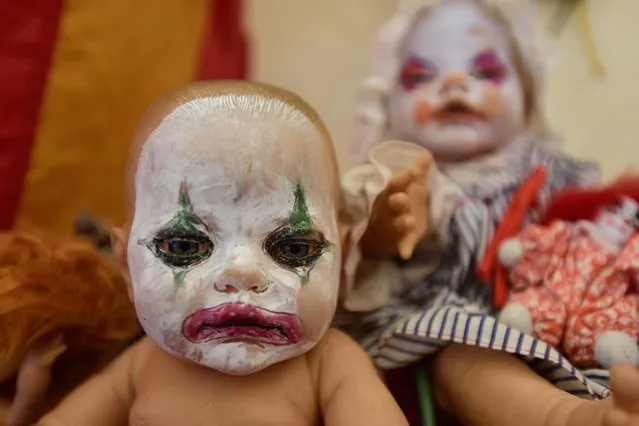
An open house known as “The Doll Asylum” in Portland, Oregon on October 23, 2016. Mark Williams and his wife Heidi Loutzenhiser love halloween so much they fill their home with over 1,000 creepy dolls before opening it up for the public to enjoy over the halloween season. (Photo by ddp USA/Rex Features/Shutterstock)
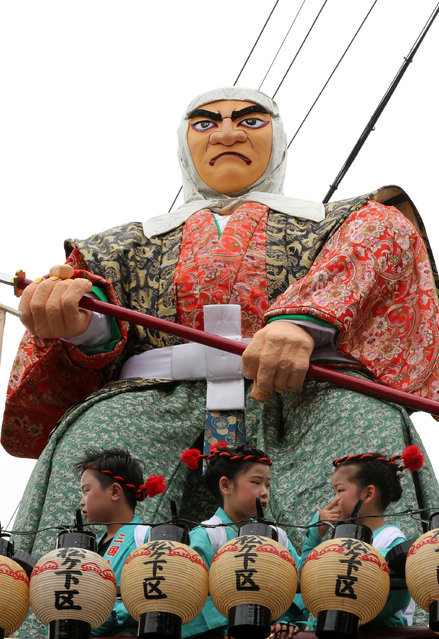
Children dressed in festival costume sit on the huge paper doll of historical Japanese figure named Hashi-Benkeii on the carts during the Mikuini annual festival on May 20, 2014 in Sakai, Japan. The annual festival takes place from May 19-21 and is attended by thousands of visitors. During the festival people dressed in traditional Japanese costumes pull carts carrying 6 meter high dolls of Japanese historical figures through the narrow streets. The origins of the festival are unclear but its history can be traced back more than 250 years. (Photo by Buddhika Weerasinghe/Getty Images)
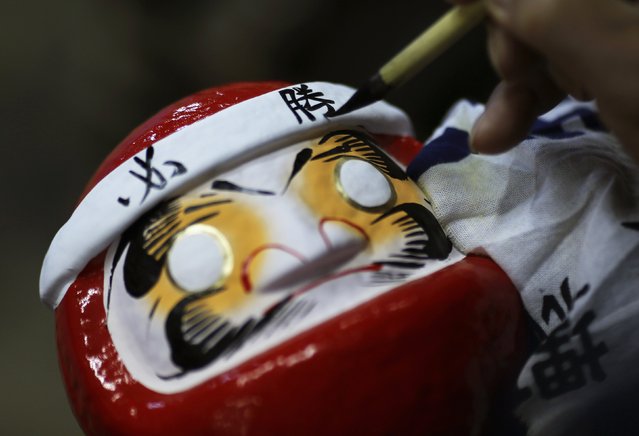
Japanese craftsman Sumikazu Nakata writes the Chinese character of “victory”, which is a part of the phrase “Certain victory”, as he adds the final touches on a Daruma doll, which is believed to bring good luck, at his studio “Daimonya” in Takasaki, northwest of Tokyo November 23, 2014. Daruma dolls, representing the Indian priest Bodhidharma, the founder of Zen Buddhism in China, is used to bring luck. It is also a favorite item of election candidates where they traditionally paint only one eye on the doll when they start their campaign and paint the other eye if they win in the election. (Photo by Yuya Shino/Reuters)
A house built on a rock on the river Drina is seen near the western Serbian town of Bajina Basta, about 160km (99 miles) from the capital Belgrade May 22, 2013. The house was built in 1968 by a group of young men who decided that the rock on the river was an ideal place for a tiny shelter, according to the house's co-owner, who was among those involved in its construction. (Photo by Marko Djurica/Reuters)
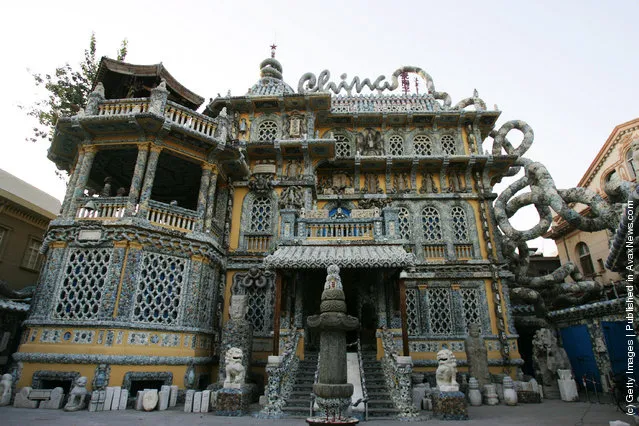
Facade of the “Porcelain House”, built by Chinese collector Zhang Lianzhi, on November 1, 2008 in the Heping district of Tianjin, China. Over 400 million porcelain fragments, 5,000 ancient vases, 4,000 antique china dishes and bowls, over 20 tons of crystalline rocks and agate, 400 white marble stone carvings were incorporated in the five year refurbishment of the unique French styled house. (Photo by China Photos/Getty Images)