Loading...
Done
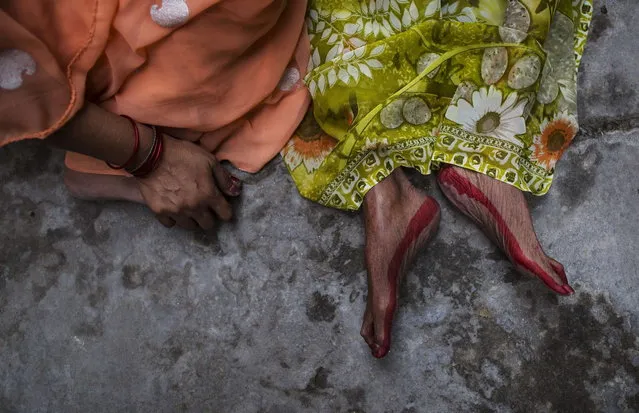
A relative (L) of Champa Devi, 88, sits next to her body, minutes after her death at Mukti Bhavan (Salvation House) at Varanasi, in the northern Indian state of Uttar Pradesh, June 21, 2014. (Photo by Danish Siddiqui/Reuters)

A relative (L) of Champa Devi, 88, sits next to her body, minutes after her death at Mukti Bhavan (Salvation House) at Varanasi, in the northern Indian state of Uttar Pradesh, June 21, 2014. The city of Varanasi, on the banks of the River Ganges, is widely considered Hinduism's holiest city and many Hindus believe that dying there and having their remains scattered in the Ganges allows their soul to escape a cycle of death and rebirth, attaining “moksha” or salvation. “Mukti Bhavan” or “Salvation House”, is a charity-run hostel that caters for people who wish to come to Varanasi to die. Guests can normally stay up to two weeks after which, if they haven't yet passed away, they are gently asked to leave. (Photo by Danish Siddiqui/Reuters)
Details
24 Jul 2014 12:32:00
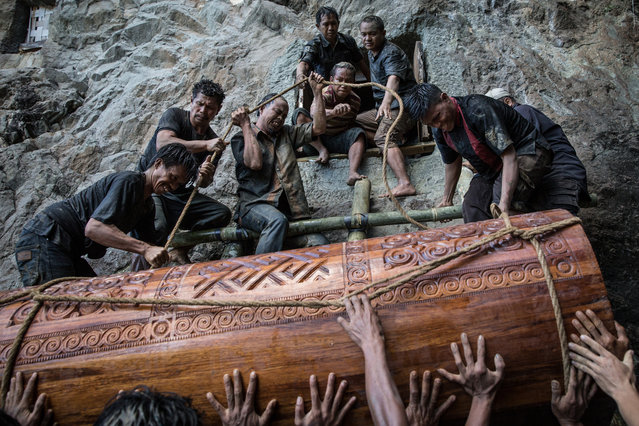
It is said that Torajans are people who “live to die”. For this Indonesian ethnic group, funerals are such extravagant events that they sometimes attract tourists. Families can postpone burials years (and the deceased are considered sick and hosted at home until the funeral) until the family can raise enough money and gather as many relatives as possible. And then it’s a jubilant multiday social event with a parade, dances and animal sacrifices. Agung Parameswara photographed these funerary practices when he traveled to South Sulawesi province, where the Torajans live. But often, their funeral isn’t the last time the dead are seen. In August, crypts are opened, coffins are slid back out and bodies delicately unsheathed. This tender ritual is known as Ma’Nene, which is customarily performed every few years. (Photo by Agung Parameswara/The Washington Post)

It is said that Torajans are people who “live to die”. For this Indonesian ethnic group, funerals are such extravagant events that they sometimes attract tourists. Families can postpone burials years (and the deceased are considered sick and hosted at home until the funeral) until the family can raise enough money and gather as many relatives as possible. And then it’s a jubilant multiday social event with a parade, dances and animal sacrifices. Agung Parameswara photographed these funerary practices when he traveled to South Sulawesi province, where the Torajans live. (Photo by Agung Parameswara/The Washington Post)
Details
06 Oct 2016 09:15:00
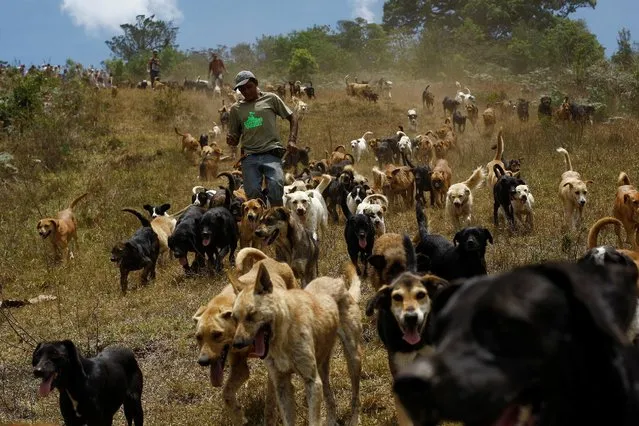
Stray dogs run at dog sanctuary Territorio de Zaguates or “Land of the Strays” in Carrizal de Alajuela, Costa Rica, April 20, 2016. In a lush, sprawling corner of Costa Rica, hundreds of dogs roam freely on a hillside – among the luckiest strays on earth. Fed, groomed and cared for by vets, more than 750 dogs rescued from the streets of Costa Rica inhabit Territorio de Zaguates or “Land of the Strays”, a pooch paradise. The 152-hectare sanctuary in the centre of the Central American country is funded by donations. Around 8,000 dogs have passed through the refuge. There are more than a million stray dogs in Costa Rica, where the government outlawed putting animals down in 2003. (Photo by Juan Carlos Ulate/Reuters)

Stray dogs run at dog sanctuary Territorio de Zaguates or “Land of the Strays” in Carrizal de Alajuela, Costa Rica, April 20, 2016. In a lush, sprawling corner of Costa Rica, hundreds of dogs roam freely on a hillside – among the luckiest strays on earth. Fed, groomed and cared for by vets, more than 750 dogs rescued from the streets of Costa Rica inhabit Territorio de Zaguates or “Land of the Strays”, a pooch paradise. (Photo by Juan Carlos Ulate/Reuters)
Details
30 Apr 2016 09:41:00
A woman with “I'm Charlie” written on her hand takes part in a Hundreds of thousands of French citizens solidarity march (Marche Republicaine) in the streets of Paris January 11, 2015. French citizens will be joined by dozens of foreign leaders, among them Arab and Muslim representatives, in a march on Sunday. (Photo by Yves Herman/Reuters)

A woman with “I'm Charlie” written on her hand takes part in a Hundreds of thousands of French citizens solidarity march (Marche Republicaine) in the streets of Paris January 11, 2015. French citizens will be joined by dozens of foreign leaders, among them Arab and Muslim representatives, in a march on Sunday in an unprecedented tribute to this week's victims following the shootings by gunmen at the offices of the satirical weekly newspaper Charlie Hebdo, the killing of a police woman in Montrouge, and the hostage taking at a kosher supermarket at the Porte de Vincennes. (Photo by Yves Herman/Reuters)
Details
12 Jan 2015 14:49:00
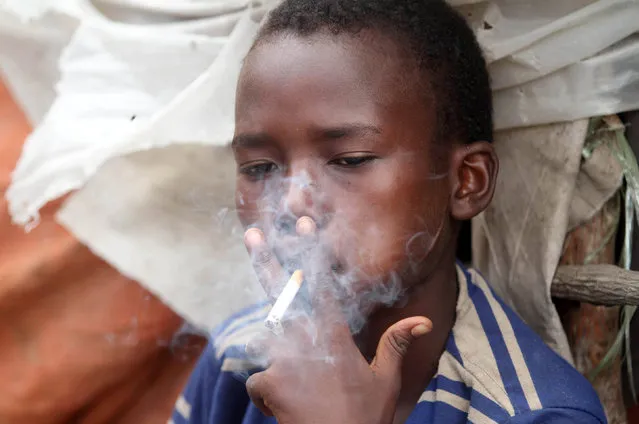
Abdulahi Yaroow, 13, smokes a cigarette while chewing khat at the same time in Mogadishu August 10, 2014. (Photo by Thomas Mukoya/Reuters)

Abdulahi Yaroow, 13, smokes a cigarette while chewing khat at the same time in Mogadishu August 10, 2014. Grown on plantations in the highlands of Kenya and Ethiopia, tonnes of khat, or qat, dubbed “the flower of paradise” by its users, are flown daily into Mogadishu airport, to be distributed from there in convoys of lorries to markets across Somalia. Britain, whose large ethnic Somali community sustained a lucrative demand for the leaves, banned khat from July as an illegal drug. This prohibition jolted the khat market, creating a supply glut in Somalia and pushing down prices, to the delight of the many connoisseurs of its amphetamine-like high. (Photo by Thomas Mukoya/Reuters)
Details
28 Aug 2014 10:35:00
In this July 10, 2014 photo, Chris Minore, of Orange, Conn., performs the under chop technique at the Adirondack Woodsmen's School at Paul Smith's College in Paul Smiths, N.Y. Eighteen young students in matching gray sports shirts took part recently in a weeklong crash course on old-school lumberjack skills such as sawing, chopping, ax throwing, log boom running and pole climbing. (Photo by Mike Groll/AP Photo)

In this July 10, 2014 photo, Chris Minore, of Orange, Conn., performs the under chop technique at the Adirondack Woodsmen's School at Paul Smith's College in Paul Smiths, N.Y. Eighteen young students in matching gray sports shirts took part recently in a weeklong crash course on old-school lumberjack skills such as sawing, chopping, ax throwing, log boom running and pole climbing. (Photo by Mike Groll/AP Photo)
Details
20 Jul 2014 11:00:00
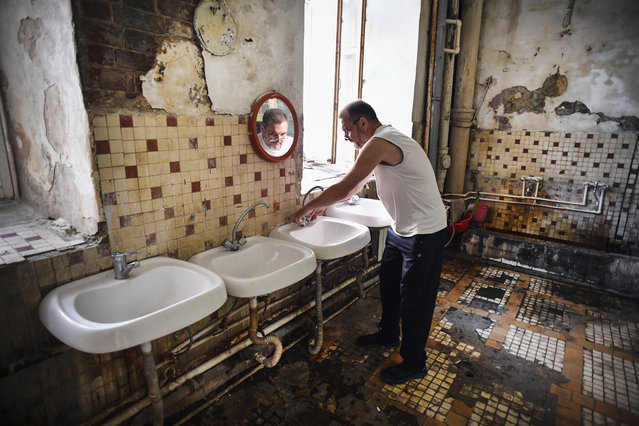
Vladimir Mogilnikov, 62, washes his hands in a communal washing room in a dormitory for the workers of Proletarka textile factory in the town of Tver, 200 kilometres north-west from Moscow on August 8, 2020. (Photo by Andrey Borodulin/AFP Photo)

Vladimir Mogilnikov, 62, washes his hands in a communal washing room in a dormitory for the workers of Proletarka textile factory in the town of Tver, 200 kilometres north-west from Moscow on August 8, 2020. (Photo by Andrey Borodulin/AFP Photo)
Details
07 Sep 2020 00:03:00
The symbol for “One Orlando” is spelled out at a makeshift memorial at Lake Eola in downtown Orlando, Fla., Saturday, June 18, 2016. Nearby, visitors lit candles and prayed at a larger memorial, at the Dr. Phillips Center for the Performing Arts, to mourn the victims of the Pulse massacre. (Photo by Joe Burbank/Orlando Sentinel via AP Photo)

The symbol for “One Orlando” is spelled out at a makeshift memorial at Lake Eola in downtown Orlando, Fla., Saturday, June 18, 2016. Nearby, visitors lit candles and prayed at a larger memorial, at the Dr. Phillips Center for the Performing Arts, to mourn the victims of the Pulse massacre. (Photo by Joe Burbank/Orlando Sentinel via AP Photo)
Details
19 Jun 2016 09:44:00