Loading...
Done
Glowing Bioluminescent Plankton

If you’ve had the unique privilege of witnessing bioluminescent plankton while diving at night, you know firsthand how beautiful the underwater light show can be. For those of us who haven’t experienced it, this unique phenomenon. So what makes this beautiful show possible? In a recent post at online scuba site AquaViews they share some insight we thought you all would find interesting.
Details
04 Jun 2013 10:55:00
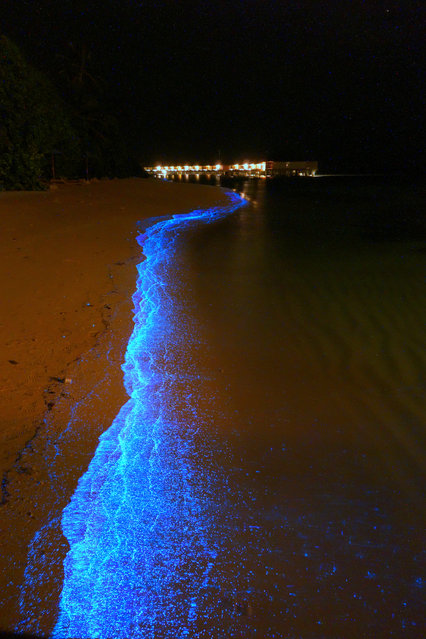
Bioluminescent phytoplankton washes up on Maldives beach. (Photo by Will Ho)

While vacationing on the Maldives Islands, Taiwanese amateur photographer Will Ho stumbled onto an incredible stretch of beach covered in millions of bioluminescent phytoplankton. These tiny organisms glow similarly to fireflies and tend to emit light when stressed, such as when waves crash or when they are otherwise agitated. While the phenomenon and its chemical mechanisms have been known for some time, biologists have only recently began to understand the reasons behind it. Photo: Bioluminescent phytoplankton washes up on Maldives beach. (Photo by Will Ho)
Details
07 Feb 2014 10:03:00
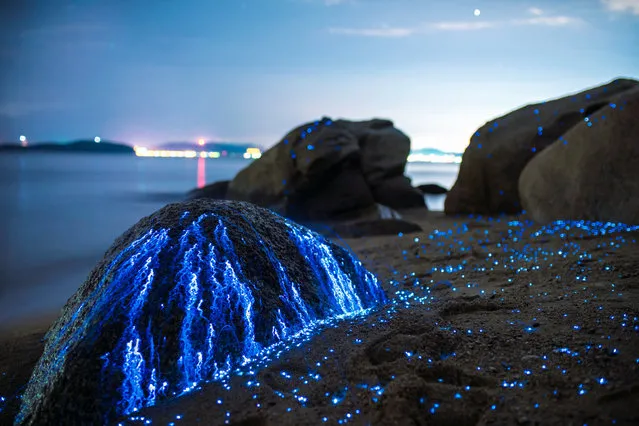
Bioluminescent sea fireflies glittering like diamonds on the rocks and sand. Okayama, Japan. July 2016. (Photo by Trevor Williams/Jonathan Galione/Getty Images)

Those lights are actually bioluminescent shrimp, better known as sea fireflies, or, in Japan, as “umibotaru”. Visible every year from May until the end of October, they live in the sand around very shallow sea water and are often seen floating between the extremes of high and low tides. Here: Bioluminescent sea fireflies glittering like diamonds on the rocks and sand. Okayama, Japan. July 2016. (Photo by Trevor Williams/Jonathan Galione/Getty Images)
Details
23 Aug 2016 10:13:00
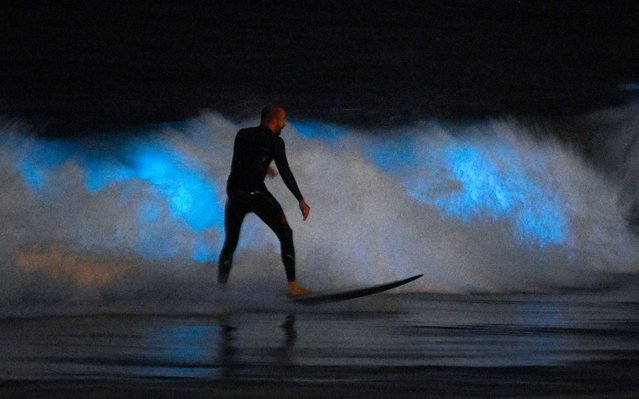
A surfer rides a wave as bioluminescent plankton lights up the surf around him during the coronavirus outbreak, Thursday, April 30, 2020, in Newport Beach, Calif. California Gov. Gavin Newsom on Thursday temporarily closed Orange County's coastline after large crowds were seen there. (Photo by Mark J. Terrill/AP Photo)

A surfer rides a wave as bioluminescent plankton lights up the surf around him during the coronavirus outbreak, Thursday, April 30, 2020, in Newport Beach, Calif. California Gov. Gavin Newsom on Thursday temporarily closed Orange County's coastline after large crowds were seen there. (Photo by Mark J. Terrill/AP Photo)
Details
09 May 2020 00:01:00
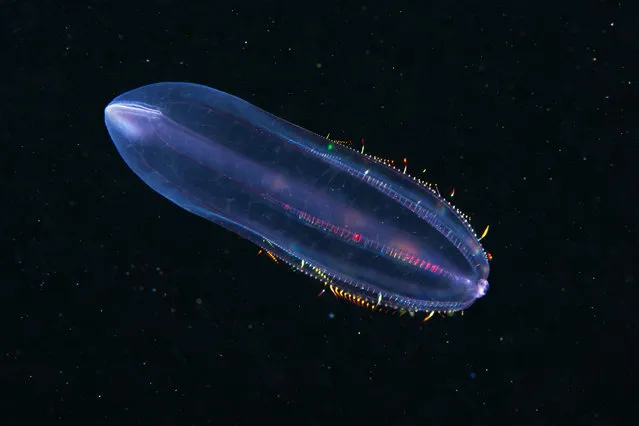
A Comb jelly – Beroe cucumis. (Photo by Alexander Semenovs/Caters News)

Underwater photographer Alexander Semenovs has snapped some of the most stunning, fragile life forms anywhere on planet Earth. Shot in deep, dark conditions, the images continue to provide an insight into what lies beneath, with glowing creatures appearing a lot like aliens in the pitch-black water. Semenovs has shot the likes of bioluminescent jellyfish, aggressive-looking worms and many species that leave a lot to the imagination. The 30-year-old from Moscow does the majority of his work in the White Sea, near the Arctic Circle. Here: A Comb jelly – Beroe cucumis. (Photo by Alexander Semenovs/Caters News)
Details
23 Nov 2015 08:06:00
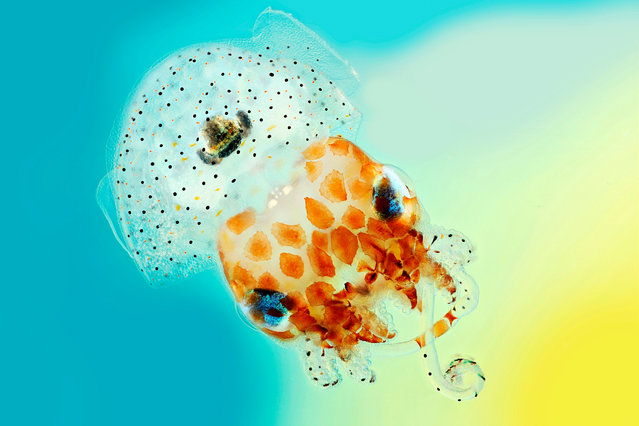
With its huge eyes, comical name and diminutive size, Mark R. Smith’s image of a baby Hawaiian bobtail squid can’t help but raise a smile. A curiously endearing creature, the cephalopod is just 1.5cm across, its mantle cavity bearing more than a passing resemblance to a rather natty shower cap. But it is also a beautiful example of symbiosis – nature’s version of “I’ll scratch your back if you scratch mine” – for on the underside of the squid is a light organ which houses bioluminescent bacteria. The squid offers the bacteria protection and food, while the bacteria emit a glow – a handy trait that the squid uses to offset its silhouette, helping it to evade predators in the depths below. Mark R. Smith’s entry combines several images of a Hawaiian bobtail squid with different focus lengths to create a final picture with greater depth of field than normal. (Photo by Mark R. Smith/Wellcome Images/Macroscopic Solutions)

With its huge eyes, comical name and diminutive size, Mark R. Smith’s image of a baby Hawaiian bobtail squid can’t help but raise a smile. A curiously endearing creature, the cephalopod is just 1.5cm across, its mantle cavity bearing more than a passing resemblance to a rather natty shower cap. But it is also a beautiful example of symbiosis – nature’s version of “I’ll scratch your back if you scratch mine” – for on the underside of the squid is a light organ which houses bioluminescent bacteria. The squid offers the bacteria protection and food, while the bacteria emit a glow – a handy trait that the squid uses to offset its silhouette, helping it to evade predators in the depths below. Mark R. Smith’s entry combines several images of a Hawaiian bobtail squid with different focus lengths to create a final picture with greater depth of field than normal. (Photo by Mark R. Smith/Wellcome Images/Macroscopic Solutions)
Details
08 Mar 2017 00:05:00
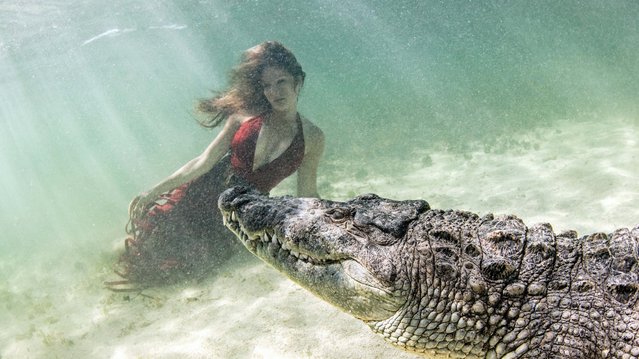
A model poses with a crocodile at Chinchorro Banks, Mexico on June 21, 2018. (Photo by Ken Kiefer/Caters News Agency)

A model poses with a crocodile at Chinchorro Banks, Mexico on June 21, 2018. These crocs had a lot to smile about – sporting huge toothy grins as they posed with stunning models in incredible underwater snaps. The brave models held their breath as they came face to face with the magnificent predators during the daring shoot. Photographer Ken Kiefer took a two hour boat ride to reach the carnivorous crocs at Chinchorro Banks, Mexico, along with his wife and model, Kimber and model, Melodie Trevino. (Photo by Ken Kiefer/Caters News Agency)
Details
25 Jul 2018 08:42:00
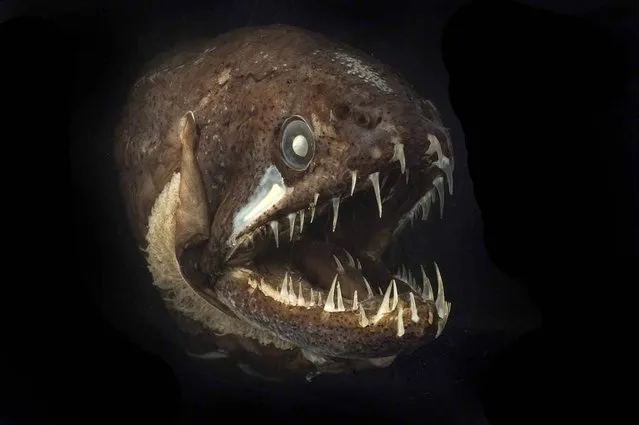
Imagine living in the sea where it is permanently dark, cold, and food is hard to find. For many animals at depth, it may be weeks to months between meals. If you find something to eat, you have to hang on to it

Imagine living in the sea where it is permanently dark, cold, and food is hard to find. For many animals at depth, it may be weeks to months between meals. If you find something to eat, you have to hang on to it. This is why so many deep-sea fishes have lots of big teeth. This dragonfish, spotted off the coast of Australia, even has teeth on its tongue. They would be terrifying animals ... if they weren’t the size of a banana. (Photo by Julian Finn/Museum Victoria)
Details
21 May 2012 12:14:00